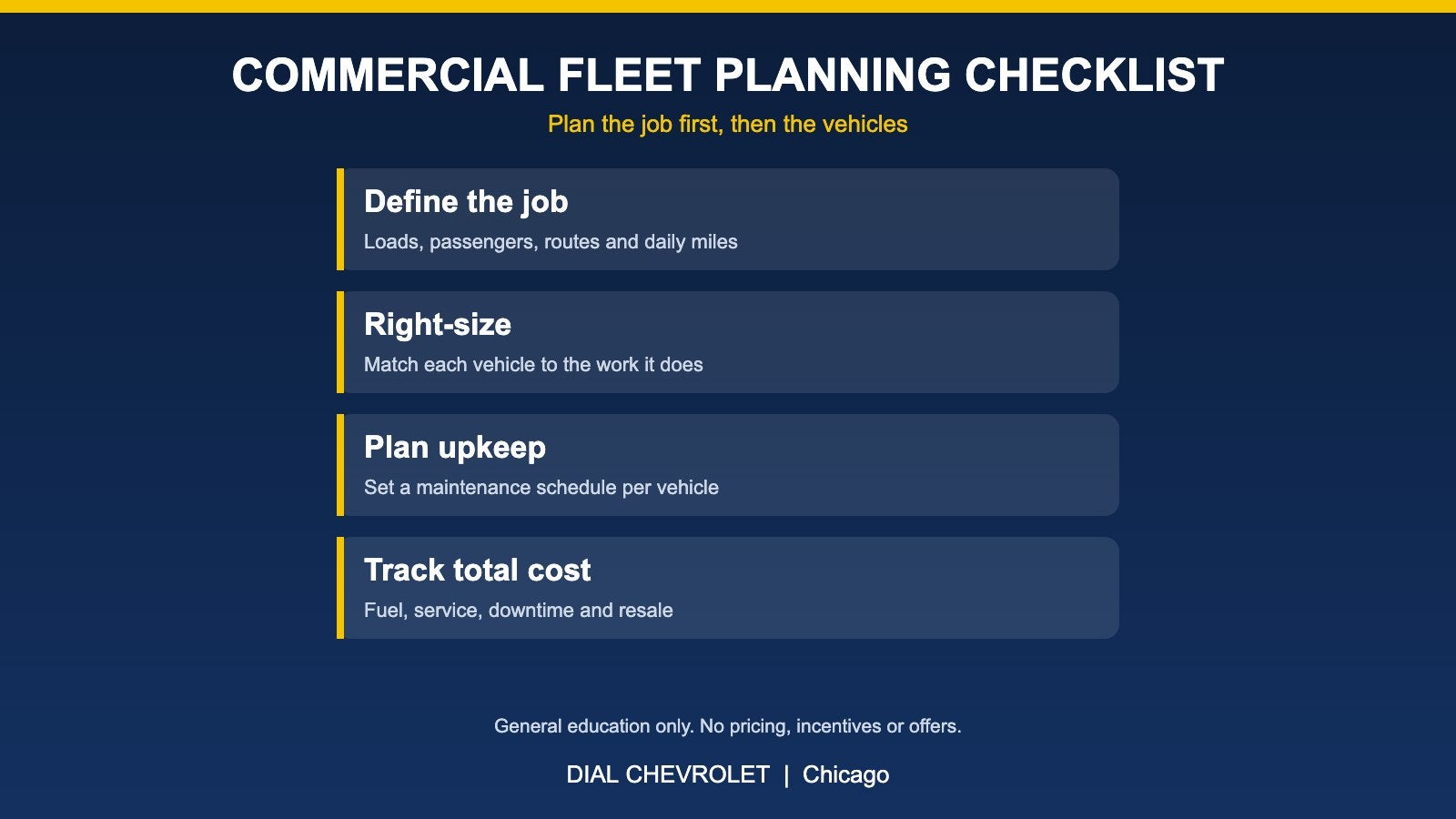
Short answer: good fleet planning starts with the work each vehicle has to do, not the vehicle itself. Define the loads, passengers, routes and daily miles first, match vehicles to those jobs, set a maintenance schedule, and track what each vehicle really costs to run over its whole life.
What Counts as a Fleet
Industry guides commonly describe a fleet as five or more vehicles used for business, though the definition varies by company and by program. A plumber with two vans and a contractor with ten trucks face many of the same questions, so the planning steps below apply at any size.
Step 1: Define the Job
List what each vehicle must carry or tow, how many people ride in it, how far it drives each day, and where it parks overnight. A vehicle that is too small struggles with the work, and one that is too large costs more to buy and run than the job needs. Our guides to payload and Silverado 1500 vs. 2500HD help with weight and capability questions.
Step 2: Match the Vehicle Type
Chevrolet lists commercial trucks, vans, and chassis cabs and cutaways among its business vehicles. Pickups suit crews that haul tools and materials in an open bed, and cargo vans suit crews that need enclosed, secure storage. If you plan to add shelving, racks or other equipment, ask early, because Chevrolet notes that equipment from independent suppliers is not covered by the GM New Vehicle Limited Warranty. Check each supplier's own terms. See work truck setup for a Chicago business for more.
Step 3: Plan Maintenance Before Problems Start
Business guides consistently recommend a written maintenance schedule for every vehicle, because downtime costs money. When service time is limited, the vehicles that keep the business moving should get the first appointments. Use our Chevy maintenance schedule article as a starting point and follow the owner's manual for your specific vehicles.
Step 4: Track Total Cost of Ownership
Purchase price is only one part of the picture. Fleet guides describe total cost of ownership as including fuel, maintenance and repairs, insurance, depreciation and resale value. Record these for each vehicle so you can see when an aging vehicle costs more to keep than to replace. Ask your accountant about how vehicle purchases are treated for tax, since rules change and depend on your business.
Talk to the Dial Chevrolet Team
If you are planning to add or replace business vehicles, contact us to talk through your needs, browse new inventory or used inventory, or request a service appointment for the vehicles you already run.
Sources
- Chevrolet: Commercial vehicles
- U.S. Chamber of Commerce: Managing company vehicle usage and maintenance
- Routific: Beginner's guide to managing small fleets
Published by Dial Chevrolet, 6603 S Western Ave, Chicago. General education only, not tax, legal or financial advice. No pricing, incentives or offers are stated.