Blog

All Service and Maintenance Silverado Trucks Used and Trade-Ins Suburban and SUVs
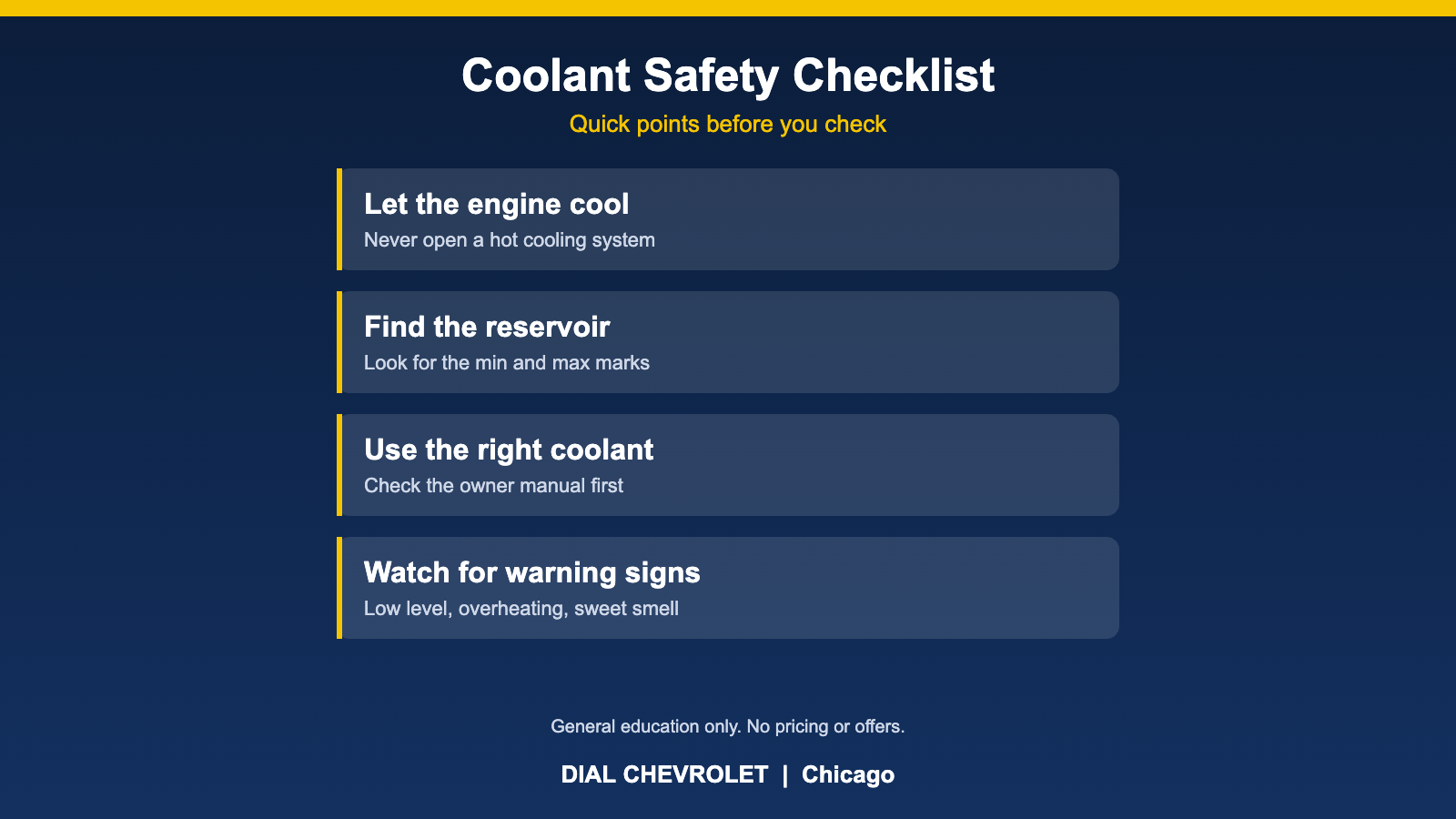
Graphic listing coolant safety checklist points
in Service and Maintenance

Engine Coolant Basics: Checking Level Safely

Short answer: check coolant only when the engine is completely cool, look at the level in the reservoir against its marks, and use the coolant type your owner's manual specifies. A level that keeps dropping, overheating or a sweet smell from the engine bay are reasons to have the cooling system inspected. What coolant does Coolant, also called antifreeze, carries heat away from the engine and helps protect against freezing and corrosion. It circulates between the engine and the radiator, so a problem in the cooling system can lead to overheating and engine damage. Safety first Never open the radiator or reservoir cap on a hot engine. Hot, pressurized coolant can spray out and cause serious burns. Let the engine cool completely before you check the level, and many sources suggest the best time is after the vehicle has sat for a while. Do not add coolant to a hot engine. Keep coolant away from children and pets, and clean up spills. How to check the level Park on level ground and let the engine cool. Open the hood and find the translucent coolant reservoir. It is often marked with a warning not to open when hot. Read the level against the minimum and maximum marks. With a cold engine it should sit between them. Do not overfill. Extra coolant can simply overflow. Check your owner's manual for the exact location and marks on your vehicle. Using the right coolant Different coolant types do not always mix well, so use the type and mixture your owner's manual calls for. If you are not sure what is in your system, ask a technician before topping it off. Signs the cooling system needs attention The level keeps dropping, which can point to a leak. The engine overheats or the temperature warning appears. A sweet, syrupy smell from the engine bay. Steam from under the hood. Pull over safely and shut the engine off. Weak heat from the vents, which can be linked to low coolant. Visible leaks, cracked hoses or a worn radiator cap. When coolant is replaced A coolant flush drains and replaces the fluid in the cooling system. The timing depends on your vehicle, so follow the maintenance schedule in your owner's manual. See our maintenance schedule guide for how fluid checks fit into regular service. Before winter and summer Many guides suggest checking the level before the hottest and coldest months. That fits Chicago well; our winter prep checklist covers other cold-weather checks. Talk to the Dial Chevrolet Team If the level is low, the temperature gauge is climbing or you smell coolant, schedule service or contact us. Our check engine light guide may also help if a warning light is on. Sources Kelley Blue Book: Do I Need a Coolant System Flush? Cars.com: How to Check Your Car's Engine Coolant RepairPal: How to Check Your Car's Coolant System Published by Dial Chevrolet, 6603 S Western Ave, Chicago. General education only. Follow your owner's manual and have a qualified technician service the cooling system.

Read More
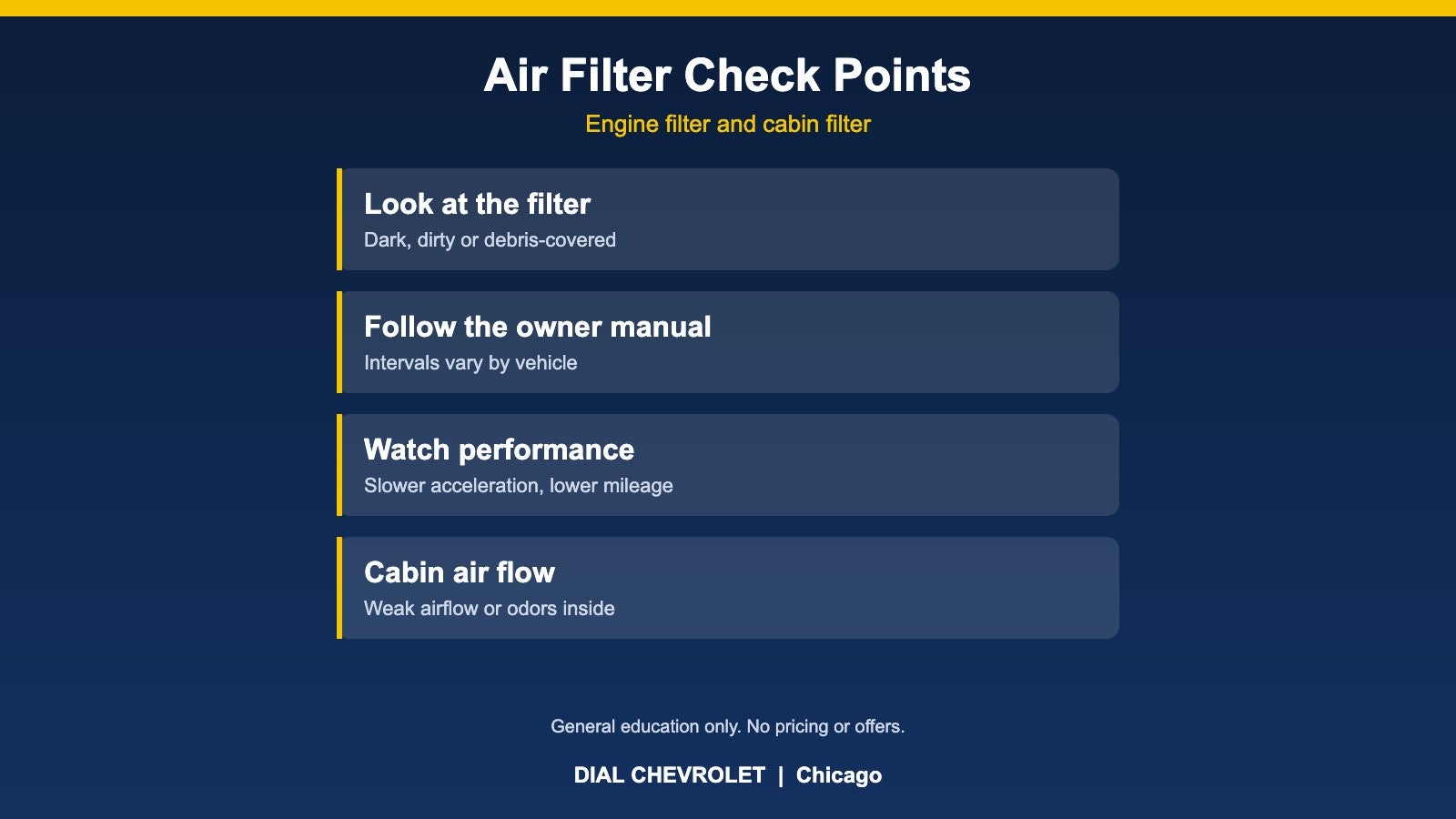
Graphic listing air filter check points

Engine and Cabin Air Filters: When to Check

Short answer: check your engine air filter by looking at it, follow the interval in your owner's manual, and replace it when it is dirty enough to restrict airflow. Cabin air filters are separate parts that also need periodic changes. What the two filters do The engine air filter cleans the air that goes into the engine. The cabin air filter cleans the air that comes into the passenger compartment through the heating and air conditioning system. Most vehicles have both, and they are replaced on their own schedules. How often to replace them Manufacturers list intervals in the owner's manual or maintenance schedule, and those intervals differ by vehicle. Several sources also point out that conditions matter more than a fixed number: dusty roads, construction areas and winter salt spray can load a filter faster. Inspecting the filter regularly is a more reliable habit than relying on a single mileage figure. Signs an engine air filter may be dirty The filter looks dark or gray, or has visible debris on it. Slower acceleration or a sluggish feel, especially with a turbocharged engine. A drop in fuel economy when your driving has not changed. Unusual engine sounds or rough running. A check engine light. Many things can cause one, so see our check engine light guide before assuming it is the filter. Signs a cabin air filter may need attention Weaker airflow from the vents. Musty or unpleasant odors when the fan or A/C runs. More dust inside the vehicle than usual. Checking it yourself The housing location varies, so use the owner's manual to find it. Some housings use clips and others use screws. If you are not comfortable inspecting it, ask a technician to check the filters during a service visit. Why Chicago driving matters Winter salt and spring construction can add grit and moisture to the air your vehicle breathes. That is a good reason to look at the filters at least when you service the vehicle for other reasons, such as the visits listed in our maintenance schedule guide. Talk to the Dial Chevrolet Team If you want filters inspected, you can schedule service or contact us. You may also like our guide to genuine GM parts versus aftermarket. Sources Cars.com: How Often Should You Change the Engine Air Filter? Autotrader: Car Air Filter, When to Replace Cars.com: Air Filters, What You Need to Know Published by Dial Chevrolet, 6603 S Western Ave, Chicago. General education only. Follow your owner's manual for your vehicle's intervals.
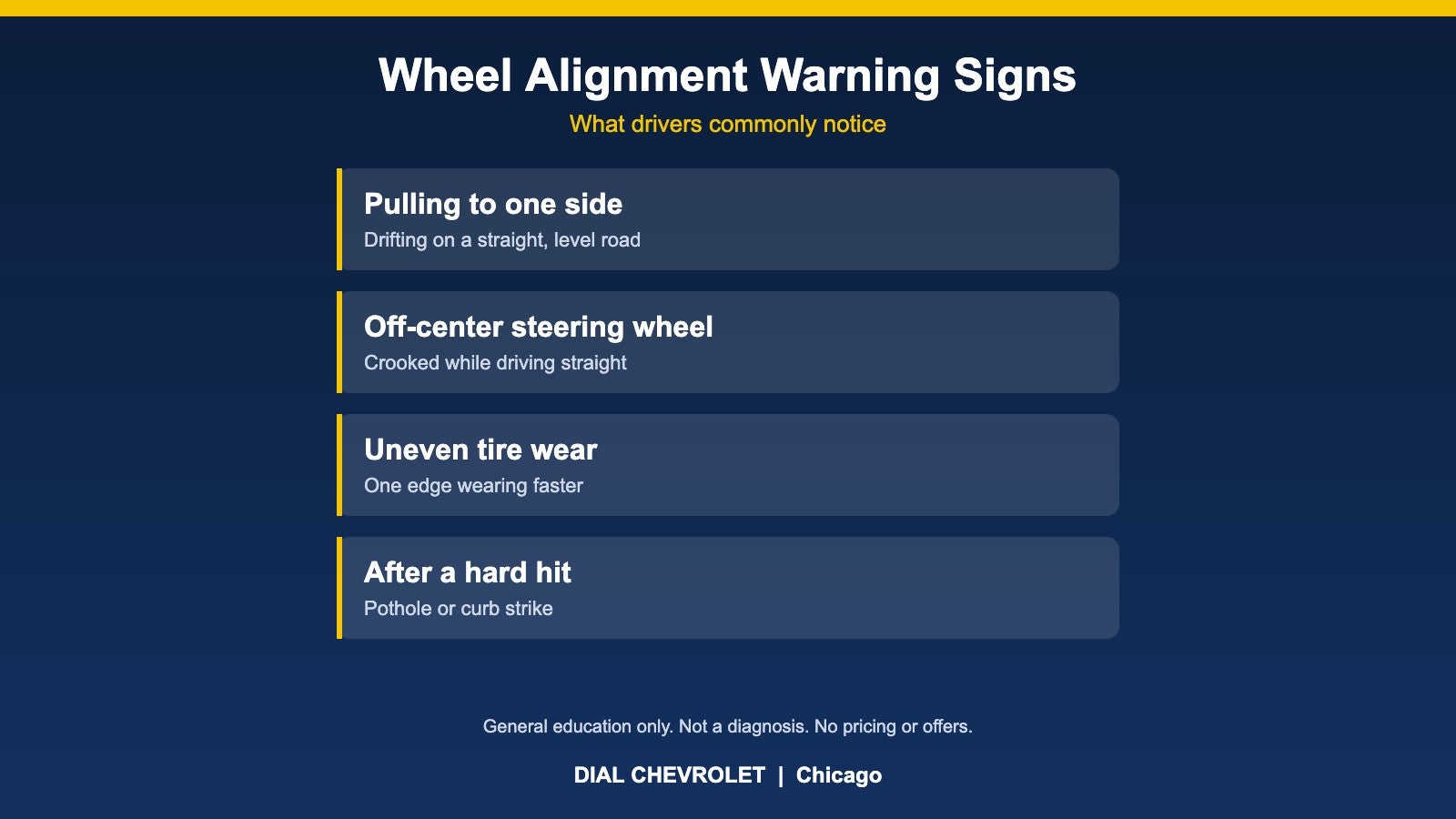
Graphic listing common signs of wheel misalignment

Wheel Alignment: Signs You May Need One

Short answer: the most common signs of a wheel alignment problem are a vehicle that pulls to one side, a steering wheel that sits off-center on a straight road, and tires that wear unevenly. A technician can confirm the cause, because other issues can look similar. What wheel alignment means Wheel alignment adjusts suspension angles, commonly called camber, caster and toe, so the tires meet the road as the vehicle was designed. When those angles drift, handling can change and tires can wear faster than they should. Signs you may need an alignment Pulling: on a straight, level road with little wind, the vehicle drifts left or right and you keep correcting the steering. Off-center steering wheel: the wheel is crooked while the vehicle is going straight. Uneven tire wear: the inner or outer edge of a tire looks more worn than the rest of the tread. Squealing tires: noise during ordinary low-speed turns. Steering that feels loose or does not return to center after a turn. Vibration: a shaking steering wheel can point to alignment, but it can also come from tire balance or worn parts. When to have it checked Many shops suggest an alignment check after a hard pothole or curb hit, after suspension or steering work, and when you install new tires. Chicago streets can be rough after winter, so it is reasonable to pay attention to how the vehicle drives in spring. Other things that feel like bad alignment Uneven tire pressure can make a vehicle pull, so check pressures first. A sticking brake caliper can also cause pulling. Worn tie rods, ball joints or other steering and suspension parts can cause loose steering and uneven wear; they need to be inspected with the vehicle raised. Tire balance problems often show up as vibration instead of pulling. A simple self-check Look at each tire's tread across its full width, and compare the front tires to each other. Wear concentrated on one edge is worth having inspected. Do this regularly, and before long trips. Why it matters Correct alignment helps tires wear evenly, supports steady handling and can protect fuel economy. Ignoring a problem can shorten tire life. Talk to the Dial Chevrolet Team If your vehicle pulls, the steering wheel is crooked or the tires look unevenly worn, you can schedule service or contact us. See also our maintenance schedule guide, brake service warning signs and winter prep checklist. Sources Kelley Blue Book: What Is Wheel Alignment AAA: Vehicle Wheel Alignment and Suspension Continental Tires: Wheel Alignment Published by Dial Chevrolet, 6603 S Western Ave, Chicago. General education only. It is not a diagnosis; have a qualified technician inspect your vehicle.

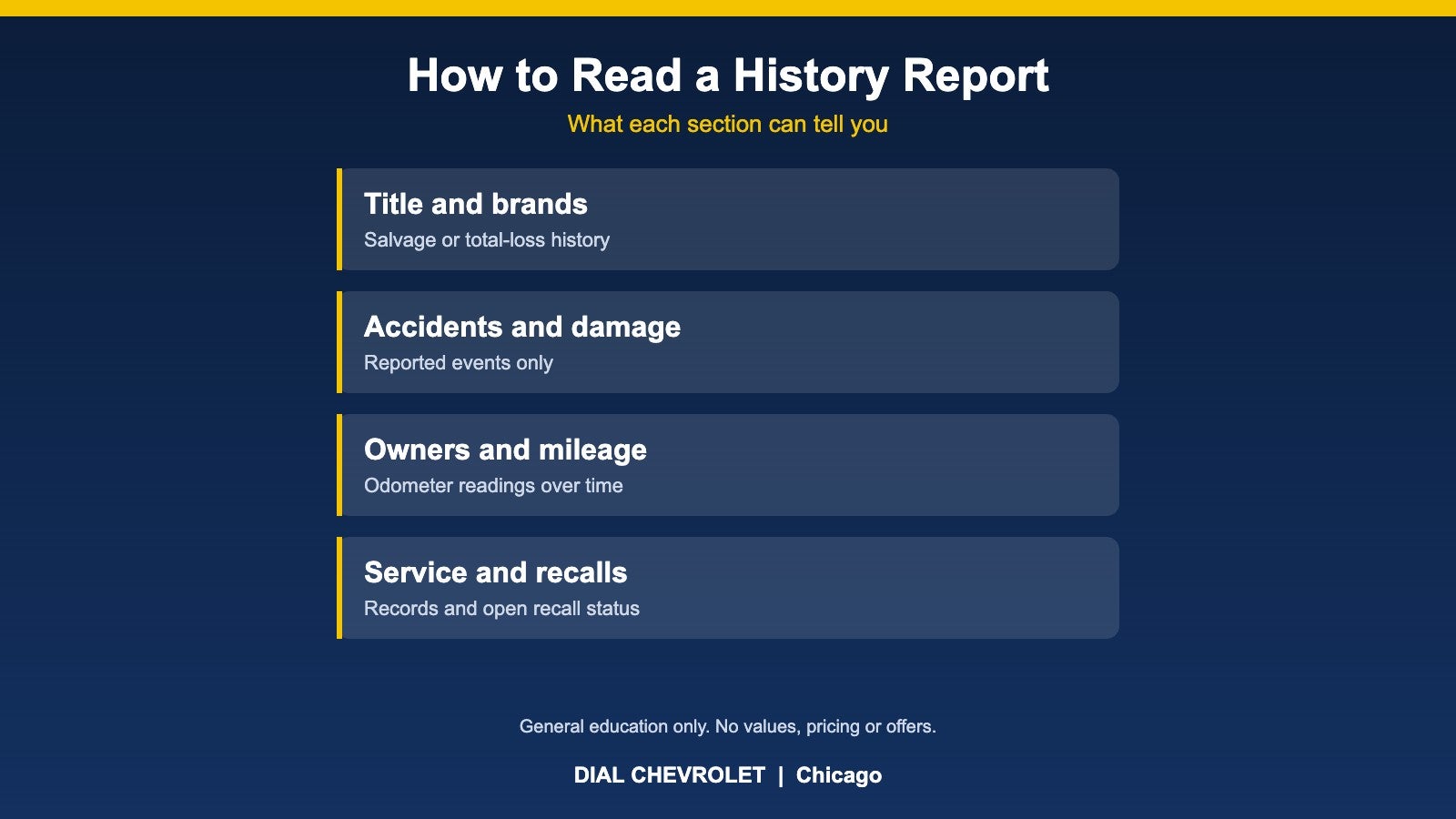
Graphic listing the main sections of a vehicle history report

How to Read a Used Car History Report

Short answer: a vehicle history report is a record of what has been reported about a used vehicle: title status, accidents or damage, owners, odometer readings, service entries and recalls. It is a helpful starting point, but it only covers what was reported, so it should be paired with an in-person inspection. Where the Report Comes From The Federal Trade Commission recommends getting a vehicle history report before buying a used car and notes that reports may include ownership history, accidents, repair records and whether the vehicle was ever declared salvage. The FTC does not endorse any specific provider. The federal National Motor Vehicle Title Information System (NMVTIS) is one source of title and brand data, and commercial report providers combine several sources. Reports differ in layout and in what they include, so the sections below are a general guide. Title and Brand Status Read this first. A brand such as salvage or total loss means the vehicle was declared a loss at some point and may need a closer look. Without knowing the brand history, a buyer may pay more than a vehicle is worth or buy one that was not properly repaired. A clean title only means that no brand was reported. Accidents and Damage Look at whether any accident or damage events were reported and how they are described. Not every collision is reported, and a report cannot show the quality of a repair. If you see a reported accident, ask for repair records and point it out to the inspecting mechanic. Our used SUV inspection checklist shows what to check in person. Owners, Registration and Use The report may show how many owners a vehicle has had and where and when it was titled. A report generally cannot show exactly how a prior owner used the vehicle. Frequent ownership changes are worth asking about, but they are not proof of a problem on their own. Odometer Readings Readings recorded at title transfers, inspections or service visits should rise over time. A reading that drops or stays unusually flat can be a sign of an error or a rollback, and is worth questioning. Service Records and Recalls Service entries can support the story a seller tells about maintenance, but many routine services never appear on a report. Check open recalls by VIN as well; our recall check guide explains how. What a Report Cannot Tell You Reports do not measure wear and tear, and they can be incomplete. Treat the report as one input, then add a test drive and an independent inspection. If you are comparing vehicles, our total cost of ownership guide can help with the bigger picture. Talk to the Dial Chevrolet Team You can browse used inventory or contact us to ask what documentation is available for a specific vehicle. Sources Federal Trade Commission: Used cars NMVTIS: Understanding a vehicle history report Chase: What is a vehicle history report? Published by Dial Chevrolet, 6603 S Western Ave, Chicago. General education only. No vehicle values, pricing, report-provider endorsements or offers are stated.

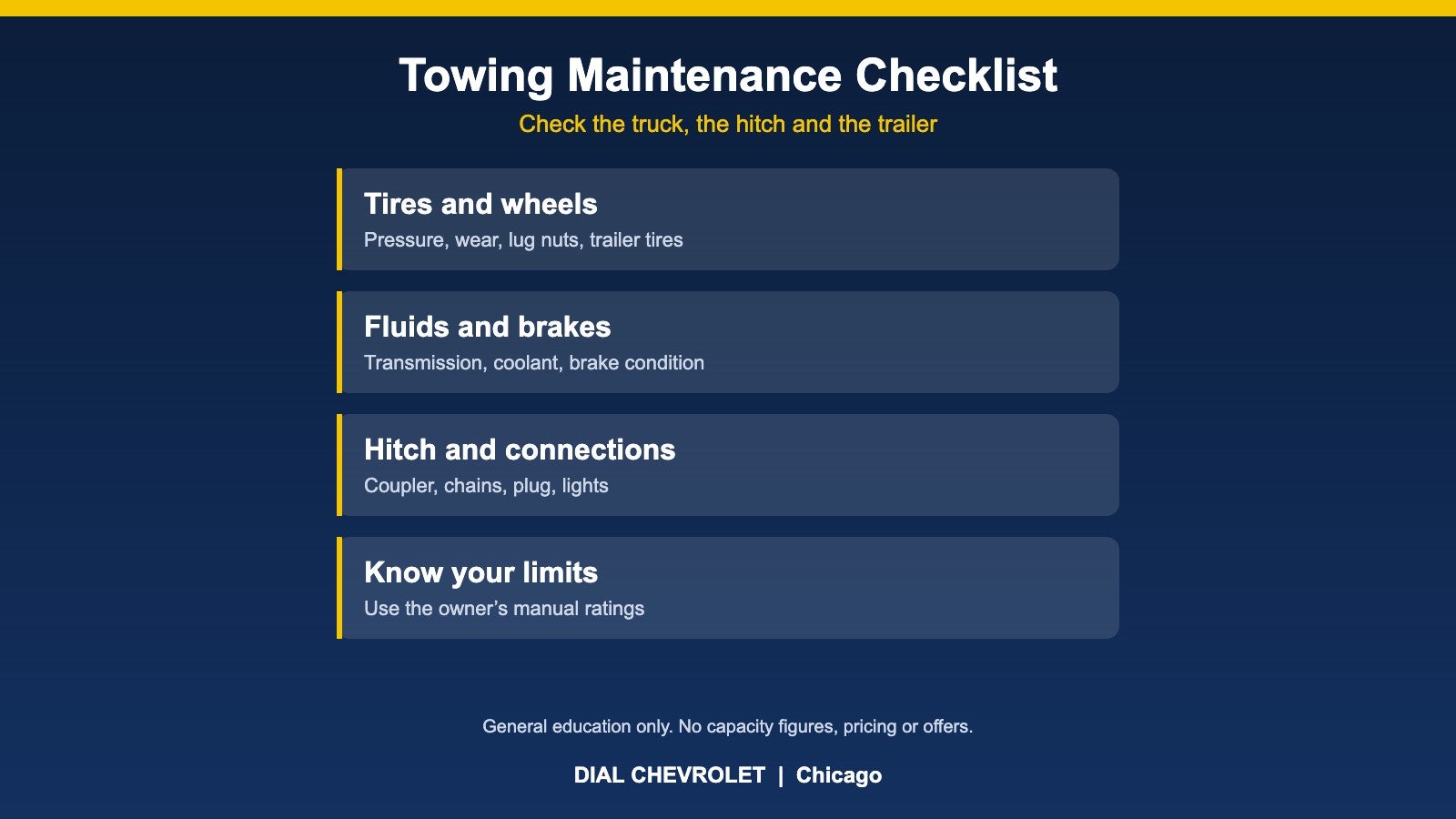
Checklist graphic for towing maintenance checks

Towing Maintenance Checklist for Trucks and SUVs

Short answer: towing puts extra stress on a vehicle, so it helps to confirm that routine maintenance is current, check the tires, fluids and brakes, and inspect the hitch, connections and trailer before every trip. The numbers that matter for your vehicle, such as towing ratings and tire pressures, come from your owner's manual. Start With Routine Maintenance Vehicle manufacturers generally advise that a vehicle used for towing needs service more often than one that is not. Review your maintenance schedule and ask about the service interval for your use. Our maintenance schedule guide covers the basics. Tires and Wheels Check pressure and condition on both the tow vehicle and the trailer, including any spare. Look for cracking or dry rot on trailer tires, especially if the trailer has been stored for months. Tires age even when tread looks good. Your owner's manual may call for a different tire pressure when towing. Confirm that the lug nuts on the vehicle and trailer are tightened to the specified torque. Fluids and Brakes Owner's manuals commonly point to engine oil, automatic transmission fluid, axle lubricant and cooling system fluid as items to watch when towing, and recommend checking transmission fluid more often. Brake condition is another item to check frequently. If your trailer has brakes, make sure they and the brake controller are working. For a related topic, see our brake service warning signs. Hitch, Coupler and Connections Make sure the coupler is fully seated and latched on the ball and that hitch bolts are tight. Inspect safety chains and their attachment points. Plug in the trailer connector and confirm brake lights, turn signals and running lights work with the trailer attached. Adjust mirrors so you can see past the trailer. Know Your Ratings Do not guess at towing capability. Capacity depends on the specific model, engine, axle ratio and equipment, so check the owner's manual and the vehicle's labels. The payload guide explains how weight limits work, and our 1500 vs. 2500HD comparison explains why the model matters. Plan for Chicago Conditions Cold weather, road salt and stop-and-go traffic add wear. A pre-trip walkaround is worth repeating at each stop on a long trip. See our winter prep checklist for seasonal checks. Talk to the Dial Chevrolet Team If you tow regularly, you can schedule a service appointment to have fluids, tires and brakes reviewed, or contact us with questions. Sources Consumer Reports: Preparation and driving tips for safe towing Progressive: Annual hitch and towing system maintenance U.S. EPA: Trailer towing pre-trip safety checklist (PDF) Published by Dial Chevrolet, 6603 S Western Ave, Chicago. General education only, not a substitute for your owner's manual. No towing capacities, pricing or offers are stated.

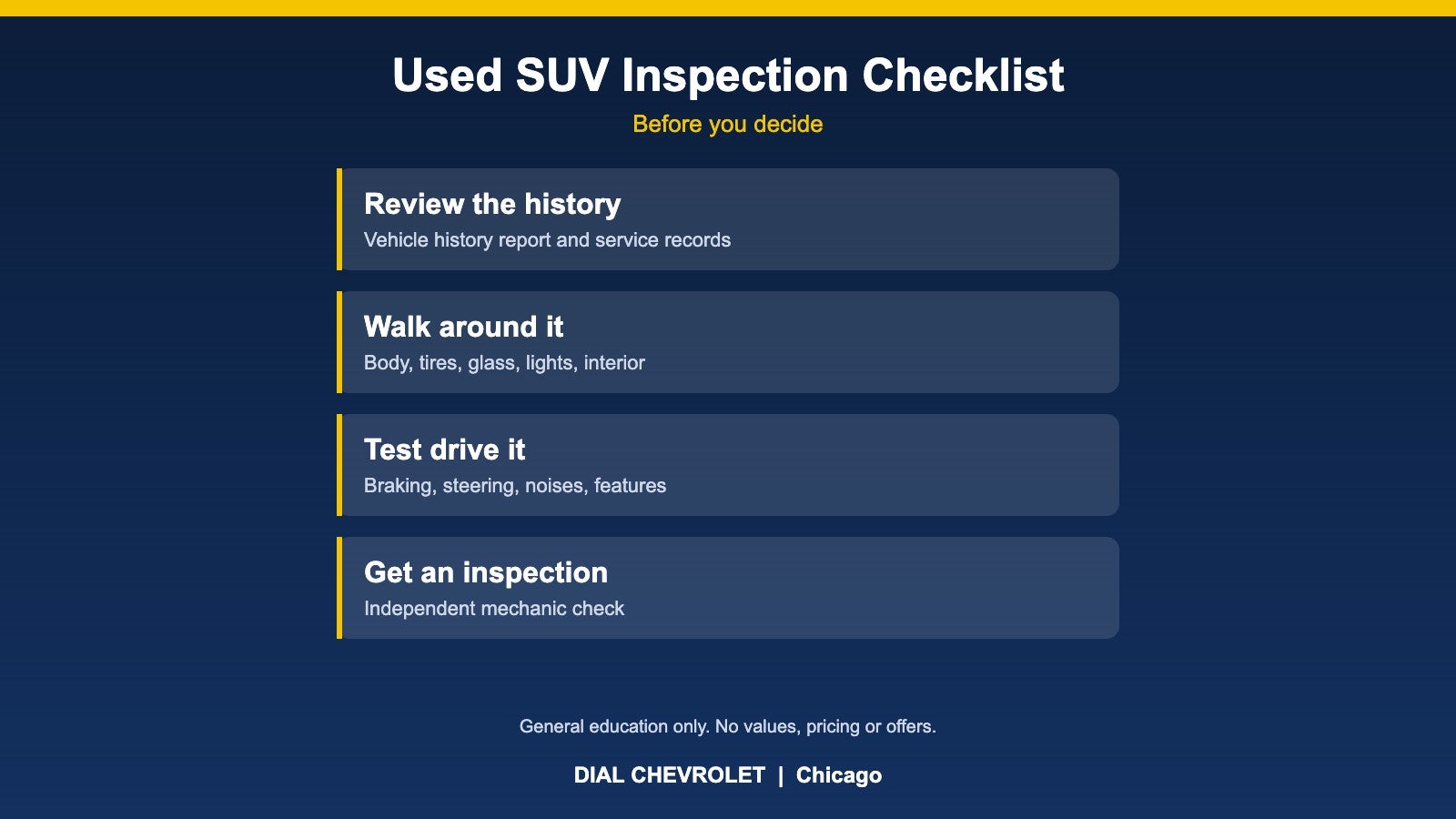
Checklist graphic for inspecting a used SUV before buying

Used SUV Inspection Checklist for Buyers

Short answer: before buying a used SUV, review its vehicle history report and service records, inspect it carefully in person, take a thorough test drive, and have an independent mechanic perform a pre-purchase inspection. Each step catches different problems, so it helps to do all of them. Start With the History Ask for a vehicle history report, which can show ownership changes, reported accidents, service entries and open recalls. Reports are a useful starting point but are not guaranteed to be complete, so treat them as one input. Service records matter too: be cautious when maintenance is claimed but cannot be documented. Walk Around the Exterior Look for mismatched paint, uneven gaps between panels or signs of past repairs. Check tires for even wear and ask how old they are. Inspect glass, lights and mirrors for damage. In Chicago, look underneath and along the lower body for rust, since road salt is hard on metal. Our road salt corrosion guide explains why. Check the Interior and Features Test every window, lock, seat adjustment, climate control setting and the infotainment system. Look for water stains, musty smells or worn areas that do not match the mileage. Confirm all warning lights turn on at start-up and go off. A light that stays on needs explaining; see our check engine light guide. For a three-row SUV, check that the second and third rows fold and latch properly, and that child-seat anchors work if you need them. Take a Real Test Drive Drive on a mix of roads that includes bumps, a highway stretch and some stop-and-go. Listen for unusual noises, feel for pulling or vibration, and test the brakes firmly in a safe place. If you plan to tow, ask about the vehicle's towing equipment and confirm capability for that exact vehicle in its documentation rather than assuming it. Get a Pre-Purchase Inspection Automotive guides consistently recommend an independent inspection by a qualified mechanic before you finalize a purchase, because many used vehicles are sold as-is and a technician can spot issues a walk-around may miss. An inspection usually covers the engine, transmission, suspension, brakes and underbody. It will not catch everything, but it improves your odds. Private sellers may be less willing to allow one, which is itself something to weigh. Compare the Total Picture Condition is only part of the decision. Think about ownership costs as well; our total cost of ownership guide and the new vs. used comparison can help. Talk to the Dial Chevrolet Team You can browse used inventory, start a trade-in request, or contact us to ask what documentation is available for a specific vehicle. Sources Edmunds: What to look for when buying a used car CarGurus: The ultimate used car buying checklist RepairPal: Pre-purchase inspection Published by Dial Chevrolet, 6603 S Western Ave, Chicago. General education only. No vehicle values, pricing, warranty terms or offers are stated.

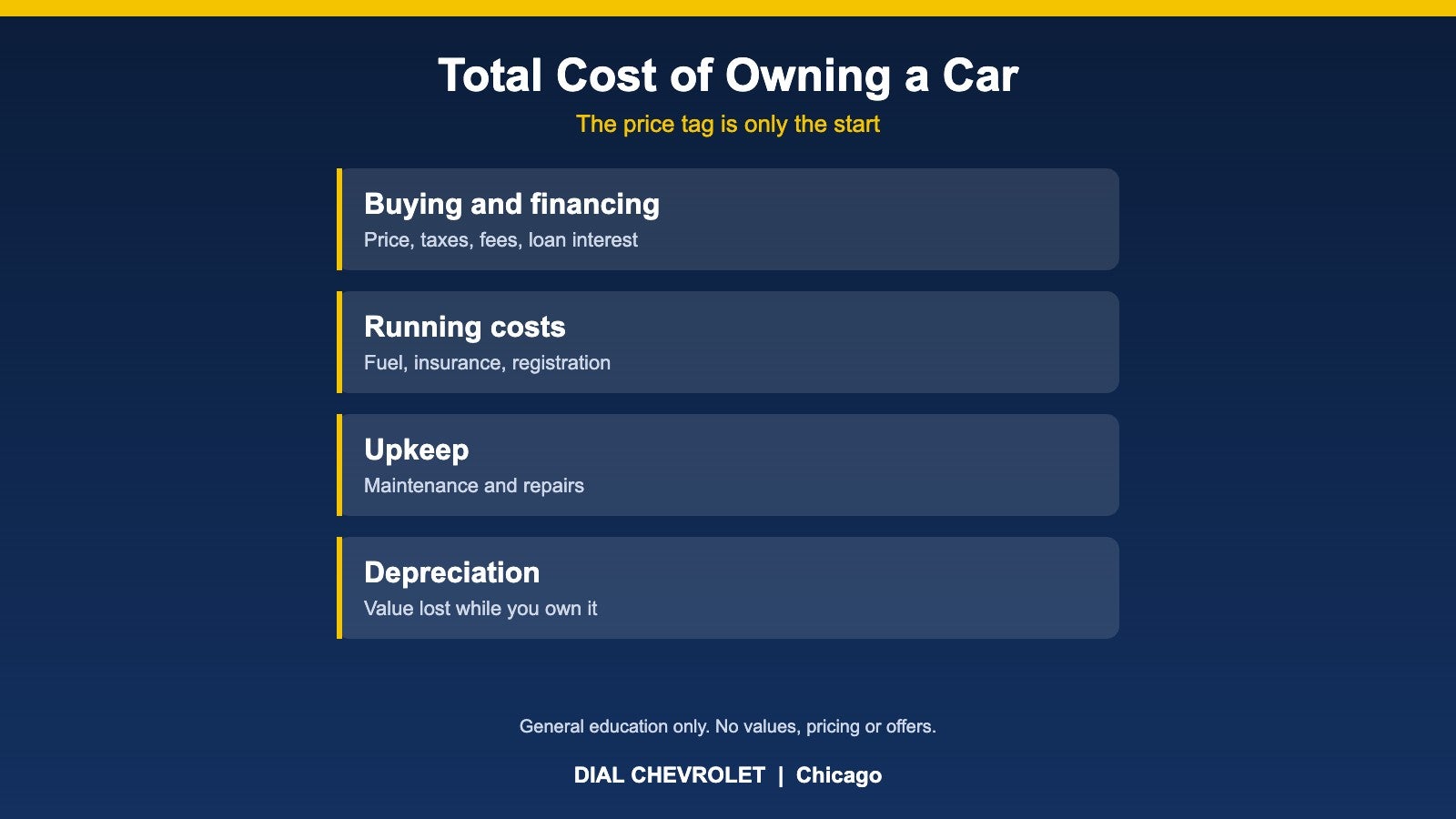
Graphic listing the main costs of owning a car

Total Cost of Owning a Car: What to Count

Short answer: the total cost of owning a car is the purchase price plus everything you pay or lose while you keep it: financing, taxes and fees, insurance, fuel, maintenance and repairs, and depreciation. Looking at all of them together gives a more realistic picture than the monthly payment alone. The Main Cost Categories Consumer guides from sources such as Edmunds, Kelley Blue Book and AAA describe ownership cost in a similar way. The common pieces are: Buying and financing: the price, sales tax, title and registration fees, and loan interest if you finance. Insurance: premiums vary by vehicle, driver and location, so a quote for the specific model is more useful than an average. Fuel: depends on fuel economy, driving habits and fuel prices. Maintenance and repairs: routine service plus repairs that come up as the vehicle ages. Depreciation: the value a vehicle loses over time. It is not a bill you pay, but it affects what you get when you sell or trade, and it is often described as one of the largest ownership costs. How to Build Your Own Estimate List the vehicles you are considering, including a new and a used option. Request insurance quotes for each specific model. Estimate fuel from your typical weekly driving and the vehicle's rated fuel economy. Check the maintenance schedule for what service is due and when. Our maintenance schedule guide is a starting point. Consider how long you plan to keep the vehicle, since depreciation and repair costs change with ownership length. Fixed and Changing Costs Loan payments and insurance premiums tend to be predictable. Fuel, maintenance and repairs change with how much you drive and how the vehicle ages. In Chicago, winter driving and road salt can add wear, so it is sensible to keep some room in a budget for upkeep. See our guides on road salt corrosion and winter preparation. New or Used A newer vehicle usually has more of its value left to lose, while an older vehicle may need more repairs. Neither is always cheaper over time. Our new vs. used comparison and buying vs. leasing guide cover the tradeoffs without quoting prices. Talk to the Dial Chevrolet Team You can browse new and used inventory, or contact us with questions. Any payment or pricing question is best answered by the dealership directly for the specific vehicle. Sources Edmunds: True Cost to Own Kelley Blue Book: Total cost of ownership Chase: How to calculate the total cost of car ownership Published by Dial Chevrolet, 6603 S Western Ave, Chicago. General education only, not financial advice. No vehicle values, pricing or offers are stated.

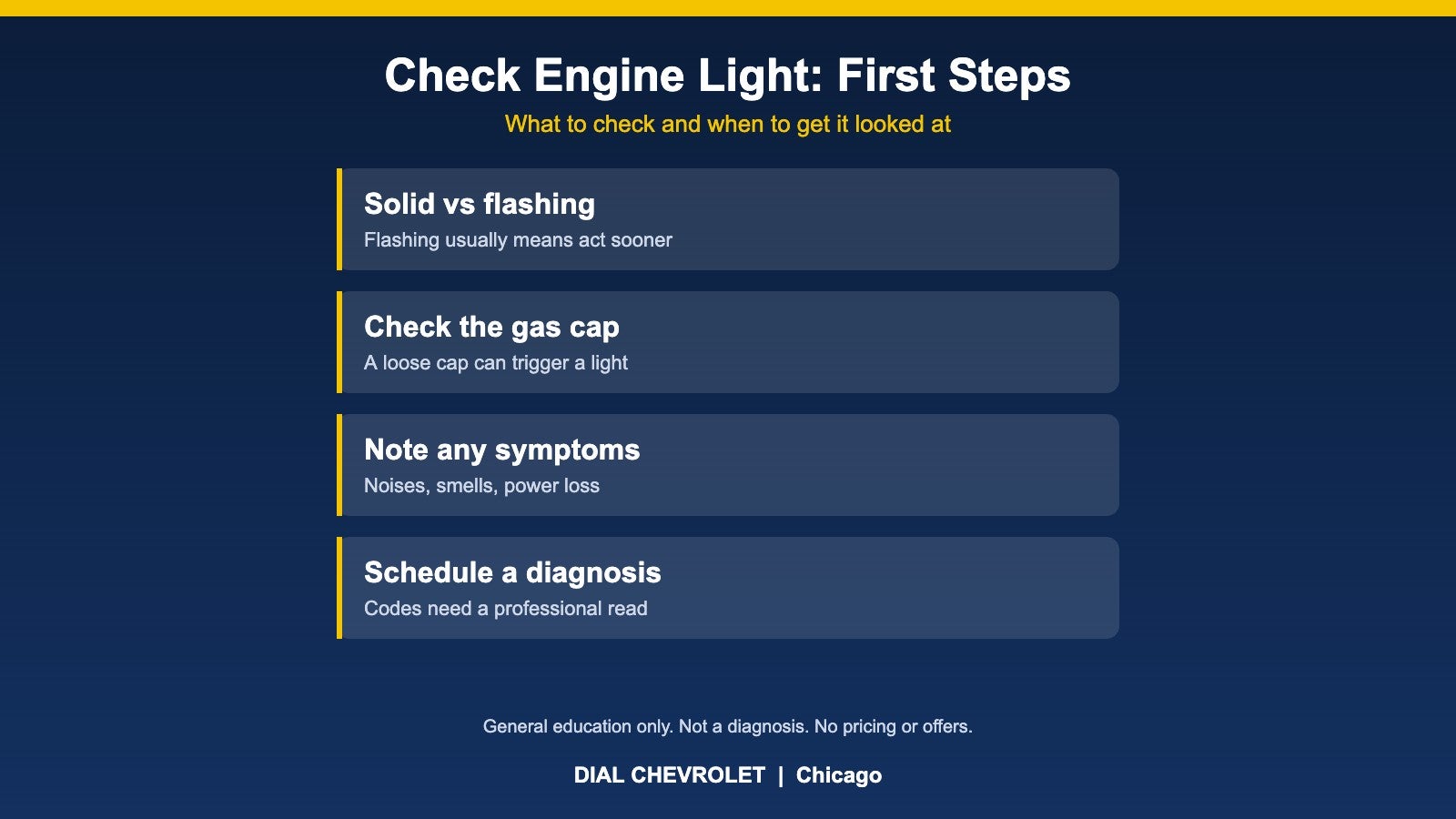
Checklist graphic with first steps when a check engine light comes on

Check Engine Light: First Steps to Take

Short answer: a solid check engine light usually means a fault that should be looked at soon, while a flashing light is more serious and calls for prompt action. Either way, a few simple checks can help you decide what to do next. Solid or Flashing: Start Here Note how the light behaves. Automotive guides generally describe a solid light as a fault affecting emissions or fuel economy that is not an immediate emergency, and a flashing light as a sign of a severe problem such as an engine misfire. A flashing light means you should reduce speed and load, find a safe place to stop, and arrange service rather than keep driving. Your owner's manual explains the warning lights on your specific vehicle. Check the Gas Cap A loose or damaged gas cap is a common trigger because it can cause a leak in the fuel vapor system. If the cap was loose, tighten it until it clicks. It can take several drives for the light to turn off, and if it stays on, something else may be the cause. Pay Attention to Symptoms Notice whether the vehicle runs differently: rough idle, hesitation, loss of power, unusual noises or smells, or a drop in fuel economy. Write down what you notice and when the light came on, because that detail helps a technician. If the temperature or oil pressure warnings are on, or the engine feels unsafe to drive, stop and call for assistance. Get the Codes Read Most causes need a code reader to diagnose, and a code points to the system involved rather than naming the part that has failed. Common causes include the gas cap, oxygen sensors, ignition components and emissions parts, but the list is long. Ignoring even a solid light can lead to reduced performance or more costly damage later. Why Winter Matters in Chicago Cold weather can bring warning lights to the surface, including problems with a weak battery. Our cold weather battery guide and winter prep checklist cover related checks, and the maintenance schedule guide explains routine service. Talk to the Dial Chevrolet Team You can schedule a service appointment or contact us with questions. We can't diagnose a vehicle from an article, and a service visit is the way to find the actual cause. Sources AAA: Check engine light Cars.com: What does the check-engine light mean? Kelley Blue Book: Check engine light quick facts Published by Dial Chevrolet, 6603 S Western Ave, Chicago. General education only, not a diagnosis. No pricing or offers are stated.

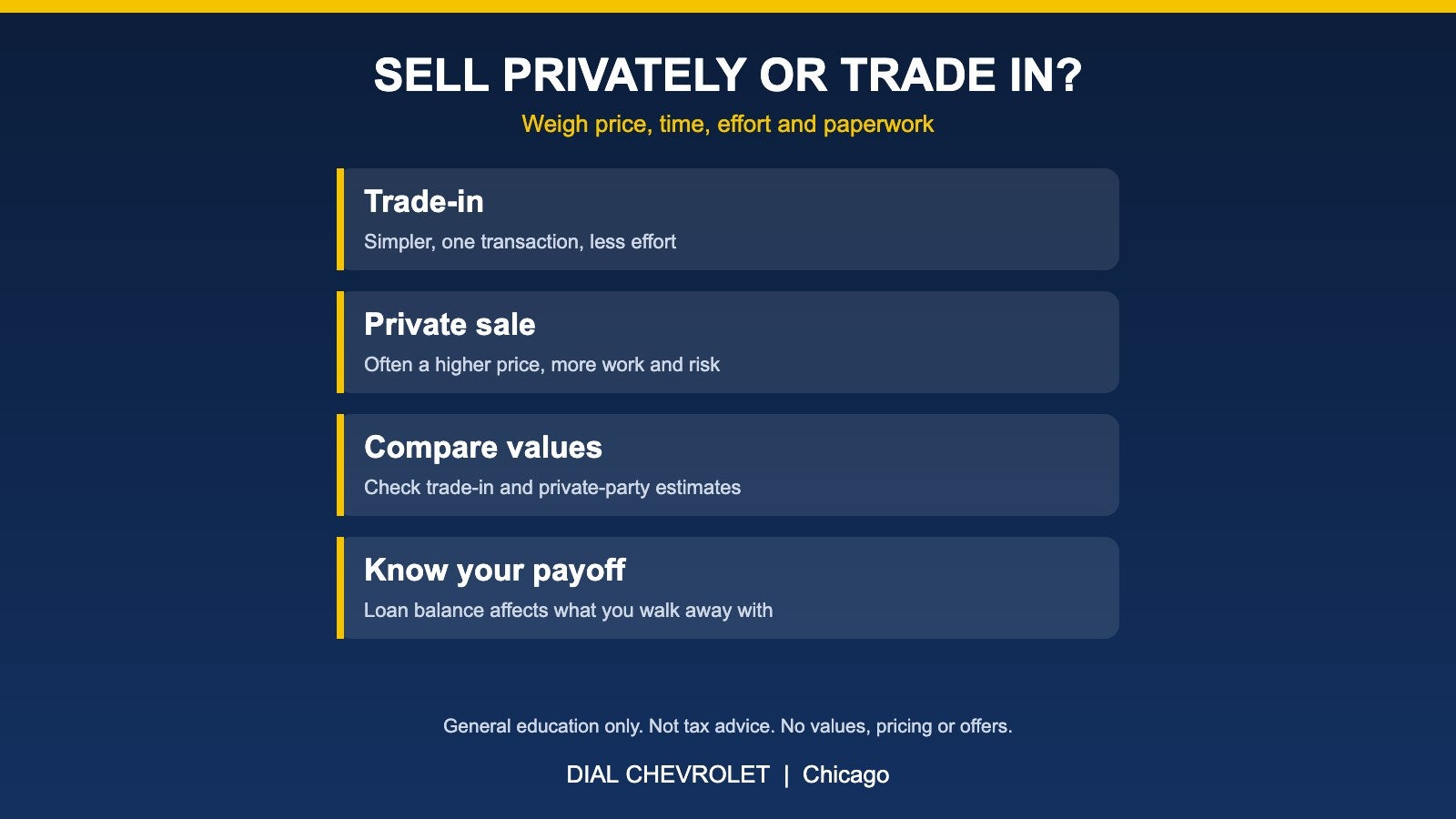
Checklist graphic comparing selling a car privately with trading it in

Sell Privately or Trade In? What to Weigh

Short answer: a trade-in is usually simpler and faster, while a private sale often brings a higher price but takes more time, effort and risk. The right choice depends on how you value convenience against money, and on whether you still owe on the vehicle. What a Trade-In Offers With a trade-in, you handle the old vehicle and the next purchase in one transaction at one dealership. There are no listings, calls or test drives with strangers, and the dealership handles the title paperwork. The trade-off is that dealer offers are generally lower than what a private buyer might pay. What a Private Sale Offers Selling it yourself can bring a higher price, but you take on the work. That includes photos, listing, answering messages, meeting buyers, taking payment and completing the title and registration steps. Consumer guides also warn about haggling, no-shows and scams in private sales, so safety and payment method matter. Compare Real Numbers First Look up both a trade-in estimate and a private-party estimate for your exact vehicle, mileage and condition from a recognized valuation site, then compare the gap. Remember that an online estimate is not an offer, and condition matters. For a checklist of what to gather, see our trade-in preparation guide. If You Still Owe on the Vehicle Either way, your loan payoff has to be settled before the title can transfer. Our guide to trading in a car with a loan explains positive and negative equity. A Note About Sales Tax Many states give a tax advantage on a trade-in, because the trade-in value can reduce the taxable price of the next vehicle. Illinois Department of Revenue rules address trade-in allowances on dealer purchases, but there are limits and exceptions and the rules change. Check with the Illinois Department of Revenue or a tax professional about your own situation. This article is not tax advice. Which Option Fits You? A trade-in may fit if you value speed, want one transaction, and are replacing the vehicle right away. A private sale may fit if you have time, are comfortable with the process, and the price gap matters to you. Talk to the Dial Chevrolet Team You can start a trade-in valuation request, browse used inventory, or contact us with questions. A valuation request is not a guaranteed offer. Sources Chase: Trading in a car vs. selling Cars.com: Pros and cons of a trade-in vs. private sale Illinois Administrative Code: Traded-in property (86 Ill. Adm. Code 130.425) Published by Dial Chevrolet, 6603 S Western Ave, Chicago. General education only, not tax or legal advice. No vehicle values, pricing or offers are stated.

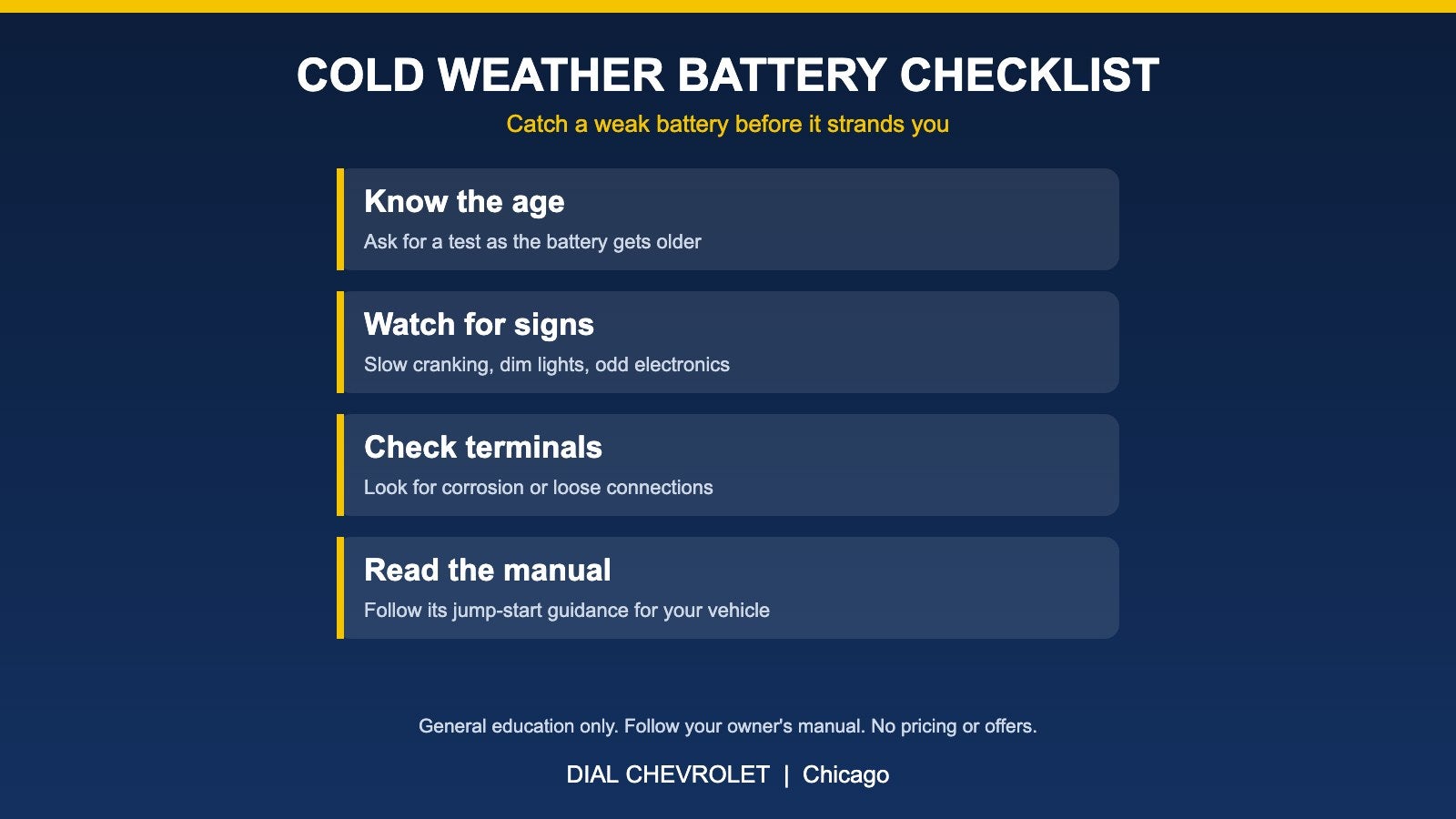
Checklist graphic for checking a car battery before and during cold weather

Cold Weather Car Battery: Signs and Prevention

Short answer: cold weather makes an engine harder to start and reduces what a battery can deliver, so a weak or aging battery often fails on the first very cold morning. A battery test before winter is the best way to find out how much life it has left. Why Cold Weather Is Hard on a Battery AAA says starting a vehicle in cold weather can require up to twice as much current as normal. Cold oil and a cold engine take more effort to turn over, and the heater and defroster add more demand. AAA also notes that heat is actually harder on battery life over time, but cold is when an already weakened battery gets exposed. How Long Do Car Batteries Last? AAA says car batteries typically last three to five years, depending on use, temperature and vibration. As a battery ages, it is more affected by cold. You cannot judge remaining life by looking at it, so ask for a test once the battery is a few years old. Warning Signs of a Weak Battery The engine cranks slowly or hesitates when you start it. Headlights or interior lights look dim, especially at idle. The radio, heated seats or phone charger do not work the way they normally do. The battery case looks swollen, leaks or smells unusual. Whitish or blue-green buildup on the terminals. If you see any of these, have the battery and charging system checked rather than waiting for a no-start. A weak battery is not always the cause of a starting problem, so a proper test helps avoid replacing parts you do not need. Ways to Reduce the Risk Get the battery tested before winter, and again if it is more than a few years old. Keep terminals clean and connections tight. Be aware that many short trips may not fully recharge the battery, especially when the heater and other accessories are running. Turn off lights and accessories before shutting the vehicle off. About Jump-Starting Check your owner's manual first. AAA advises that some newer vehicles, including hybrids and electric vehicles, may require manufacturer-specific procedures, and it warns against trying to charge or jump-start a frozen or damaged battery. Even electric vehicles have a 12-volt battery that can run down. If you are unsure, call roadside assistance or a professional rather than guessing. For a wider winter checklist, see preparing your Chevy for a Chicago winter and road salt and corrosion. For intervals on other service items, see the Chevy maintenance schedule. Talk to the Dial Chevrolet Team If your Chevy is slow to start or the battery is getting older, you can request a service appointment or contact us with questions. Sources AAA: When to replace your car's battery AAA: How long do car batteries last? AAA Northeast: How to jump a car battery safely Published by Dial Chevrolet, 6603 S Western Ave, Chicago. General education only. Follow your owner's manual. No pricing or offers are stated.

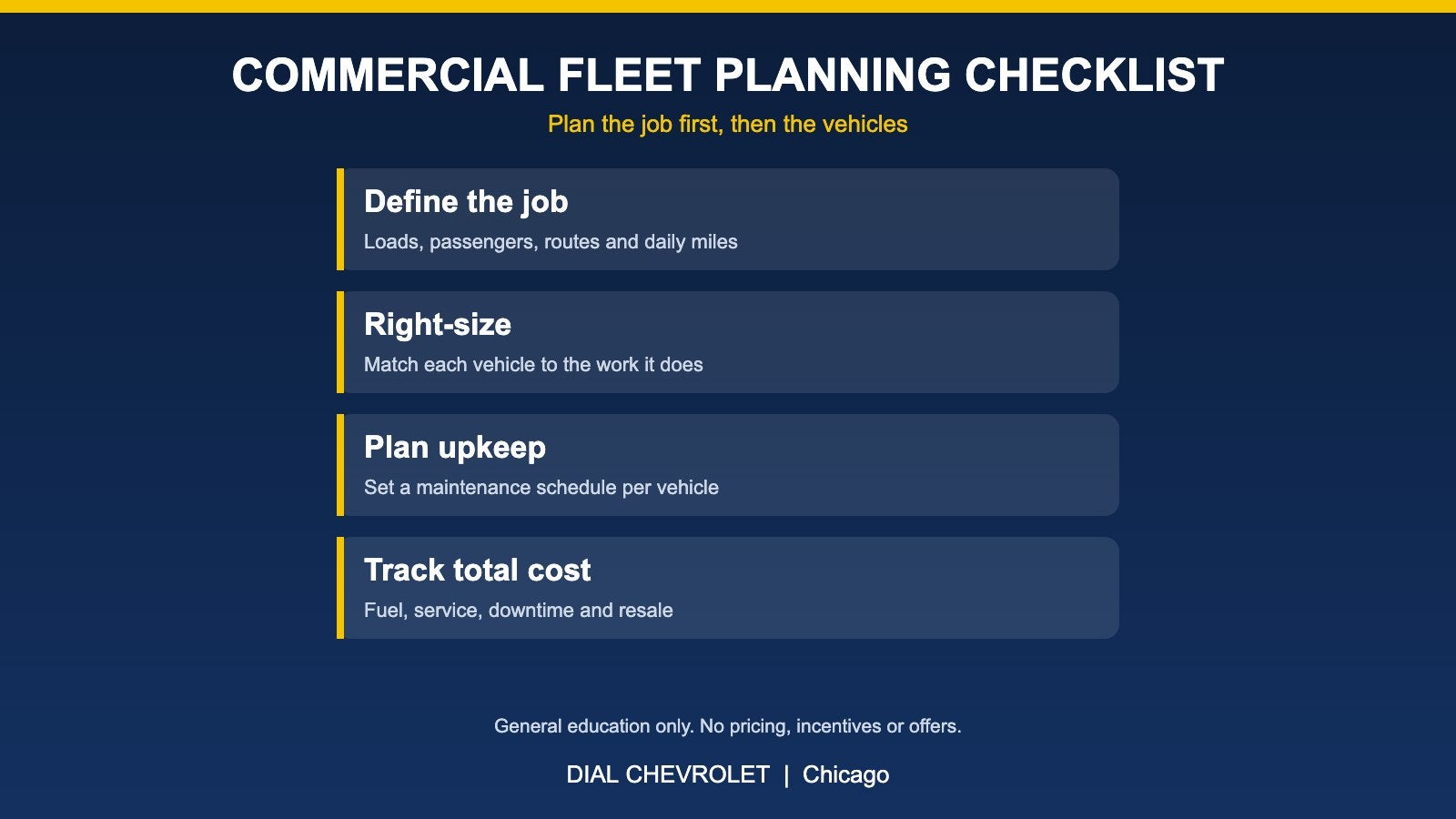
Checklist graphic for planning a commercial vehicle fleet for a Chicago business

Commercial Fleet Planning for Chicago Businesses

Short answer: good fleet planning starts with the work each vehicle has to do, not the vehicle itself. Define the loads, passengers, routes and daily miles first, match vehicles to those jobs, set a maintenance schedule, and track what each vehicle really costs to run over its whole life. What Counts as a Fleet Industry guides commonly describe a fleet as five or more vehicles used for business, though the definition varies by company and by program. A plumber with two vans and a contractor with ten trucks face many of the same questions, so the planning steps below apply at any size. Step 1: Define the Job List what each vehicle must carry or tow, how many people ride in it, how far it drives each day, and where it parks overnight. A vehicle that is too small struggles with the work, and one that is too large costs more to buy and run than the job needs. Our guides to payload and Silverado 1500 vs. 2500HD help with weight and capability questions. Step 2: Match the Vehicle Type Chevrolet lists commercial trucks, vans, and chassis cabs and cutaways among its business vehicles. Pickups suit crews that haul tools and materials in an open bed, and cargo vans suit crews that need enclosed, secure storage. If you plan to add shelving, racks or other equipment, ask early, because Chevrolet notes that equipment from independent suppliers is not covered by the GM New Vehicle Limited Warranty. Check each supplier's own terms. See work truck setup for a Chicago business for more. Step 3: Plan Maintenance Before Problems Start Business guides consistently recommend a written maintenance schedule for every vehicle, because downtime costs money. When service time is limited, the vehicles that keep the business moving should get the first appointments. Use our Chevy maintenance schedule article as a starting point and follow the owner's manual for your specific vehicles. Step 4: Track Total Cost of Ownership Purchase price is only one part of the picture. Fleet guides describe total cost of ownership as including fuel, maintenance and repairs, insurance, depreciation and resale value. Record these for each vehicle so you can see when an aging vehicle costs more to keep than to replace. Ask your accountant about how vehicle purchases are treated for tax, since rules change and depend on your business. Talk to the Dial Chevrolet Team If you are planning to add or replace business vehicles, contact us to talk through your needs, browse new inventory or used inventory, or request a service appointment for the vehicles you already run. Sources Chevrolet: Commercial vehicles U.S. Chamber of Commerce: Managing company vehicle usage and maintenance Routific: Beginner's guide to managing small fleets Published by Dial Chevrolet, 6603 S Western Ave, Chicago. General education only, not tax, legal or financial advice. No pricing, incentives or offers are stated.

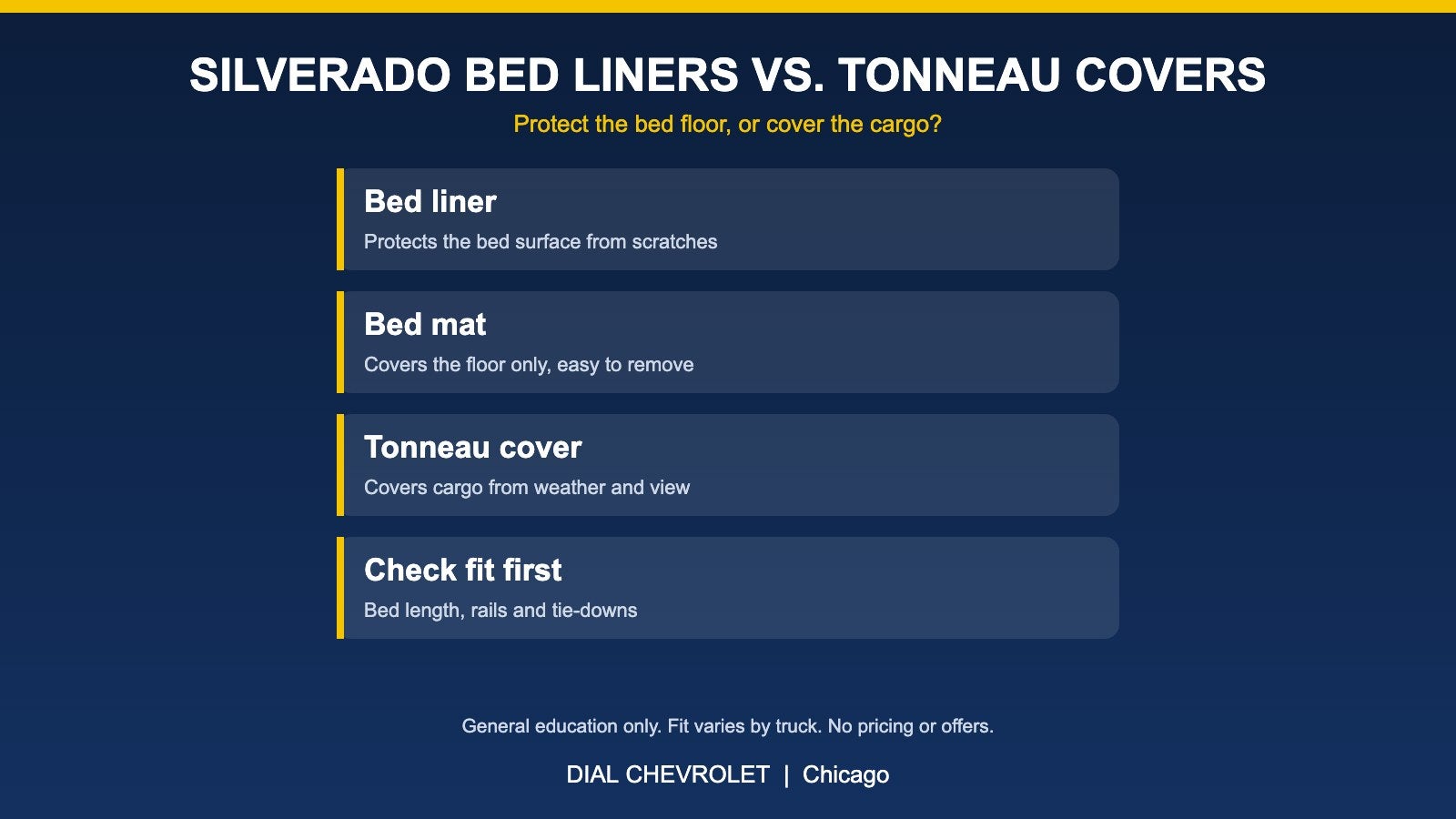
Checklist graphic comparing Silverado bed liners, bed mats and tonneau covers

Silverado Bed Liners and Tonneau Covers Compared

Short answer: a bed liner or bed mat protects the surface of your Silverado bed from scratches and wear, while a tonneau cover covers the bed to shield cargo from weather and view. Many owners use both, and the right choice depends on how you use the truck and which options it already has. Bed Liners: Drop-In, Spray-In and Mats Drop-in liners are molded shells that fit into the bed. Spray-in liners are a coating applied to the bed surface and are usually done by a professional. Bed mats cover the floor only, and they are easier to remove than a full liner. Liners generally protect the bed floor, sides and bulkhead, and some also cover the tailgate, while mats protect the floor alone. Some Silverado trims offer a factory spray-on liner, so check your build sheet or ask us what a specific truck has before you buy an add-on. Tonneau Covers: The Main Types Soft roll-up: lightweight and simple, and it rolls toward the cab for full bed access. Soft folding: folds in sections, and retailers describe it as giving access to roughly two-thirds of the bed at a time. Hard folding: panels made of aluminum or composite materials that add security compared with soft vinyl. Hard roll-up and retractable: slatted designs that roll out of the way. Soft covers are generally less expensive and easy to operate, while hard covers are generally more durable and more secure, but heavier and often costlier. Soft covers may also not hold up as well to heavy snow, which matters in a Chicago winter. What to Check Before You Buy Bed length, since Silverado beds come in more than one length. Our cab sizes and bed lengths guide explains the options. Whether the cover or liner works with the bed rails, tie-downs and any accessories already on your truck. Whether you need to haul tall items, which can rule out some covers. The warranty terms for the product itself. Anything you add to the bed counts toward the load you carry. See Silverado payload explained for how to think about weight, and work truck setup for a Chicago business if the truck earns its living. Talk to the Dial Chevrolet Team Browse new Silverados or used trucks, or contact us to ask what accessories fit a specific truck. Sources AmericanTrucks: Finding the right tonneau cover for a Silverado RealTruck: Tonneau and bed covers for the Silverado 1500 RealTruck: Bed liners and bed mats for the Silverado 1500 Published by Dial Chevrolet, 6603 S Western Ave, Chicago. General education only. Product availability, fit and warranty vary; no pricing or offers are stated.

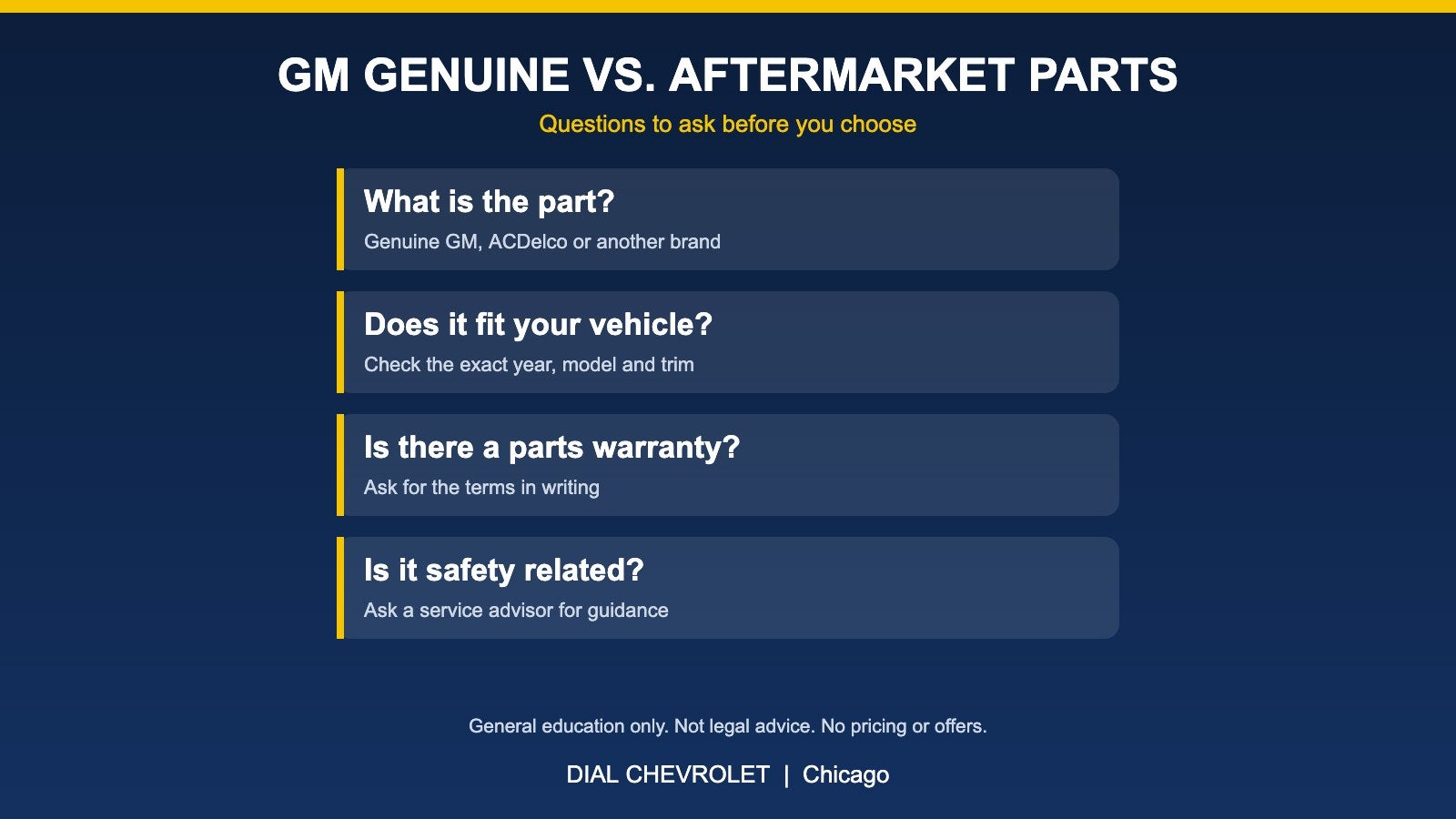
Checklist graphic comparing genuine GM parts and aftermarket parts for Chevrolet owners

Genuine GM Parts vs. Aftermarket: How to Choose

Short answer: genuine GM parts are made or validated by GM for your specific Chevrolet, while aftermarket parts come from other companies and vary in design and quality. Federal consumer guidance says that using an aftermarket part does not, by itself, void your vehicle warranty, so the better question is which part is right for your repair. What Counts as a Genuine GM Part GM describes its parts portfolio in tiers. GM Genuine Parts and ACDelco Original Equipment are the parts installed during production or validated by GM for Chevrolet, Buick, GMC and Cadillac vehicles. GM also sells ACDelco lines aimed at the aftermarket. When you ask about a part, it helps to ask which of these lines it belongs to. What Aftermarket Means An aftermarket part is made by a company other than the vehicle manufacturer. Some are well engineered and some are not, so brand, fit and testing matter more than the label alone. Ask for the exact part number and confirm it lists your model year, model and engine. Does an Aftermarket Part Void a Warranty? The Federal Trade Commission has stated that companies may not tell customers a warranty is void simply because third-party parts or independent repairs were used. That does not mean every claim is covered. If a part causes damage, the repair of that damage may not be. Always read your own warranty booklet for exact terms. Questions to Ask Before You Choose Is this part genuine GM, ACDelco or another brand? Does it fit my exact year, model and trim? What warranty comes with the part, and for how long? Ask for the terms in writing. Is the part safety related, such as brakes or steering? Is the repair covered by my vehicle warranty or a recall? For wear items such as brakes, see our guide to brake service warning signs, and for upkeep timing see the Chevy maintenance schedule article. Talk to the Dial Chevrolet Team If you are unsure which part fits your vehicle, our service team can explain the options. You can request a service appointment or contact us with your questions. Sources GM Parts: Our portfolio, three tiers of parts GM Parts: Repair FTC Consumer Alert: Warranty restrictions Published by Dial Chevrolet, 6603 S Western Ave, Chicago. General education only, not legal advice. Check your own warranty for exact terms.

Contact Us

Fill out this form below and we'll contact you shortly
*Required Fields