Blog

All Service and Maintenance Silverado Trucks Used and Trade-Ins Suburban and SUVs
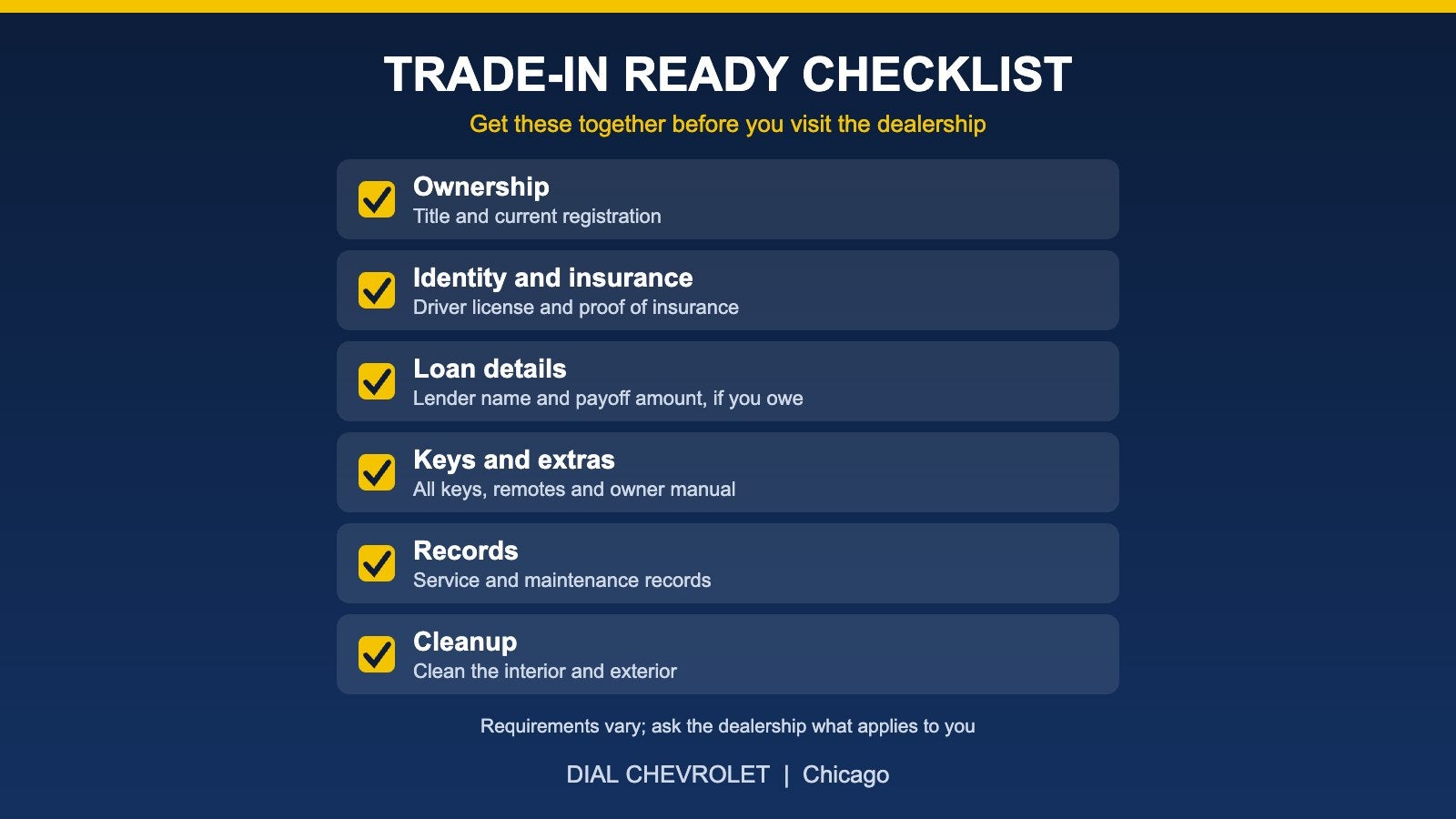
Six-item trade-in ready checklist: ownership, identity and insurance, loan details, keys and extras, records and cleanup

Trade-In Preparation Checklist: What to Do Before You Visit the Dealership

Short answer: before you bring a vehicle in for a trade-in appraisal, gather your paperwork, find out whether you still owe money on it, collect your keys and records, and give it a good cleaning. None of this is complicated, but having it ready makes the visit faster and gives you a clearer picture of where you stand. Gather your paperwork first Requirements can vary by vehicle and by situation, so ask the dealership what it needs for yours. These are the items most people are asked for: The title, if you own the vehicle outright, or the lender’s details if you still have a loan Your current registration A valid driver license Proof of insurance Any service and maintenance records you have kept Know what you owe If you still have a loan, contact your lender and ask for the payoff amount. The payoff is what it would take to close the loan, and it can differ from the balance on your latest statement. Knowing it helps you understand whether your vehicle is worth more than you owe (positive equity) or less (negative equity). If you owe more than the vehicle is worth, that gap does not disappear. It may be rolled into a new purchase, which can raise what you finance. It is worth asking about before you decide, and our team can walk through it with you. Collect keys, remotes and manuals Bring every key and remote you have. A missing second key fob is one of the things an appraiser may note. If you still have the owner’s manual and any accessories that came with the vehicle, bring those too. Pull together your service records Oil changes, tire rotations, brake work and other documented maintenance show that the vehicle was looked after. If you are not sure how often an oil change is due, our guide on how often to change oil in a Chevy explains how the oil life system works. Clean it, but keep repairs in perspective A clean interior and exterior makes a better first impression and lets the appraiser see the vehicle clearly. Remove personal items, clear out the glove box and trunk, and vacuum the seats and floors. Small fixes, such as a burnt-out bulb, can be worth handling. For larger repairs, it is generally smart to ask before spending money, since the cost of a major repair does not always come back in the appraisal. Do your homework on value Check what similar vehicles are listed for in your area Be ready to describe condition honestly, including any warning lights, dents or interior wear Consider getting more than one offer so you can compare What happens at the appraisal An appraiser will typically look over the exterior and interior, check the mileage, review the vehicle’s history and condition, and often take it for a short drive. Having your records and honest notes ready keeps the process smooth. Ready to find out what your vehicle is worth? Start with our trade-in page, browse new Chevrolet inventory or used vehicles, or contact us with questions. If your vehicle is due for service before you trade it in, you can schedule a service appointment. Sources Experian: When should you trade in a car? AAA: Preparing your car for trade-in Cars.com: How should I prep my car for sale to a dealer? Published by Dial Chevrolet, 6603 S Western Ave, Chicago, IL. Trade-in requirements and values vary by vehicle and situation. This guide does not list prices or offers.
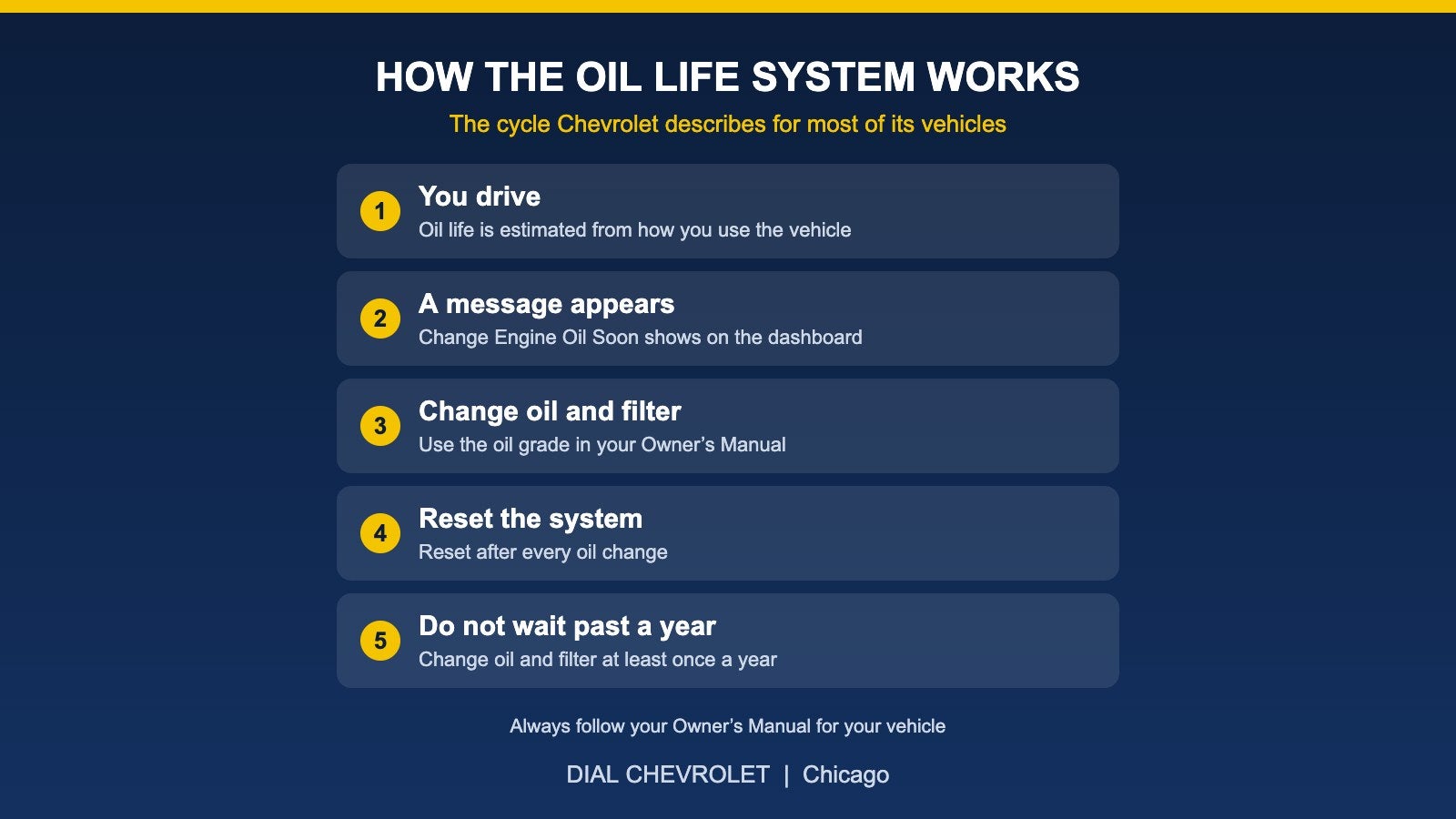
Five-step cycle of the Chevrolet Engine Oil Life System: you drive, a message appears, change oil and filter, reset the system and do not wait past a year

Chevy Oil Change: How Often, and What the Oil Life Monitor Means

Short answer: Chevrolet says most of its vehicles have an Engine Oil Life System that tells you when to change the oil, so the old rule of changing it every 3,000 miles does not apply to many newer vehicles. You should still change the oil and filter at least once a year, and you need to reset the system after every oil change. Always check your Owner’s Manual for the details that apply to your exact vehicle. What the Oil Life System Does Chevrolet describes the Engine Oil Life System as a feature on most of its vehicles. Instead of counting only miles, the system estimates how long your oil will last based on how you use your vehicle. When it is time, a “Change Engine Oil Soon” message appears on your dashboard. When you see it, have the oil and filter changed as soon as you can. Why 3,000 Miles Is Not the Rule for Every Chevy Chevrolet says many older vehicles, including those built before the Oil Life System existed, needed oil changes at 3,000-mile intervals, while newer models can go much longer between changes thanks to advances in engine technology. Your Owner’s Manual gives the interval for your specific vehicle, so treat it as the source of truth. Reset the System After Every Oil Change The system can only track the new oil if it is reset when the oil is changed. If you recently had your oil changed and the message is still showing, the system may not have been reset. Your Owner’s Manual explains how to reset it on your vehicle, and the shop doing your oil change can do it for you. Do Not Skip the Yearly Change Even if you drive gently and the system does not call for service, Chevrolet says the engine oil and filter must be changed at least once a year. Short trips, long periods of parking and Chicago winters can all affect how your vehicle is used, so do not rely on the calendar alone, and do not ignore it either. Check the Oil Level, Too Chevrolet advises checking your engine oil level regularly, even if your vehicle has the Oil Life System. For an accurate reading, the engine should be off and the vehicle on level ground. Your Owner’s Manual explains how to check the level on your vehicle. If you ever see an “Oil Pressure Low/Stop Engine” type of warning, follow the instructions in your Owner’s Manual and contact a service expert. Use the Right Oil The correct oil grade depends on your engine. Check your Owner’s Manual or ask a service advisor so you use the grade your vehicle calls for. Quick Checklist Watch for the “Change Engine Oil Soon” message and act on it promptly. Change the oil and filter at least once a year. Reset the Oil Life System after every oil change. Check the oil level regularly. Use the oil grade listed in your Owner’s Manual. Heading into colder weather? See our Chicago winter prep checklist for your Chevy. Schedule Service With Dial Chevrolet You can schedule an appointment online, browse current service and parts specials on our site, order parts, or contact the Dial Chevrolet team with questions. If it is time to think about a different vehicle, you can also get a trade-in estimate or browse new inventory. Sources Chevrolet Certified Service: Oil Change and Engine Oil Life System Chevrolet Support: Engine Oil Published by Dial Chevrolet, 6603 S Western Ave, Chicago, IL. This guide is general information based on Chevrolet’s published guidance and is not a substitute for your Owner’s Manual. This guide does not list prices or offers.
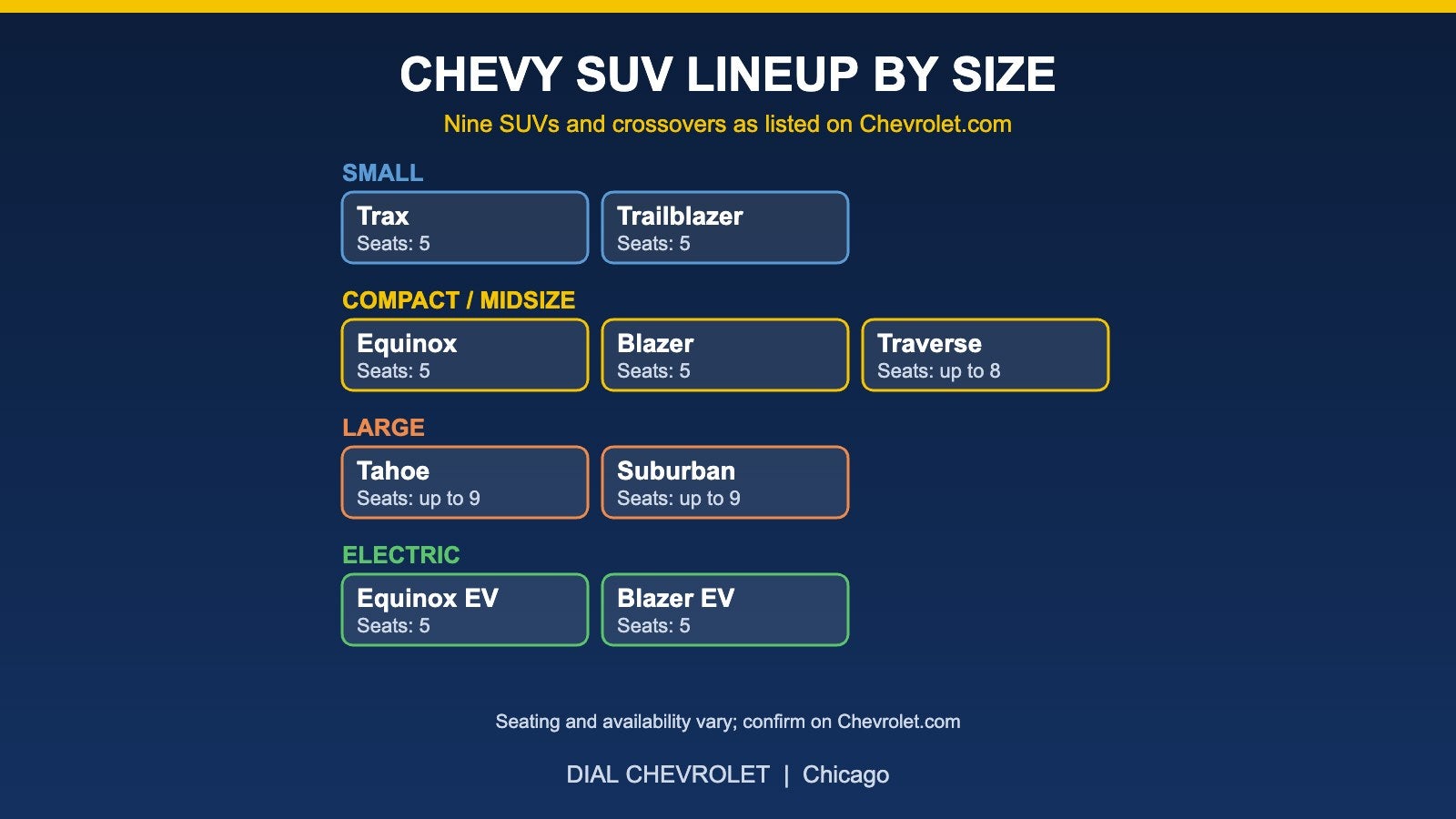
Chevrolet SUV lineup grouped by size: small, compact and midsize, large and electric, with seating as listed on Chevrolet.com

Chevy SUV Buying Guide: Which Chevrolet SUV Fits Your Family?

Short answer: Chevrolet’s SUV page lists nine SUVs and crossovers, from the small Trax to the large Tahoe and Suburban, plus two electric models. The best one for you depends mostly on how many people you carry, how much you haul and where you park. This guide groups the lineup by size and explains what to think about at each step, using what Chevrolet lists on its website. Availability, trims and features change, so confirm details on the exact vehicle you are considering. The Lineup by Size Small: Chevrolet lists the Trax and the Trailblazer, both with seating for five. Compact and midsize: the Equinox and Blazer seat five, and the Traverse offers seating for up to eight with optional third-row seating. Large: the Tahoe and Suburban each offer seating for up to nine, and Chevrolet describes the Suburban as the largest SUV in its lineup. Electric: Chevrolet lists the Equinox EV and Blazer EV, both with seating for five. Start With People and Cargo Count the people you carry every week, not just on holidays. If it is usually four or five, the small and compact models may be enough. If you need a third row regularly, look at the Traverse, Tahoe or Suburban. Then think about cargo: strollers, sports gear, luggage and pets all take space, and that space changes with the seating setup. For a closer look at the two largest models, read our comparison of the Suburban and Tahoe and our guide to 2027 Suburban trims, engines and cargo space. Think About Where You Park A larger SUV can be harder to fit in a garage, an alley space or a tight street spot. Measure your regular parking spots, and bring that measurement when you visit. Gas or Electric Chevrolet lists the Equinox EV and Blazer EV as electric options. Charging at home, your daily mileage and cold-weather driving all matter for an electric SUV. We will cover those topics separately; for now, talk through your own routine with the team before you decide. Towing and Hauling If you tow a trailer, check the rating for the specific model and configuration you are considering, and do not assume that a bigger SUV tows more. Ratings vary by model, engine and equipment. A Simple Way to Decide Write down how many people ride with you most weeks. List the largest items you carry regularly. Note any trailer you tow and how heavy it is. Measure your regular parking space. Pick the smallest size that covers items 1 to 4, then compare two or three models in person. See Them in Person You can browse new Chevrolet inventory, browse used vehicles, get a trade-in estimate for your current vehicle, or contact the Dial Chevrolet team to ask what is on the lot and to arrange a time to look. If you already drive a Chevy, you can schedule service online. Sources Chevrolet SUVs on Chevrolet.com Published by Dial Chevrolet, 6603 S Western Ave, Chicago, IL. The lineup is as listed on Chevrolet.com at the time of writing and may change. This guide does not list prices or offers.
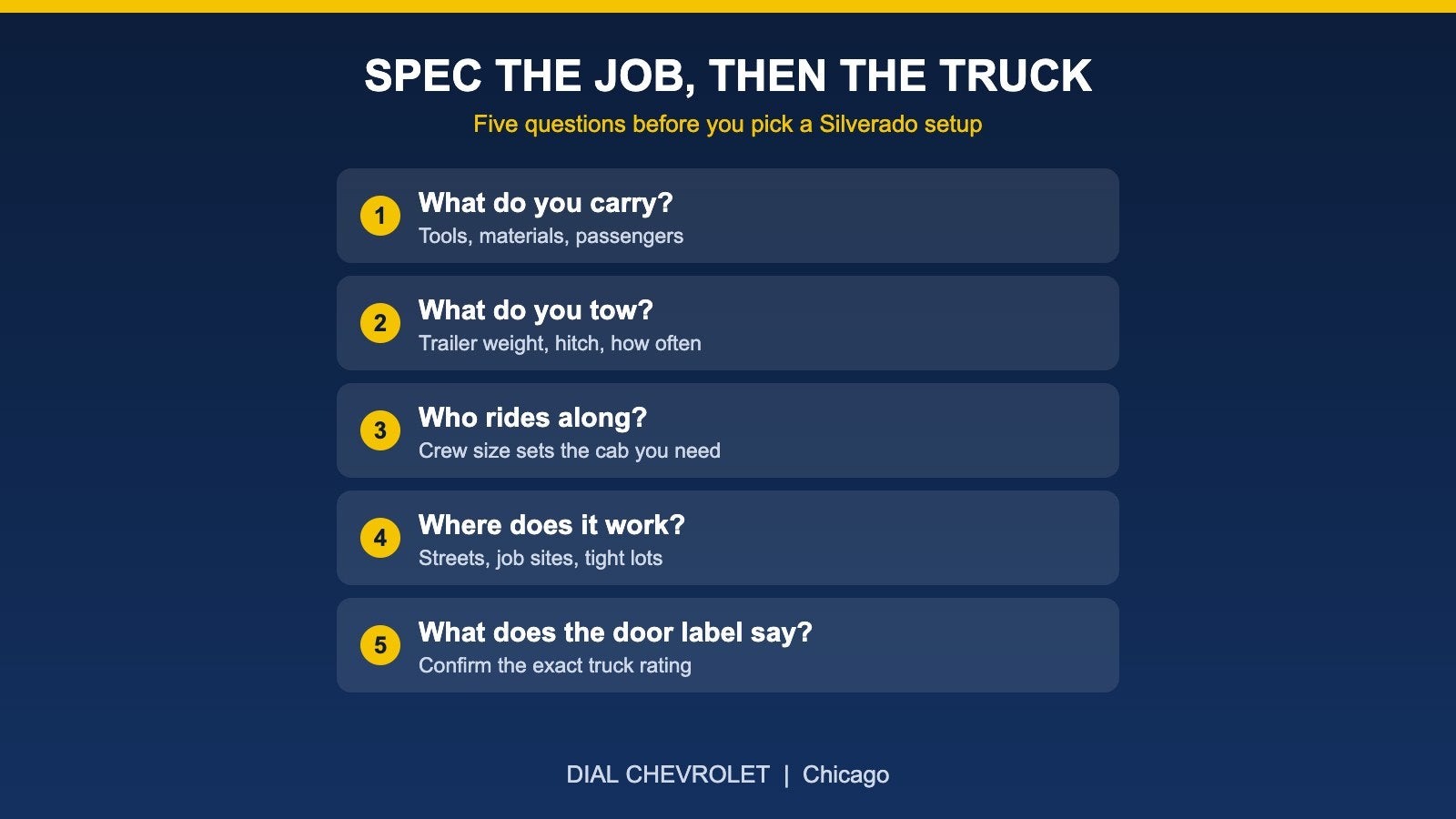
Five questions to answer before choosing a Silverado work truck setup: what you carry, tow, who rides along, where it works and what the door label says

Choosing a Silverado Work Truck Setup for Your Chicago Business

Short answer: The right Silverado work truck setup starts with the job, not the trim. Decide what you carry, what you tow, how many people ride along and where the truck works, then match those needs to the truck’s actual ratings. This guide gives Chicago business owners a simple way to do that, using what Chevrolet publishes for the 2027 Silverado 1500. For the exact capability of any specific truck, always check that truck’s own label and paperwork. Start With the Job Write down the heaviest, most common load you carry and the heaviest trailer you tow. Be honest about both. A truck that is only just able to do your hardest day will struggle on a typical one, and a truck rated far beyond your needs may cost more to buy and run than you need to spend. What Chevrolet Publishes for the 2027 Silverado 1500 Work-focused trim: Chevrolet describes the WT as the workhorse trim, listing an enhanced TurboMax engine with a 10-speed transmission and an available Duramax 3.0L Turbo-Diesel. Payload by engine: Chevrolet lists maximum payload from 1,510 pounds with the 6.6L V8 to 2,340 pounds with the TurboMax engine. Towing: Chevrolet lists maximum towing up to 13,700 pounds with the 5.7L V8. Length: Chevrolet says overall length depends on the cab and bed configuration, with a range of 212.1 to 242.5 inches. Bed features by trim: Chevrolet mentions bed-mounted power outlets and an EZ lift and lower tailgate on the Custom, a Multi-Flex Tailgate on the ZR2 and a power up/down tailgate on the High Country. These are maximums for specific engine and equipment combinations, so a given truck will usually be rated lower. Our guides to how payload works and 2027 Silverado 1500 towing and payload by engine explain how to read them. Five Questions to Answer What do you carry? Add up tools, materials and passengers. Payload covers everything you put in the truck, including people. What do you tow? Know your trailer weight and how often you tow it. Who rides along? Your crew size helps decide how much cab you need. Chevrolet’s 2027 Silverado 1500 page does not name specific cab styles or bed lengths, so confirm those options on the vehicle you are considering. Where does it work? City streets, tight lots and parking garages favor a size you can maneuver and park. Job sites may favor other priorities. What does the label say? The sticker on the driver’s door frame shows the payload for that exact truck. When a Half-Ton Is Not Enough If your heaviest loads or trailers push past what a half-ton can do, look at the heavy-duty trucks. Our Silverado 1500 vs. 2500HD comparison explains how the classes differ and what Chevrolet publishes for each. Talk to the Dial Chevrolet Team Bring your list of loads, trailers and crew size, and ask the team what is available. You can contact Dial Chevrolet, browse new Chevrolet inventory, browse used vehicles or get a trade-in estimate for the vehicle you drive now. To keep your work vehicles running, you can schedule service online. This guide does not cover fleet programs or pricing, so ask the dealership about any business program directly. Sources Chevrolet Silverado 1500 on Chevrolet.com Published by Dial Chevrolet, 6603 S Western Ave, Chicago, IL. Figures are from Chevrolet.com at the time of writing and may change. This guide does not list prices or offers.
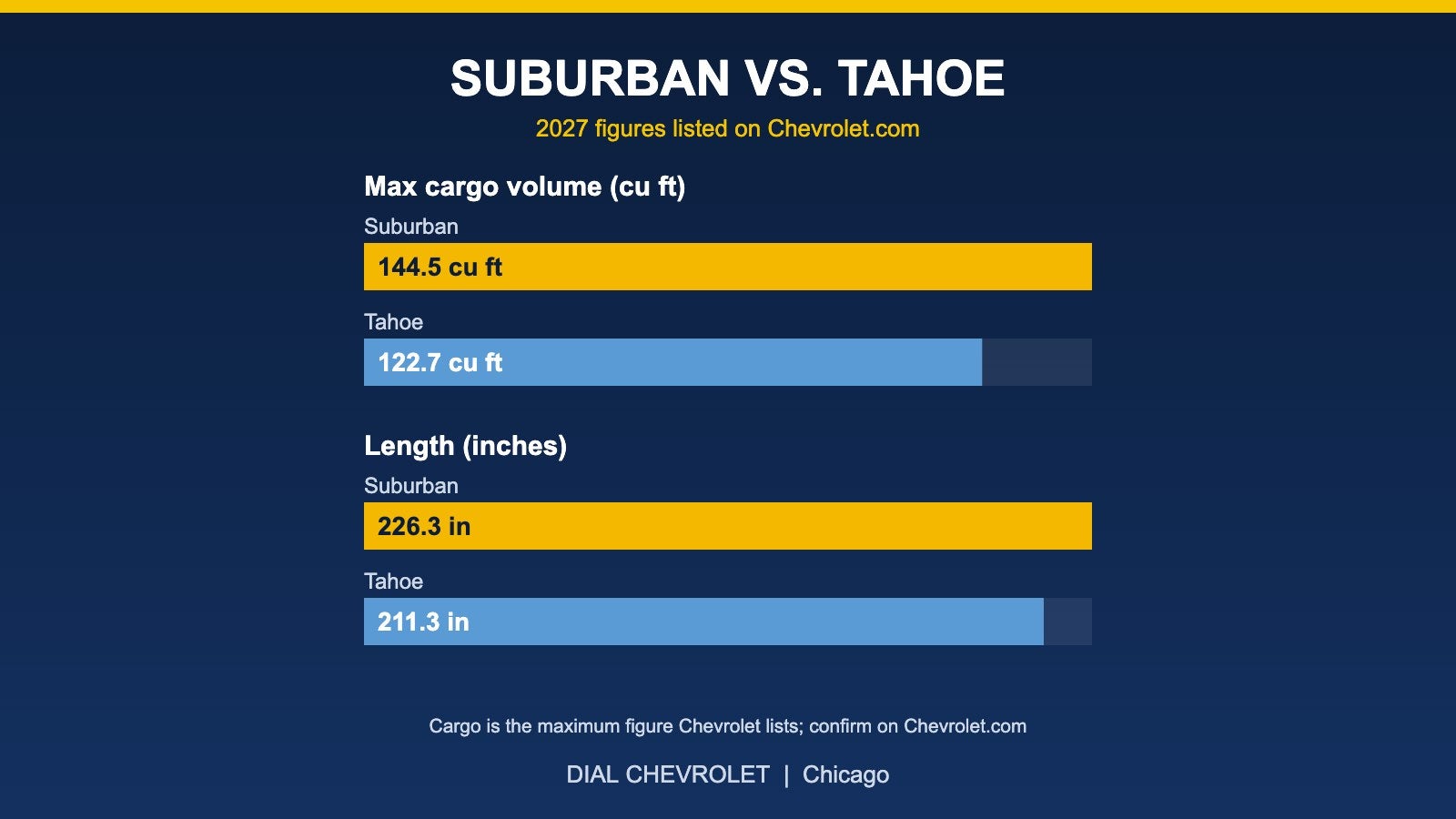
Bar chart comparing Suburban and Tahoe maximum cargo volume and length using 2027 figures listed on Chevrolet.com

Suburban vs. Tahoe: Which Full-Size Chevy SUV Fits Your Life?

Short answer: The Suburban and Tahoe are built on the same full-size SUV idea, and Chevrolet lists the same engine choices for both. The Suburban is the longer one with more maximum cargo room; the Tahoe is the shorter one. If you regularly carry people and cargo together, or need to haul luggage with every seat in use, the extra length can matter. If you park in tight Chicago spaces most days, the shorter Tahoe may suit you better. Here is how Chevrolet’s 2027 numbers compare and how to decide. Size: The Biggest Difference Length: Chevrolet lists the 2027 Suburban at 226.3 inches and the Tahoe at 211.3 inches, a difference of 15 inches. Maximum cargo volume: Chevrolet lists 144.5 cubic feet for the Suburban and 122.7 cubic feet for the Tahoe, so the Suburban offers about 21.8 cubic feet more at its maximum. Those cargo numbers are maximums with seats folded. What matters day to day is how much space you have behind the last row you actually use, and that depends on the seating setup. Our guide to 2027 Suburban trims, engines and cargo space breaks cargo down by row. Seating Chevrolet lists eight seats as standard on both vehicles, with seven- and nine-seat configurations also available. Seating options can vary by trim, so confirm what is offered on the specific vehicle you are considering. Engines Chevrolet lists the same three engines for both: a 5.3L EcoTec3 V8 (355 horsepower, 383 lb-ft), a 6.2L EcoTec3 V8 (420 horsepower, 460 lb-ft) that is standard on High Country, and an available 3.0L Duramax Turbo-Diesel (305 horsepower, 495 lb-ft). Which engines come on which trim, and which are available, varies, so check the trim you want. Towing Chevrolet lists maximum towing of 8,400 pounds for the Tahoe. Chevrolet’s Suburban page shows more than one figure, 8,400 and 8,200 pounds in different sections, so do not rely on a single headline number. Real towing capacity depends on the configuration, equipment and what is in the vehicle, so always check the specific vehicle’s rating before you tow. Which One Fits You? Choose the Suburban if you want the most cargo room, regularly carry a full load of passengers plus luggage, or take long family trips. Choose the Tahoe if you want a full-size SUV that is easier to park and fit in a garage, and you can live with less maximum cargo space. Either way, measure your garage or parking space and think about the largest load you carry most often. Check It In Person Numbers on a screen only go so far. You can browse new Chevrolet inventory, browse used vehicles, get a trade-in estimate, or contact the Dial Chevrolet team to ask what is available and to see both vehicles side by side. If you already own a Chevy, you can schedule service online. Sources Chevrolet Suburban on Chevrolet.com Chevrolet Tahoe on Chevrolet.com Published by Dial Chevrolet, 6603 S Western Ave, Chicago, IL. Figures are from Chevrolet.com at the time of writing and may change. Availability varies by vehicle. This guide does not list prices or offers.
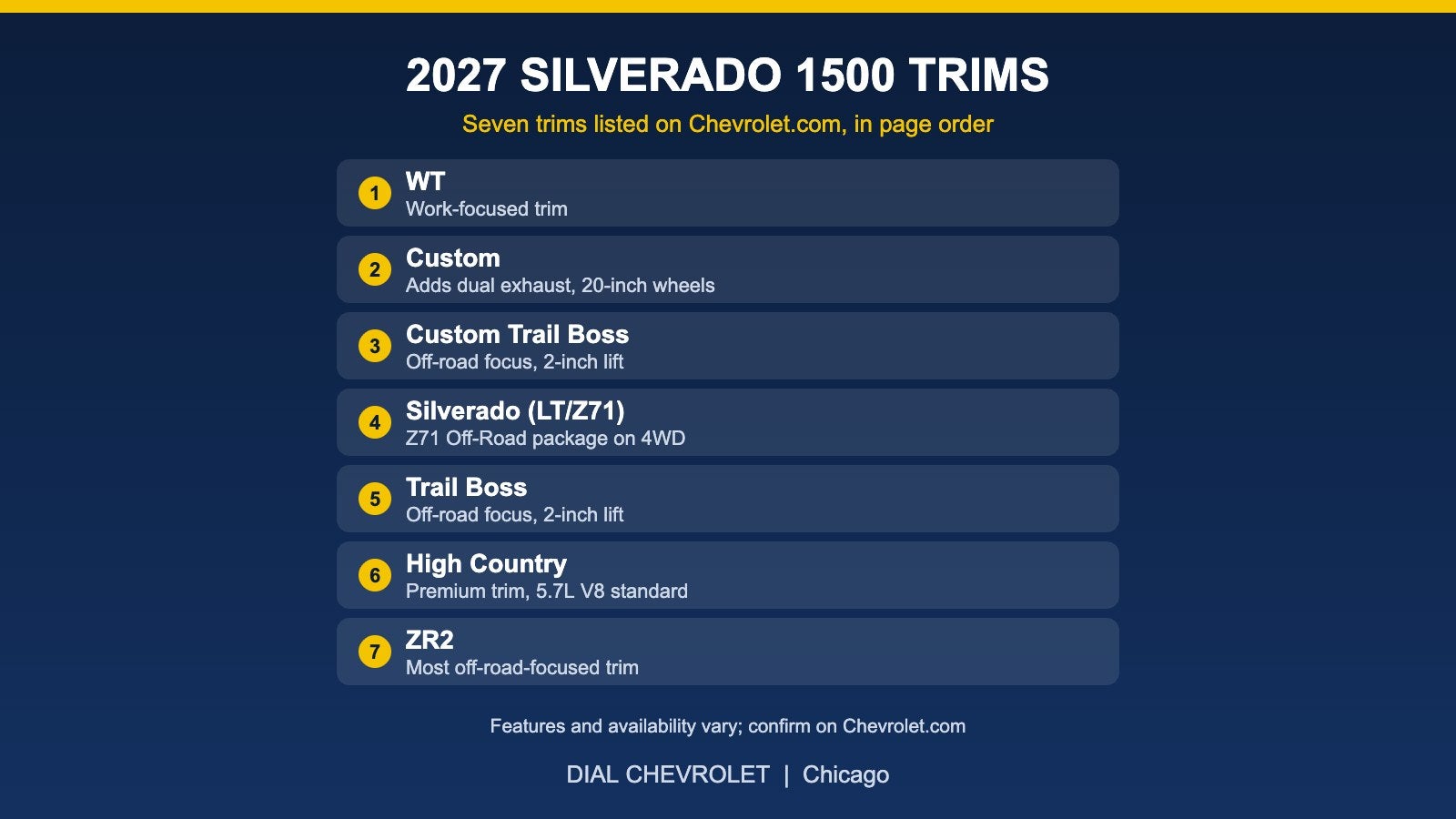
List of the seven 2027 Silverado 1500 trims shown on Chevrolet.com, from WT to ZR2, with a short description of each

2027 Silverado 1500 Trim Levels Explained: WT to High Country and ZR2

Short answer: Chevrolet’s 2027 Silverado 1500 website lists seven trims: WT, Custom, Custom Trail Boss, Silverado (listed as LT/Z71), Trail Boss, High Country and ZR2. They cover work, everyday, off-road and premium use. This guide walks through each one using what Chevrolet publishes, so you can narrow down which trim to look at before you visit. Features, engines and availability can change, so confirm the details on the exact truck you are considering. A Note on Model Year The 2027 Silverado 1500 is a redesigned truck, and the images on Chevrolet’s site are preproduction. Some trim names you may remember from earlier model years, such as RST and LTZ, are not shown on Chevrolet’s 2027 page, so do not assume they carry over. If you are shopping a 2026 or earlier truck, the trim lineup can be different, and you should check that truck’s own information. 1. WT The WT is the work-focused trim. Chevrolet lists it with an enhanced TurboMax engine and a 10-speed transmission, with an available Duramax 3.0L Turbo-Diesel. It fits buyers who want a capable truck for work and straightforward daily use. 2. Custom Chevrolet lists the Custom with 20-inch Technical Gray machine-faced wheels, dual exhaust and an EZ lift and lower tailgate. It adds style and convenience features over the base work trim. 3. Custom Trail Boss This is an off-road-oriented version of the Custom. Chevrolet lists 34-inch mud-terrain tires, a 2-inch lift, skid plates and a two-speed transfer case. 4. Silverado (LT/Z71) Chevrolet labels this trim “Silverado” with “LT/Z71” beside it. It lists the Z71 Off-Road package as standard on 4WD models, plus heated front seats and a heated steering wheel. This is a common choice for buyers who want more comfort features and some off-road capability. 5. Trail Boss Chevrolet lists the Trail Boss with 18-inch aluminum wheels, 34-inch mud-terrain tires, a 2-inch lift and front bucket seats. It is aimed at drivers who want an off-road-focused truck with more interior features than the Custom Trail Boss. 6. High Country The High Country is the premium trim. Chevrolet lists the 5.7L V8 as standard, along with 22-inch wheels, a panoramic sunroof, and Super Cruise with trailering. It fits buyers who want the most comfort and technology. 7. ZR2 The ZR2 is the most off-road-focused trim. Chevrolet lists 35-inch mud-terrain tires, a 2-inch factory lift and an available 6.6L V8. How to Choose a Trim Mostly work or fleet use: start with the WT and compare it to the Custom. Daily driving with comfort features: look at the Silverado (LT/Z71). Off-road use: compare the Custom Trail Boss, Trail Boss and ZR2, and decide how much capability you actually need. Maximum comfort and technology: look at the High Country. Heavy towing: do not choose by trim alone. Towing and payload depend on engine, cab, bed, drivetrain and equipment together. To understand the numbers, read our guides to 2027 Silverado 1500 towing and payload by engine and how payload works. If you are not sure whether a half-ton fits your work, see Silverado 1500 vs. 2500HD. See Silverados in Person You can browse new Chevrolet inventory, browse used vehicles, get a trade-in estimate, or contact the Dial Chevrolet team to ask about trims and availability. For service on the truck you drive now, you can schedule an appointment online. Sources Chevrolet Silverado 1500 on Chevrolet.com Published by Dial Chevrolet, 6603 S Western Ave, Chicago, IL. Trim details are from Chevrolet.com at the time of writing and may change; preproduction models are shown and production models may vary. This guide does not list prices or offers.
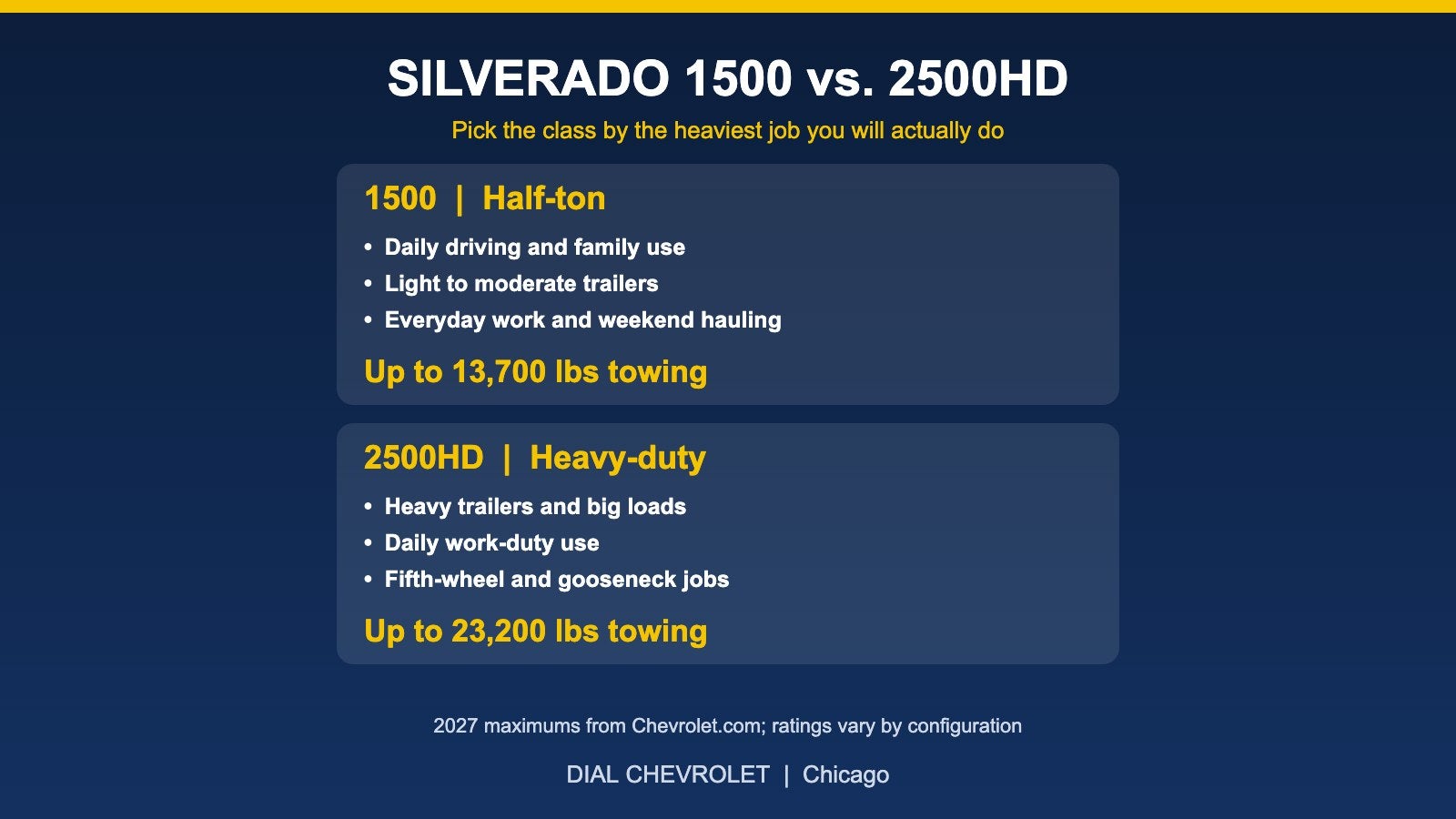
Comparison of the Silverado 1500 half-ton and 2500HD heavy-duty classes with 2027 maximum towing figures from Chevrolet.com

Silverado 1500 vs. 2500HD: Which Truck Do You Actually Need?

Short answer: choose the Silverado 1500 if the heaviest thing you regularly do is daily driving, family trips, a boat or a moderate trailer, and consider the Silverado 2500HD if you regularly pull heavy trailers, haul heavy loads for work, or use fifth-wheel or gooseneck hitches. The right answer comes from the heaviest job you will actually do with the truck, not from the biggest number on a brochure. This guide explains the difference between the two classes, what Chevrolet has published for the 2027 model year, and how to decide. What “Half-Ton” and “Heavy-Duty” Mean The Silverado 1500 is Chevrolet’s half-ton full-size pickup. The Silverado 2500HD is a heavy-duty truck built for bigger towing and hauling work, and the Silverado 3500HD sits above it. Heavy-duty trucks are designed around work, so they come with different engines, axles, frames and suspension. Names like “half-ton” no longer describe exact payload, so treat them as class labels rather than numbers. What Chevrolet Has Published for 2027 Silverado 1500: Chevrolet lists a maximum towing figure of 13,700 pounds tied to the available 5.7L V8, and a maximum payload figure of 2,340 pounds tied to the TurboMax engine. These are two different engines, so no single 1500 achieves both maximums at once. Silverado 2500HD: Chevrolet states that it offers up to 23,200 pounds of towing, and that the 3500HD offers up to 38,000 pounds. Chevrolet notes that actual capacity varies by model, configuration, powertrain and equipment. HD powertrains: the 2027 Silverado HD is offered with a 6.6L gas V8 and an available Duramax 8.3L Turbo-Diesel V8. Treat these as upper limits for specific builds, not as what every truck can do. Our guide to 2027 Silverado 1500 towing and payload by engine explains how to read the 1500 numbers. When the 1500 Is the Better Fit You use the truck as a daily driver, a family vehicle or a commuter. Your trailer is a boat, a utility trailer, a camper or equipment in the light-to-moderate range. You want easier parking, a more car-like ride and a smaller turning circle in the city. Your heaviest regular load fits comfortably within the payload on the truck’s door-jamb label. When the 2500HD Is Worth Considering You tow heavy trailers often, not just once or twice a year. You carry heavy bed loads such as a slide-in camper, equipment or tools. You need a fifth-wheel or gooseneck hitch. You use the truck for work every day and want a platform designed for that duty. Trade-Offs to Weigh Honestly Size. Heavy-duty trucks are larger, which matters in Chicago garages, alleys and tight street parking. Ride. A heavy-duty truck is built for load, and it can ride firmer when it is empty. Fuel and running costs. Larger engines, tires and parts can change what the truck costs to run and maintain. Everyday comfort. If you only tow heavy a few times a year, a properly equipped 1500 may be enough, and renting or hiring for the rare big job may be a better fit than owning more truck than you need. A Simple Way to Decide Write down the heaviest trailer you will tow and how often. Write down the heaviest load you will carry in the bed and cab, including passengers and gear. Check the ratings for the exact configuration you are considering on the truck’s label, not only in an ad. Our payload guide shows where to find them. Leave a safety margin rather than loading to the limit. Test drive both on roads you actually use. If you are also weighing a Silverado against another brand, see our guide to comparing the Silverado 1500 and Ford F-150 fairly. Talk to the Dial Chevrolet Team If you are not sure which class fits your work, you can contact the Dial Chevrolet team, browse new Chevrolet inventory, browse used vehicles, or get a trade-in estimate. For service, you can schedule an appointment online. Sources Chevrolet Silverado 1500 on Chevrolet.com Chevrolet Silverado HD on Chevrolet.com Published by Dial Chevrolet, 6603 S Western Ave, Chicago, IL. Figures are manufacturer-published maximums for the 2027 model year at the time of writing and depend on configuration; production models and availability may vary. Always confirm ratings for the exact vehicle you are considering.

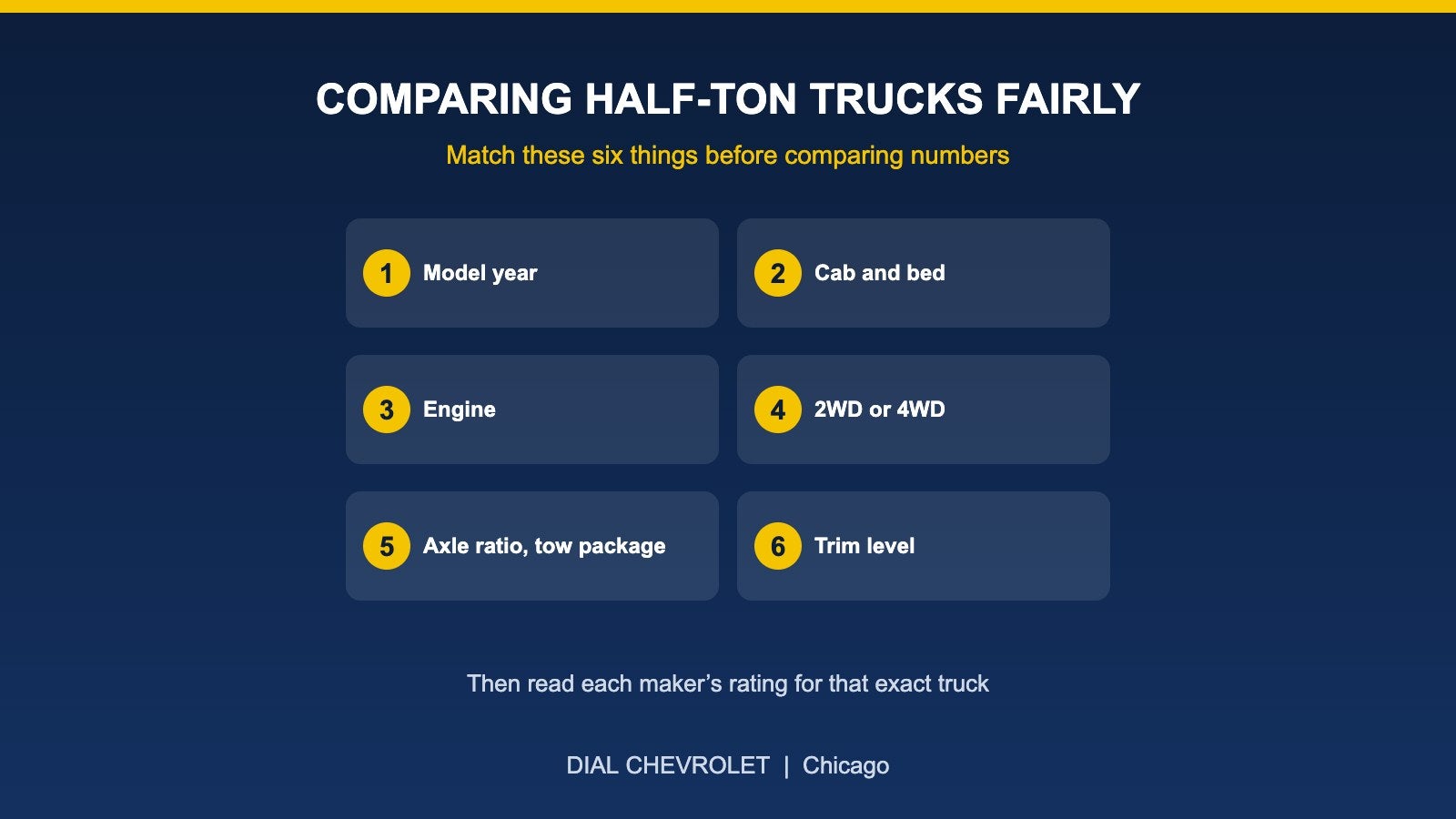
Six-item checklist for comparing half-ton trucks fairly: model year, cab and bed, engine, drivetrain, axle ratio and tow package, trim

Silverado 1500 vs. Ford F-150: How to Compare Them Fairly

Short answer: the Chevrolet Silverado 1500 and the Ford F-150 are both capable full-size pickups, and the fair way to compare them is to line up the same model year, cab, bed, engine, drivetrain and tow package before you look at any towing or payload number. A headline figure for one truck is almost never the figure for the truck you would actually buy. This guide explains what to match, what to read from each manufacturer, and what to check in person. We are a Chevrolet dealership, so we will say plainly where you should confirm Ford’s details with Ford. 1. Start With the Model Year Model year matters more than usual right now. Chevrolet has announced a redesigned 2027 Silverado with new engine choices, while the F-150 is carried into 2027 without a full redesign. Comparing a 2027 Silverado to a 2025 or 2026 F-150, or the reverse, means you are comparing two different generations of engineering. Decide which model year you are shopping, then compare trucks from that same year. If you are weighing a new 2027 against a 2026 truck, treat that as a separate question about timing and available inventory. 2. Match the Cab and Bed Both brands sell regular, extended and four-door crew cab body styles, with several bed lengths. Cab and bed change payload, towing, turning radius and parking. A crew cab with a short bed is a different truck from a regular cab with a long bed, even inside the same model line. Pick the cab and bed you need, then compare only trucks built that way. 3. Match the Engine Each brand offers a range of engines, and Ford also offers hybrid powertrains in the F-150. Rather than comparing engine names, compare what you will use the truck for: daily commuting, trailer towing, work loads or a mix. Compare fuel economy figures from the EPA estimates for each exact configuration, and remember that your real-world numbers will change with load, weather and driving style. 4. Match 2WD and 4WD Four-wheel drive adds weight and can change both payload and tow ratings. For Chicago winters many buyers want 4WD, so compare 4WD trucks against 4WD trucks. 5. Read Tow and Payload Ratings for the Exact Configuration Maximum ratings are tied to specific builds. Each maker’s top towing number usually requires a particular engine, axle, cab, bed and tow package together. Payload is set by the individual truck. The yellow label on the driver’s door frame shows the real payload for that vehicle, and it drops as you add passengers, gear and accessories. Use each manufacturer’s own towing guide. Do not mix numbers from a Chevrolet page with numbers from a Ford ad. Use Chevrolet’s published ratings for the Silverado and Ford’s published ratings for the F-150, both for the same type of build. Our guides on how payload works and 2027 Silverado towing and payload by engine explain how to read these numbers. 6. Compare Trim Levels, Not Just Trucks Both brands run a ladder from basic work trims to luxury trims, plus off-road versions. Compare a work-oriented trim with a work-oriented trim and a premium trim with a premium trim. Trim names do not line up one-to-one between brands, so compare the features you actually want: seating, driver-assistance features, towing technology, bed features and cabin materials. What to Check In Person Visibility from the driver’s seat and how the mirrors work when towing Ease of getting in and out, and how the rear seat feels in a crew cab Infotainment and phone connection, using your own phone Bed access, tailgate features and tie-down locations How the truck feels on a rough city street, not just a smooth road Whether the truck fits your garage or parking spot A Fair Way to Decide Choose the model year, cab, bed and drivetrain you need. Write down the heaviest trailer and the heaviest load you will realistically carry. Find each manufacturer’s rating for that exact configuration. Drive both trucks back to back on the same route. Compare ownership factors such as warranty coverage, maintenance and service access. See a Silverado in Person If you want to see how a Silverado 1500 compares to the truck you are considering, you can browse new Chevrolet inventory, browse used vehicles, get a trade-in estimate, or contact the Dial Chevrolet team to arrange a test drive. If you plan to haul or tow, our service team can help keep your truck ready: schedule service. Sources Chevrolet Silverado 1500 on Chevrolet.com Edmunds: 2027 Silverado, F-150 and Tundra half-ton comparison Published by Dial Chevrolet, 6603 S Western Ave, Chicago, IL. This is general educational guidance, not a claim that one truck is better for every buyer. Specifications and availability vary by model year and configuration; confirm details with each manufacturer. Ford and F-150 are trademarks of Ford Motor Company.

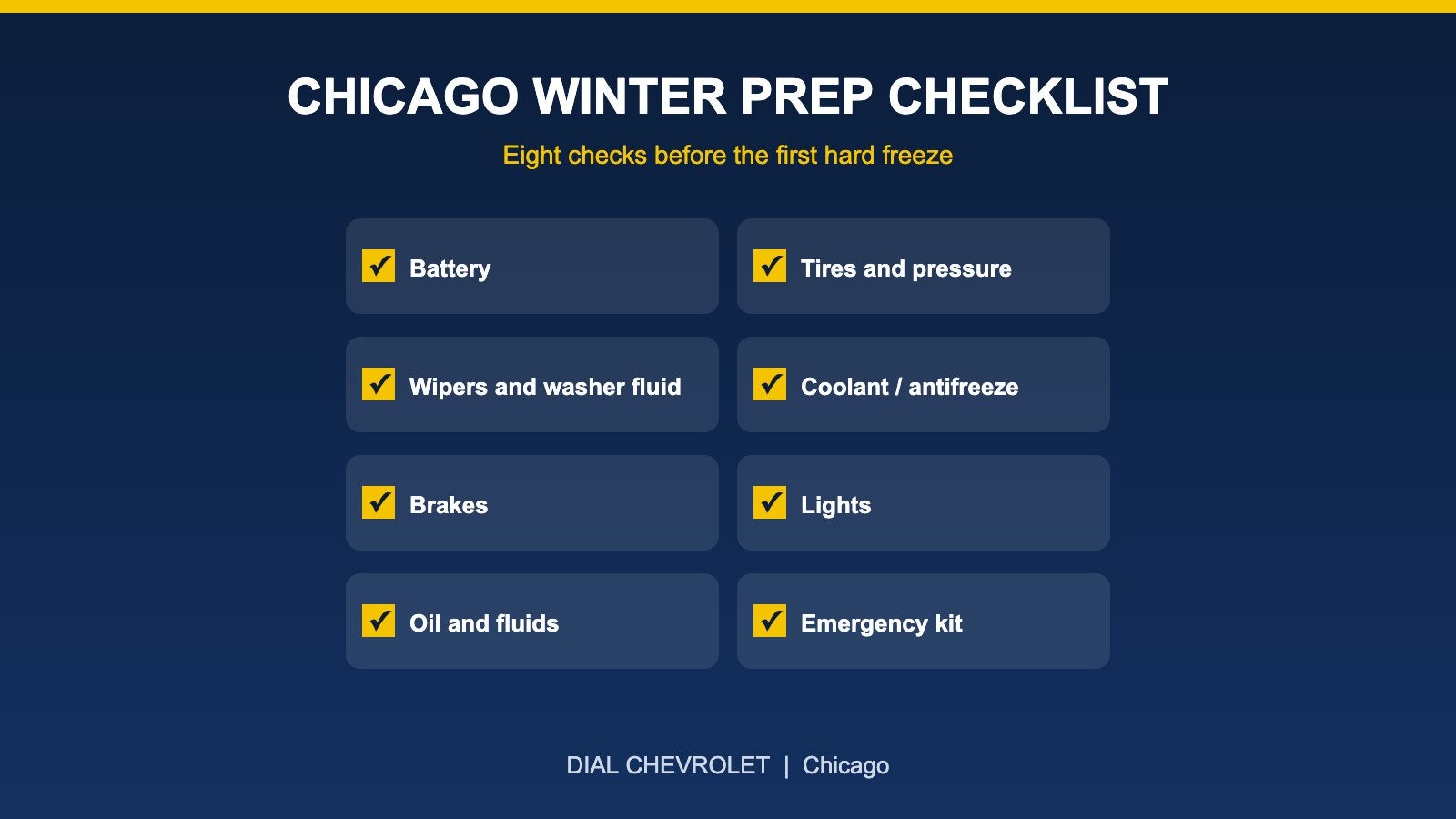
Eight-item Chicago winter prep checklist for a Chevy: battery, tires, wipers, coolant, brakes, lights, fluids and emergency kit

Getting Your Chevy Ready for a Chicago Winter: A Practical Checklist

Short answer: the best time to get your Chevy ready for winter is before the first hard freeze, and most of the work comes down to eight checks: battery, tires, wipers and washer fluid, coolant, brakes, lights, oil and other fluids, and an emergency kit. Chicago winters combine deep cold, road salt, snow and potholes, so small problems that go unnoticed in October tend to show up as no-starts and slick-road surprises in January. This checklist explains what to look at, what to ask your service department about, and what you can do yourself in a few minutes. 1. Battery Cold weather reduces what a battery can deliver at the same moment the engine needs more power to start. Slow cranking, dimming lights at idle and a battery that is several years old are all reasons to have it tested before winter, not after a morning when the truck will not start. Ask your service department to test the battery and charging system. 2. Tires and Tire Pressure Pressure. Tire pressure drops as temperatures fall, so check it regularly. Use the pressure listed on the label in the driver’s door frame or in your owner’s manual, not the number printed on the tire sidewall. Tread. Worn tread loses grip on snow and slush. If the tread is low, replace tires before the weather turns. Tire type. If you drive in deep snow often, ask about winter or all-weather tire options for your vehicle. 3. Wipers and Washer Fluid Streaky or cracked wiper blades are hard to see through in slush and road spray. Replace worn blades and fill the reservoir with washer fluid rated for freezing temperatures. 4. Coolant Coolant protects the engine from freezing as well as overheating. Your owner’s manual lists the correct type and service interval, and a technician can check the condition and freeze protection of what is in your system. 5. Brakes Snow, slush and road salt are hard on brakes. Pulsing, grinding, squealing or a longer stopping distance are signs to have them inspected before you rely on them in bad weather. 6. Lights Winter means more driving in the dark. Check headlights, tail lights, brake lights and turn signals, and keep the lenses clean of road film and snow. 7. Oil and Other Fluids Follow the oil change schedule in your owner’s manual and the oil life monitor if your Chevy has one. Cold starts are harder on an engine that is overdue for service. This is also a good time to confirm that other fluids are at the right level. 8. Emergency Kit Jumper cables or a portable jump starter Ice scraper and snow brush Flashlight with fresh batteries Warm blanket, gloves and a hat Small shovel Phone charger Something for traction, such as sand or cat litter Protecting Against Road Salt Road salt can speed up corrosion on the underbody, brake lines and other metal parts. Washing your vehicle regularly during the winter, including the underside, helps remove salt buildup. Ask your service department about inspecting for early signs of corrosion. A Few Habits That Help All Winter Keep the fuel tank reasonably full. Allow extra following distance on snow and ice. Check tire pressure after big temperature swings. Watch for warning lights and do not ignore them. Schedule Winter Service If you would like a technician to look over your Chevy before the cold hits, you can schedule service online. You can also see the dealership’s current service and parts specials, order parts, or contact the Dial Chevrolet team with questions. If you tow a trailer, our guide to Silverado payload explains how to check your load before you head out. Published by Dial Chevrolet, 6603 S Western Ave, Chicago, IL. This is general guidance. For your vehicle’s exact service intervals and fluid specifications, check your owner’s manual.

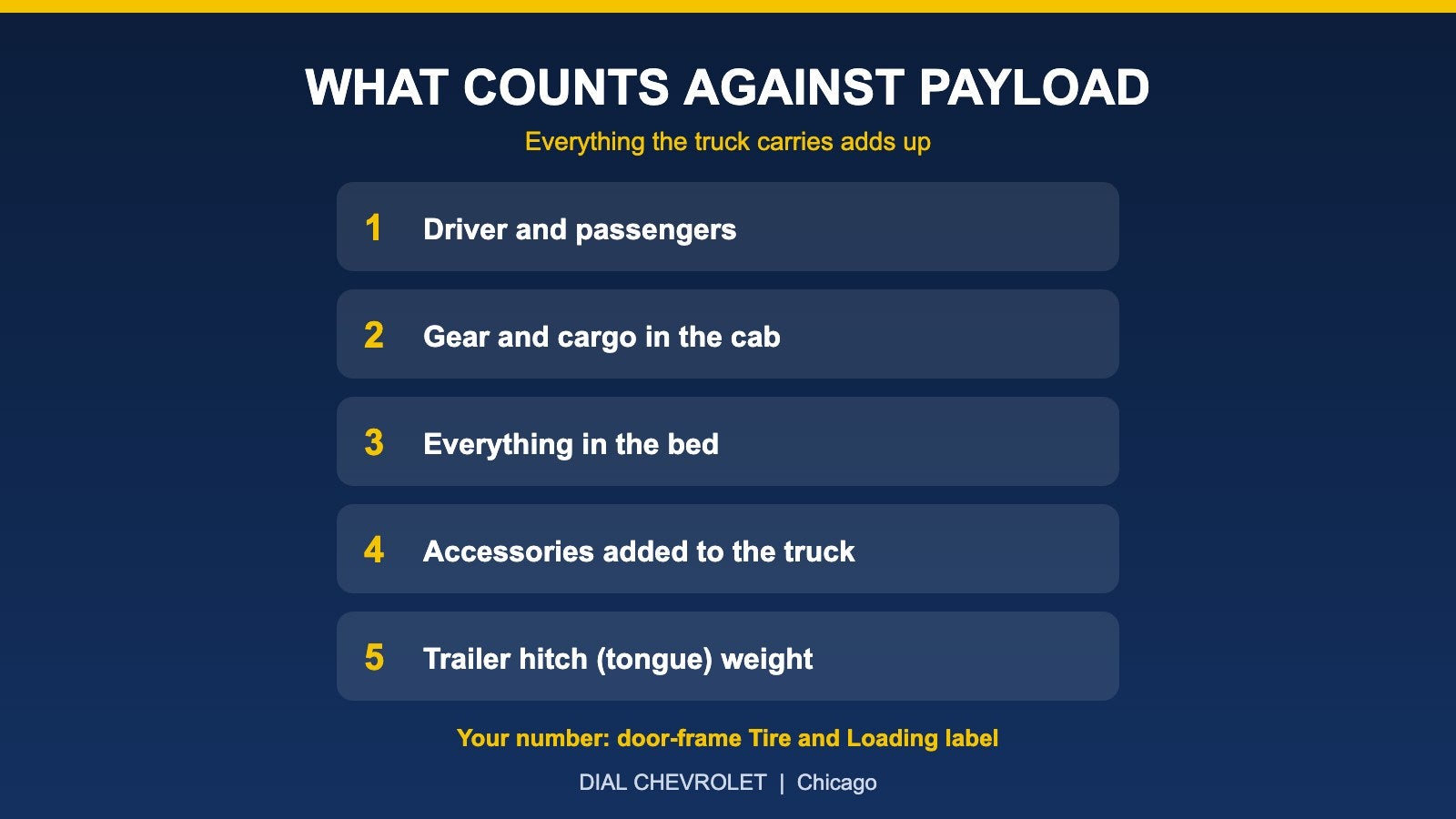
List of five things that count against a Silverado's payload, from passengers to trailer tongue weight

Silverado Payload Explained: How to Find Your Truck's Real Number

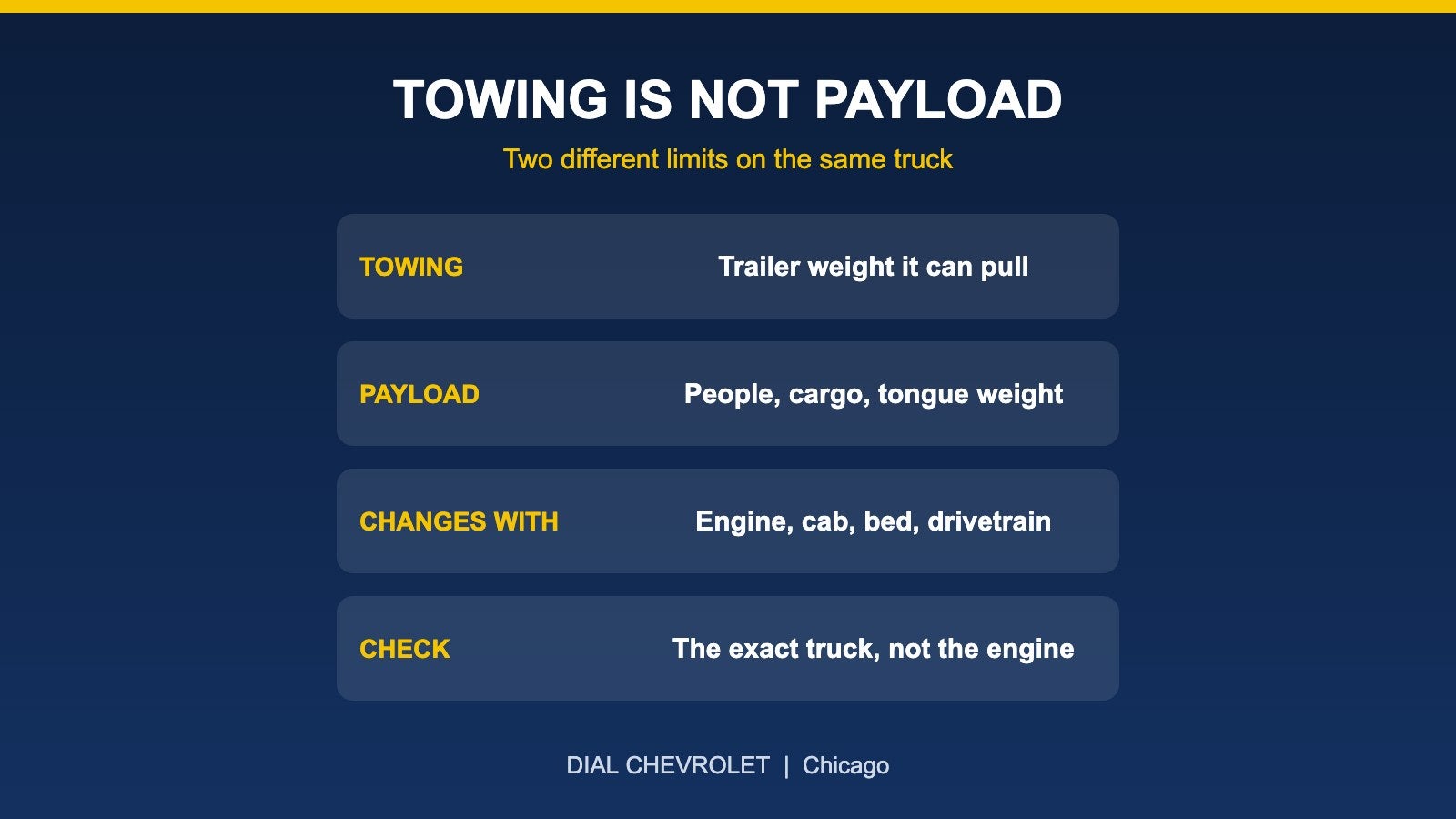
Short answer: payload is the total weight your Silverado can carry in the cab and bed, and the number that applies to your truck is printed on the truck itself, not in an ad. Every cab, bed, engine, drivetrain and option package changes it, so the headline maximum you see online almost never matches the exact truck in your driveway. This guide explains what payload really includes, where to find your own number, and how to avoid the most common mistake, which is forgetting how much weight a trailer puts on the hitch. What Payload Means Payload is the maximum weight a truck is designed to carry. It includes every passenger, every piece of gear in the cab, everything in the bed, and the downward weight of a trailer on the hitch. In simple terms, it is the gross vehicle weight rating (GVWR) minus the weight of the empty truck. Because options and accessories make the empty truck heavier, adding them lowers the payload you have left. Payload Is Not the Same as Towing Capacity Towing capacity is how much trailer the truck can pull. Payload is how much weight the truck can carry on its own frame. A truck can have a high towing number and a modest payload, or the reverse. If you are new to the difference, our guide to 2027 Silverado 1500 towing and payload by engine walks through how GM publishes both numbers. Where To Find Your Truck’s Real Payload The driver’s door frame label. Look for the Tire and Loading Information label. It states the combined weight of occupants and cargo that the vehicle should not exceed. The owner’s manual. The loading and trailering sections explain weight ratings and how to calculate what you can carry. Your Chevrolet dealer. Ask about the specific truck, including cab, bed length, drivetrain, engine and installed options. Why The Maximum Payload In An Ad Is Not Your Number Chevrolet publishes a maximum payload for each engine, but each maximum belongs to one specific configuration. A regular cab with a standard bed and two-wheel drive is lighter than a crew cab with four-wheel drive, so it can carry more. Add a bed cover, running boards, a tool box or a heavier trim package and the available payload goes down. The only reliable figure is the one for the exact truck you plan to buy. What Counts Against Your Payload The driver and every passenger Cargo in the cab, including toolboxes, coolers and gear Everything in the bed, including bed covers, liners and equipment Hitch (tongue) weight from a trailer Aftermarket accessories added to the truck The Hitch Weight Mistake When you tow, part of the trailer’s weight rests on the hitch and counts against payload. A common rule of thumb is that conventional trailer tongue weight is roughly 10 to 15 percent of the trailer’s weight, but your trailer’s manufacturer is the right source for the actual figure. That means a trailer that is within your towing rating can still push a loaded truck past its payload if you also have passengers and gear on board. A Simple Worked Example This example uses made-up numbers, not a Silverado rating. Imagine a door label says the truck can carry 1,500 pounds. Two adults weigh 350 pounds together, gear in the bed weighs 400 pounds, and the trailer puts 600 pounds on the hitch. That totals 1,350 pounds, which leaves 150 pounds of margin. Add two more passengers and the truck is over its limit even though the trailer itself may be well within the towing rating. Payload Checklist Before You Load Up Find the weight limit on your truck’s door-frame label. Add up passengers, cargo, accessories and hitch weight. Compare the total to the label figure, and leave some margin. Redistribute or reduce the load if you are close to the limit. If you tow often, ask about a configuration with more payload or a heavy-duty Silverado. Choosing A Truck Around Payload If you carry heavy loads regularly, such as tools, materials or a camper, start with payload and not horsepower. Tell the dealership what you carry and what you tow, then compare the label figures on the exact trucks you are considering. You can browse new Chevrolet Silverado inventory or pre-owned trucks, ask about a trade-in for your current vehicle, or contact the Dial Chevrolet team with your questions. Sources Chevrolet.com Silverado 1500 Your vehicle’s owner’s manual and door-frame Tire and Loading Information label Published by Dial Chevrolet, 6603 S Western Ave, Chicago, IL. Ratings vary by configuration; always confirm figures for the exact vehicle.

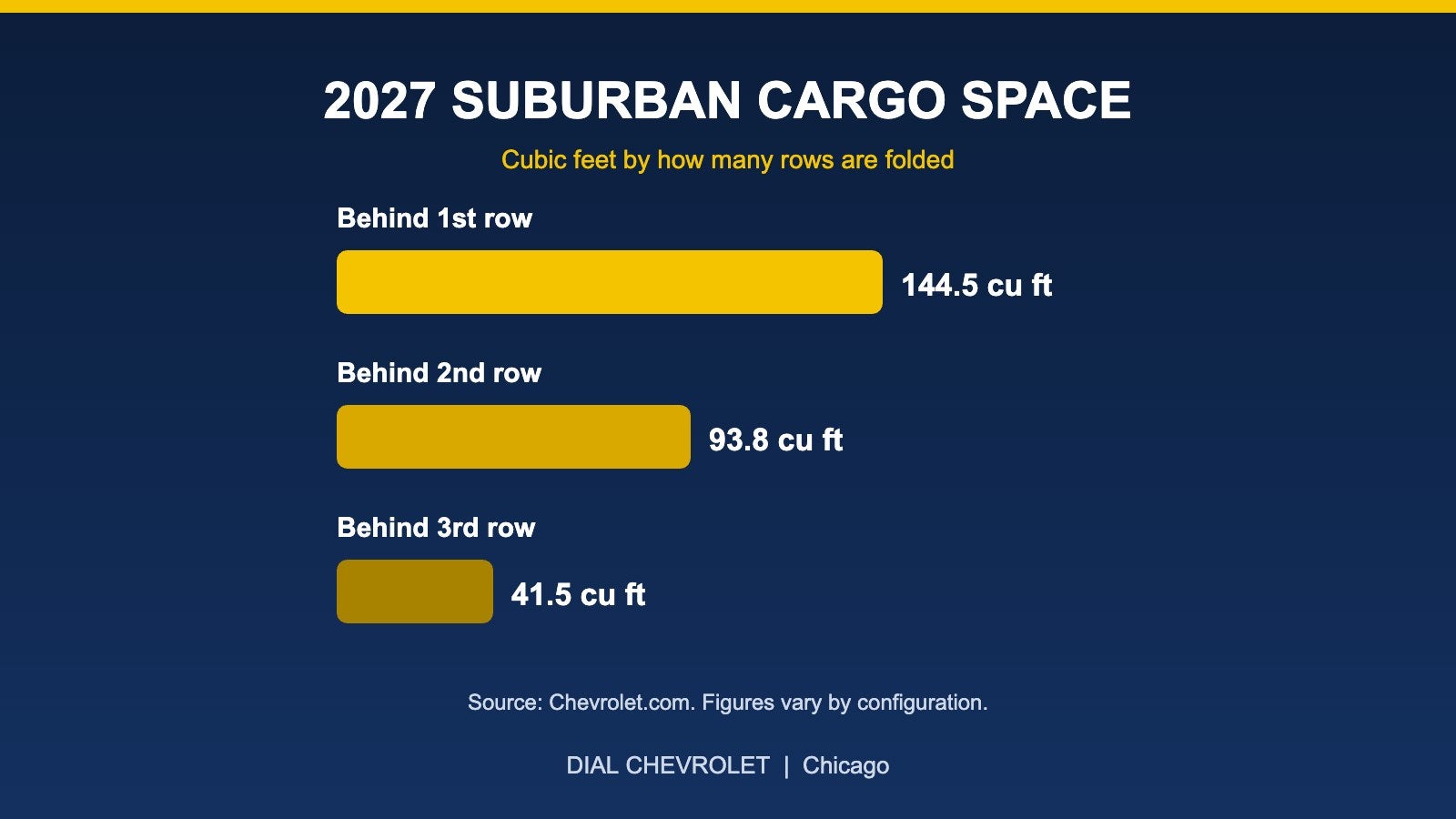
Bar chart of 2027 Chevrolet Suburban cargo volume behind the first, second and third rows

2027 Chevy Suburban Trims, Engines and Cargo Space: Which One Fits Your Family?

Short answer: the 2027 Chevrolet Suburban is a full-size, three-row SUV sold in six trims (LS, LT, RST, Z71, Premier and High Country) with three engine choices: a 5.3L V8, a 6.2L V8 and a 3.0L Duramax turbo-diesel. Which one fits your family depends less on the badge than on three practical questions: how many people you carry, how much you haul behind the third row, and how far you drive on a typical trip. This guide lays out what Chevrolet publishes for each so you can narrow the list before you visit. 2027 Suburban engines at a glance According to Chevrolet, the engine you can choose depends on the trim: 5.3L EcoTec3 V8 Power: 355 hp, 383 lb-ft Where it is offered: Standard on every trim except High Country 6.2L EcoTec3 V8 Power: 420 hp, 460 lb-ft Where it is offered: Standard on High Country; available on RST, Z71 and Premier 3.0L Duramax Turbo-Diesel Power: 305 hp, 495 lb-ft Where it is offered: Available on LT, RST, Z71, Premier and High Country Chevrolet cites up to 728 miles of EPA-estimated maximum highway range per tank for the diesel. That number depends on the configuration, so treat it as a ceiling, not a promise for every truck. How much room is there? Chevrolet lists these cargo volumes for the Suburban: 144.5 cubic feet behind the first row 93.8 cubic feet behind the second row 41.5 cubic feet behind the third row The 41.5 cubic feet behind the third row is the number that matters for a family that uses all the seats. It is the space left for luggage, strollers or sports gear when every seat is occupied. Chevrolet says the Suburban can seat up to nine depending on configuration, but seating layouts differ by trim and equipment, so confirm the exact seating on the specific vehicle you are considering. What every Suburban shares Chevrolet lists Google built-in, wireless Apple CarPlay and wireless Android Auto as standard. Its standard safety and driver-assistance package includes Intersection and Enhanced Automatic Emergency Braking, Reverse Automatic Braking, Rear Cross Traffic Braking, Blind Zone Steering Assist with Trailering and Adaptive Cruise Control. Chevrolet reminds drivers that these features do not replace the driver's responsibility. Choosing a trim and engine If you want the lowest-cost way into a three-row Suburban The 5.3L V8 is standard on the LS, LT, RST, Z71 and Premier. Start there, compare the equipment differences between trims, and decide whether the added features justify the step up. If you drive long distances The Duramax diesel is the engine Chevrolet highlights for highway range. It is available from the LT up. Ask for the EPA fuel-economy label on the exact vehicle and compare it with the gas engines before deciding. If you want the most power The 6.2L V8 is the most powerful engine offered, with 420 hp. It is standard on High Country, which is the top trim. If you tow Suburban towing capacity changes with engine, drivetrain and equipment such as a trailering package. Do not rely on a single headline number. Ask for the rating of the exact vehicle and check it against the loaded weight of your trailer, plus the passengers and gear in the vehicle. Questions to ask before you buy Which seating configuration does this specific Suburban have? Which engine and drivetrain does it have, and is it rear-wheel drive or four-wheel drive? What is its trailering rating if I plan to tow? What does the window sticker show for the equipment and total price? Next steps Browse new Chevrolet inventory at Dial Chevrolet, look at pre-owned options, or value your trade. If you would like help comparing trims for your family, contact our team. Sources: Chevrolet.com, 2027 Suburban. Specifications are manufacturer-published and subject to change. Reviewed Nov. 21, 2026. Vehicle prices and offers are not included in this article.

Diagram explaining that towing capacity and payload are two different limits on the same Silverado

2027 Chevy Silverado 1500 Towing and Payload by Engine: What the Numbers Mean

Short answer: there is no single towing or payload number for the 2027 Chevrolet Silverado 1500. General Motors publishes a maximum for each of the four engines, and every maximum belongs to one specific cab, bed, drivetrain and equipment combination. The truck you are looking at may be rated well below the headline figure. 2027 Silverado 1500 engines: maximum towing and payload These are the figures GM published for the next-generation Silverado 1500. Each one applies only to the configuration shown in the last column. Enhanced TurboMax 2.7L Horsepower: 350 Torque: 455 lb-ft Max towing: 9,400 lbs (Regular Cab Long Bed, 2WD) Max payload: 2,340 lbs (Regular Cab Standard Bed, 2WD) Duramax 3.0L Turbo-Diesel Horsepower: 305 Torque: 495 lb-ft Max towing: 12,000 lbs (Crew Cab Short Bed, 4WD, Max Trailering Package) Max payload: 1,870 lbs (Crew Cab Short Bed, 2WD) 5.7L V8 (L76) Horsepower: 402 Torque: 428 lb-ft Max towing: 13,700 lbs (Double Cab Standard Bed, 2WD, Max Trailering Package) Max payload: 2,170 lbs (Regular Cab Long Bed, 2WD) 6.6L V8 (L78) Horsepower: 481 Torque: 501 lb-ft Max towing: 9,700 lbs (Crew Cab Short or Standard Bed, 4WD) Max payload: 1,510 lbs (Crew Cab Short Bed ZR2, 4WD) GM notes that towing ratings are for comparison only and that real-world capacity depends on passengers, cargo and options. What the table tells you The most powerful engine is not the best tow engine The 6.6L V8 makes the most horsepower and torque of the four, but its published maximum towing figure (9,700 lbs) is well below the 5.7L V8 (13,700 lbs). The 6.6L maximum payload (1,510 lbs) is also the lowest, and that figure is for a ZR2. If your priority is pulling a heavy trailer, compare the rating for the exact truck, not the engine's horsepower. Payload and towing are different limits Payload is what the truck can carry in the cab and bed, including passengers, gear and the downward weight a trailer puts on the hitch. Towing capacity is the trailer weight the truck can pull. A truck can have a strong towing number and a modest payload, or the reverse. Load the bed and cab with people and equipment and you reduce what is left for hitch weight. Cab, bed and drivetrain change the number Two of the four headline towing figures above are for two-wheel-drive trucks. Four-wheel drive adds traction for Chicago winters, but it can change the rating, so check the specific truck rather than assuming the maximum applies. The 2027 trim lineup Chevrolet offers the 2027 Silverado 1500 in seven trims: Work Truck, Custom, Silverado (the trim formerly called LT), Custom Trail Boss, Trail Boss, High Country and ZR2. All trims come with a 16.3-inch center touchscreen and a 12.2-inch driver display, according to GM. Super Cruise with trailering support is standard on High Country and ZR2 and available on Silverado and Trail Boss, and it requires an active Super Cruise plan. How to find the real rating for the truck you want Ask for the exact cab, bed length, drivetrain, engine and whether the Max Trailering Package is installed. Check the trailering section of the owner's manual and the tire and loading information label on the driver's door frame for that truck. Weigh your real trailer loaded, not its empty weight, and remember to account for hitch weight and passengers against payload. If you tow often or near the limit, ask about a step up in configuration or a heavy-duty Silverado instead of stretching a half-ton. Timing: 2026 trucks now, 2027 coming GM says the next-generation 2027 Silverado 1500 is expected to go on sale at the end of this year. Until then, current inventory is 2026 model-year trucks, whose ratings differ from the 2027 figures above. Inventory changes daily, so confirm the model year and configuration of any truck before you plan around a number. Next steps Browse new Chevrolet inventory at Dial Chevrolet and compare configurations, check used trucks, or value your trade. Questions about which Silverado fits what you tow? Contact our team and tell us the trailer and the load. Sources: GM, Next-Generation 2027 Silverado 1500 announcement (updated Oct. 2, 2026); Chevrolet.com, 2027 Silverado 1500. Specifications are manufacturer-published and subject to change. Reviewed Nov. 21, 2026. Vehicle prices and offers are not included in this article.

Contact Us

Fill out this form below and we'll contact you shortly
*Required Fields