Blog / Silverado Trucks

Silverado 1500 vs. Ford F-150: How to Compare Them Fairly

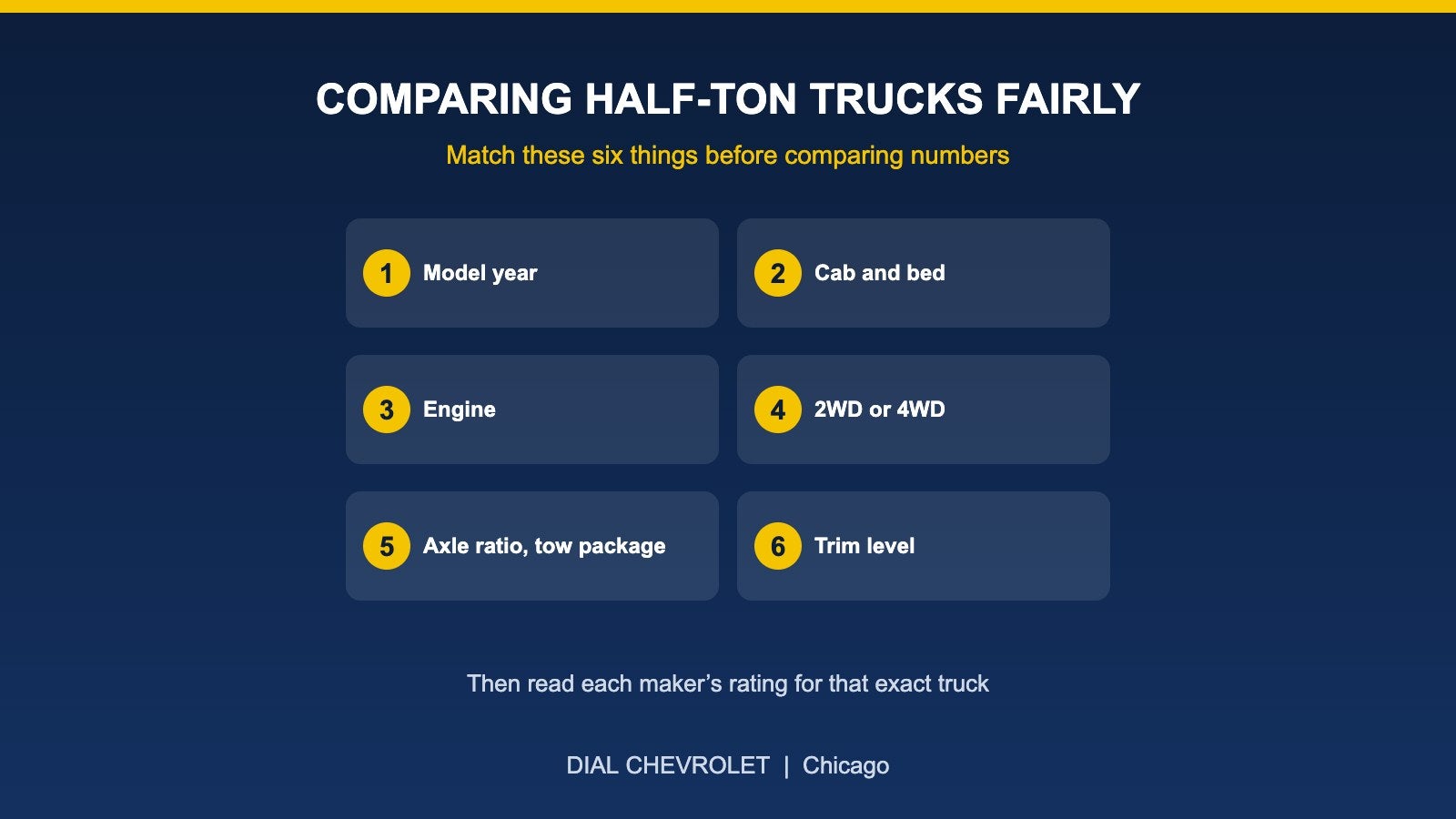
Six-item checklist for comparing half-ton trucks fairly: model year, cab and bed, engine, drivetrain, axle ratio and tow package, trim

Short answer: the Chevrolet Silverado 1500 and the Ford F-150 are both capable full-size pickups, and the fair way to compare them is to line up the same model year, cab, bed, engine, drivetrain and tow package before you look at any towing or payload number. A headline figure for one truck is almost never the figure for the truck you would actually buy. This guide explains what to match, what to read from each manufacturer, and what to check in person. We are a Chevrolet dealership, so we will say plainly where you should confirm Ford’s details with Ford.

1. Start With the Model Year

Model year matters more than usual right now. Chevrolet has announced a redesigned 2027 Silverado with new engine choices, while the F-150 is carried into 2027 without a full redesign. Comparing a 2027 Silverado to a 2025 or 2026 F-150, or the reverse, means you are comparing two different generations of engineering. Decide which model year you are shopping, then compare trucks from that same year. If you are weighing a new 2027 against a 2026 truck, treat that as a separate question about timing and available inventory.

2. Match the Cab and Bed

Both brands sell regular, extended and four-door crew cab body styles, with several bed lengths. Cab and bed change payload, towing, turning radius and parking. A crew cab with a short bed is a different truck from a regular cab with a long bed, even inside the same model line. Pick the cab and bed you need, then compare only trucks built that way.

3. Match the Engine

Each brand offers a range of engines, and Ford also offers hybrid powertrains in the F-150. Rather than comparing engine names, compare what you will use the truck for: daily commuting, trailer towing, work loads or a mix. Compare fuel economy figures from the EPA estimates for each exact configuration, and remember that your real-world numbers will change with load, weather and driving style.

4. Match 2WD and 4WD

Four-wheel drive adds weight and can change both payload and tow ratings. For Chicago winters many buyers want 4WD, so compare 4WD trucks against 4WD trucks.

5. Read Tow and Payload Ratings for the Exact Configuration

  • Maximum ratings are tied to specific builds. Each maker’s top towing number usually requires a particular engine, axle, cab, bed and tow package together.
  • Payload is set by the individual truck. The yellow label on the driver’s door frame shows the real payload for that vehicle, and it drops as you add passengers, gear and accessories.
  • Use each manufacturer’s own towing guide. Do not mix numbers from a Chevrolet page with numbers from a Ford ad. Use Chevrolet’s published ratings for the Silverado and Ford’s published ratings for the F-150, both for the same type of build.

Our guides on how payload works and 2027 Silverado towing and payload by engine explain how to read these numbers.

6. Compare Trim Levels, Not Just Trucks

Both brands run a ladder from basic work trims to luxury trims, plus off-road versions. Compare a work-oriented trim with a work-oriented trim and a premium trim with a premium trim. Trim names do not line up one-to-one between brands, so compare the features you actually want: seating, driver-assistance features, towing technology, bed features and cabin materials.

What to Check In Person

  • Visibility from the driver’s seat and how the mirrors work when towing
  • Ease of getting in and out, and how the rear seat feels in a crew cab
  • Infotainment and phone connection, using your own phone
  • Bed access, tailgate features and tie-down locations
  • How the truck feels on a rough city street, not just a smooth road
  • Whether the truck fits your garage or parking spot

A Fair Way to Decide

  1. Choose the model year, cab, bed and drivetrain you need.
  2. Write down the heaviest trailer and the heaviest load you will realistically carry.
  3. Find each manufacturer’s rating for that exact configuration.
  4. Drive both trucks back to back on the same route.
  5. Compare ownership factors such as warranty coverage, maintenance and service access.

See a Silverado in Person

If you want to see how a Silverado 1500 compares to the truck you are considering, you can browse new Chevrolet inventory, browse used vehicles, get a trade-in estimate, or contact the Dial Chevrolet team to arrange a test drive. If you plan to haul or tow, our service team can help keep your truck ready: schedule service.

Sources

Published by Dial Chevrolet, 6603 S Western Ave, Chicago, IL. This is general educational guidance, not a claim that one truck is better for every buyer. Specifications and availability vary by model year and configuration; confirm details with each manufacturer. Ford and F-150 are trademarks of Ford Motor Company.
Posted in:

Related Posts

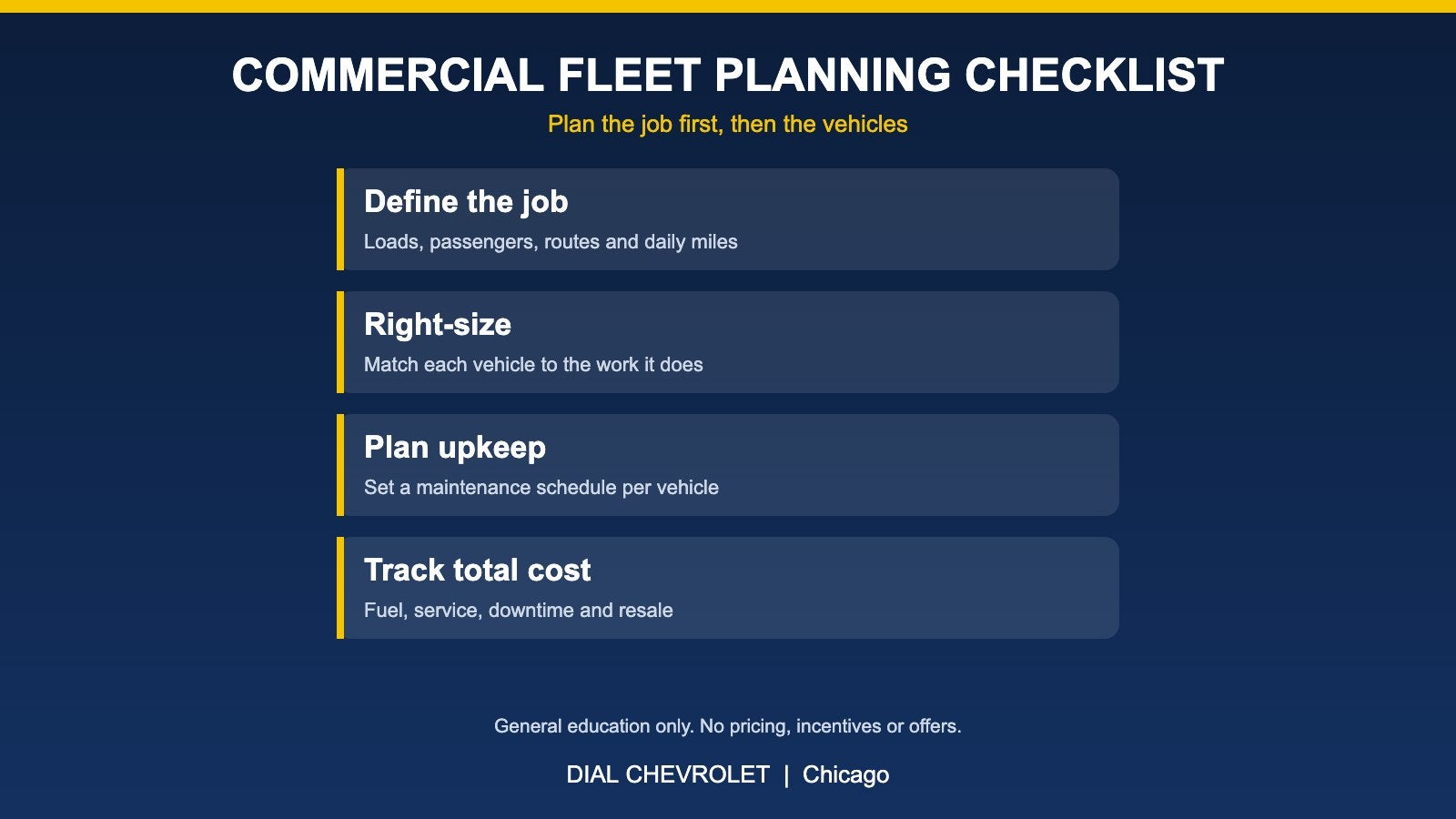
Checklist graphic for planning a commercial vehicle fleet for a Chicago business

Commercial Fleet Planning for Chicago Businesses

Short answer: good fleet planning starts with the work each vehicle has to do, not the vehicle itself. Define the loads, passengers, routes and daily miles first, match vehicles to those jobs, set a maintenance schedule, and track what each vehicle really costs to run over its whole life. What Counts as a Fleet Industry guides commonly describe a fleet as five or more vehicles used for business, though the definition varies by company and by program. A plumber with two vans and a contractor with ten trucks face many of the same questions, so the planning steps below apply at any size. Step 1: Define the Job List what each vehicle must carry or tow, how many people ride in it, how far it drives each day, and where it parks overnight. A vehicle that is too small struggles with the work, and one that is too large costs more to buy and run than the job needs. Our guides to payload and Silverado 1500 vs. 2500HD help with weight and capability questions. Step 2: Match the Vehicle Type Chevrolet lists commercial trucks, vans, and chassis cabs and cutaways among its business vehicles. Pickups suit crews that haul tools and materials in an open bed, and cargo vans suit crews that need enclosed, secure storage. If you plan to add shelving, racks or other equipment, ask early, because Chevrolet notes that equipment from independent suppliers is not covered by the GM New Vehicle Limited Warranty. Check each supplier's own terms. See work truck setup for a Chicago business for more. Step 3: Plan Maintenance Before Problems Start Business guides consistently recommend a written maintenance schedule for every vehicle, because downtime costs money. When service time is limited, the vehicles that keep the business moving should get the first appointments. Use our Chevy maintenance schedule article as a starting point and follow the owner's manual for your specific vehicles. Step 4: Track Total Cost of Ownership Purchase price is only one part of the picture. Fleet guides describe total cost of ownership as including fuel, maintenance and repairs, insurance, depreciation and resale value. Record these for each vehicle so you can see when an aging vehicle costs more to keep than to replace. Ask your accountant about how vehicle purchases are treated for tax, since rules change and depend on your business. Talk to the Dial Chevrolet Team If you are planning to add or replace business vehicles, contact us to talk through your needs, browse new inventory or used inventory, or request a service appointment for the vehicles you already run. Sources Chevrolet: Commercial vehicles U.S. Chamber of Commerce: Managing company vehicle usage and maintenance Routific: Beginner's guide to managing small fleets Published by Dial Chevrolet, 6603 S Western Ave, Chicago. General education only, not tax, legal or financial advice. No pricing, incentives or offers are stated.

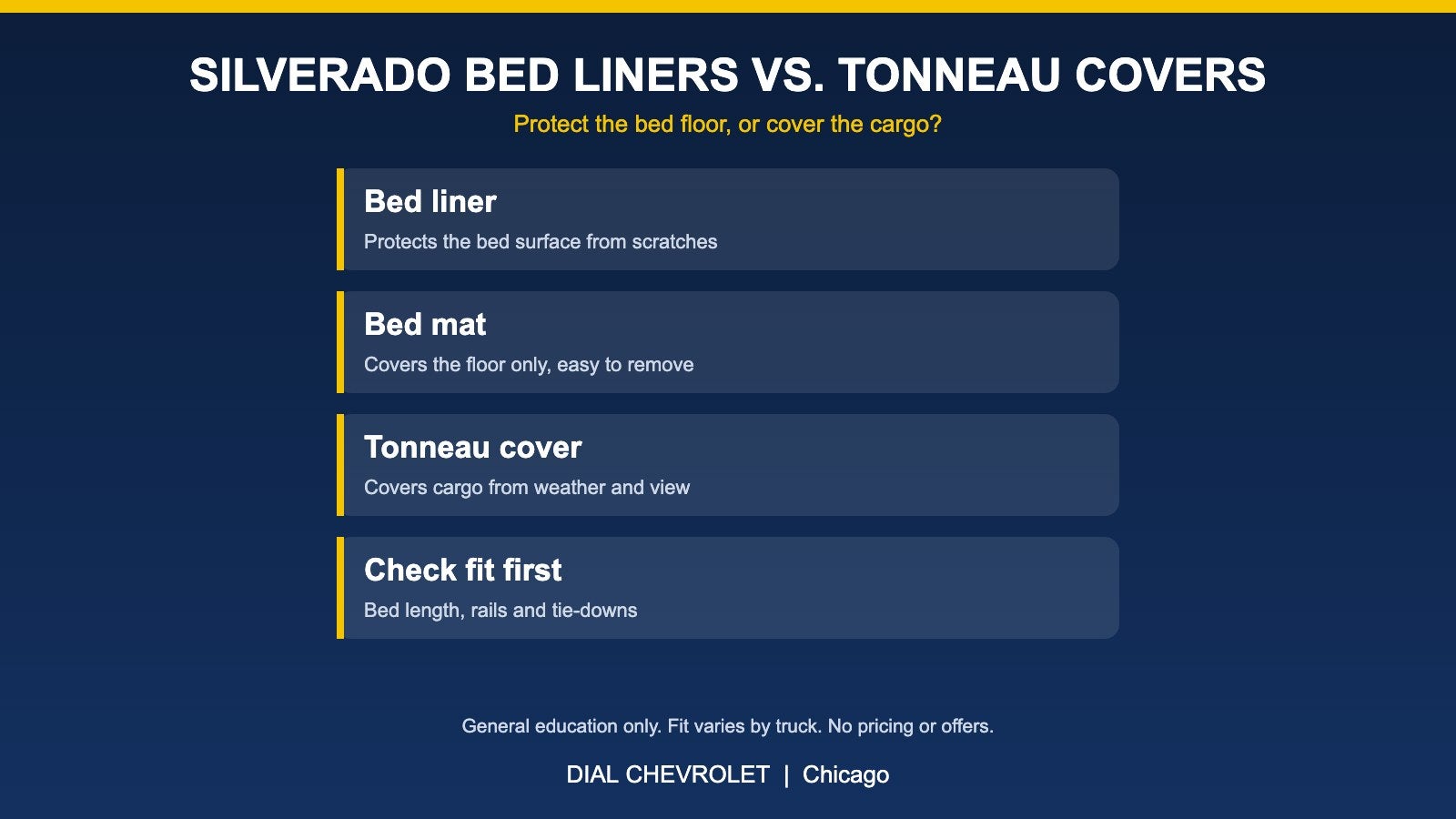
Checklist graphic comparing Silverado bed liners, bed mats and tonneau covers

Silverado Bed Liners and Tonneau Covers Compared

Short answer: a bed liner or bed mat protects the surface of your Silverado bed from scratches and wear, while a tonneau cover covers the bed to shield cargo from weather and view. Many owners use both, and the right choice depends on how you use the truck and which options it already has. Bed Liners: Drop-In, Spray-In and Mats Drop-in liners are molded shells that fit into the bed. Spray-in liners are a coating applied to the bed surface and are usually done by a professional. Bed mats cover the floor only, and they are easier to remove than a full liner. Liners generally protect the bed floor, sides and bulkhead, and some also cover the tailgate, while mats protect the floor alone. Some Silverado trims offer a factory spray-on liner, so check your build sheet or ask us what a specific truck has before you buy an add-on. Tonneau Covers: The Main Types Soft roll-up: lightweight and simple, and it rolls toward the cab for full bed access. Soft folding: folds in sections, and retailers describe it as giving access to roughly two-thirds of the bed at a time. Hard folding: panels made of aluminum or composite materials that add security compared with soft vinyl. Hard roll-up and retractable: slatted designs that roll out of the way. Soft covers are generally less expensive and easy to operate, while hard covers are generally more durable and more secure, but heavier and often costlier. Soft covers may also not hold up as well to heavy snow, which matters in a Chicago winter. What to Check Before You Buy Bed length, since Silverado beds come in more than one length. Our cab sizes and bed lengths guide explains the options. Whether the cover or liner works with the bed rails, tie-downs and any accessories already on your truck. Whether you need to haul tall items, which can rule out some covers. The warranty terms for the product itself. Anything you add to the bed counts toward the load you carry. See Silverado payload explained for how to think about weight, and work truck setup for a Chicago business if the truck earns its living. Talk to the Dial Chevrolet Team Browse new Silverados or used trucks, or contact us to ask what accessories fit a specific truck. Sources AmericanTrucks: Finding the right tonneau cover for a Silverado RealTruck: Tonneau and bed covers for the Silverado 1500 RealTruck: Bed liners and bed mats for the Silverado 1500 Published by Dial Chevrolet, 6603 S Western Ave, Chicago. General education only. Product availability, fit and warranty vary; no pricing or offers are stated.

Comparison of 2026 Chevrolet Colorado and Silverado 1500 maximum towing, payload and torque as listed by Chevrolet

Chevy Colorado vs. Silverado 1500: Which Truck Size Fits?

Short answer: choose the Colorado if you want a midsize truck for lighter towing and everyday use, and the Silverado 1500 if you need more towing and payload room. Compare the ratings for the exact configuration you plan to buy, because the maximums depend on how each truck is equipped. What Chevrolet lists for each truck For the 2026 model year, Chevrolet lists the Colorado with a 2.7L TurboMax engine rated at 310 hp and 430 lb-ft of torque, up to 7,700 lbs of maximum available towing and up to 1,710 lbs of maximum available payload. The Silverado 1500 page lists up to 13,300 lbs of maximum available trailering, up to 2,260 lbs of maximum available payload and up to 495 lb-ft of maximum available torque, with four engine choices. Chevrolet's current Colorado page lists a higher engine output of 350 hp and 450 lb-ft, so confirm which model year and rating apply to the truck you are looking at. Size and daily driving The Colorado is a midsize pickup and the Silverado 1500 is a full-size pickup, so the Silverado is generally larger overall. If you park on the street, use a tight garage or drive in dense areas of Chicago, measure your space and test drive both trucks before deciding. Cab style and bed length change the size of either truck, which our guide to Silverado cab sizes and bed lengths explains. When the Colorado is a good fit You tow smaller trailers or loads well within its rating. You want a truck bed for weekend projects, bikes or gear without the size of a full-size pickup. Easier parking and maneuvering matter to you. When the Silverado 1500 is a better fit You regularly tow heavier trailers or want more margin under the truck's limits. You carry heavy cargo or use the truck for work. You want a wider choice of engines, cab and bed combinations and trims. See Silverado 1500 trim levels explained. Check the numbers that apply to you Weigh what you actually tow and carry, then compare it with the ratings for the exact truck, including the payload sticker. Our guides on towing fundamentals and how payload works show how to read those limits. Talk to the Dial Chevrolet Team The team at Dial Chevrolet can help you compare available trucks side by side. You can browse new inventory, contact the dealership or value your trade-in. More truck guides are in our Silverado Trucks category. Sources Chevrolet.com, Colorado Chevrolet.com, Silverado 1500 Chevrolet.com, Colorado comparison page Published by Dial Chevrolet, 6603 S Western Ave, Chicago. This article is general education only and does not include pricing or offers. Ratings are manufacturer maximums and vary by configuration; confirm details with the dealership and the owner's manual.