Blog / Service and Maintenance

Chevy Oil Change: How Often, and What the Oil Life Monitor Means

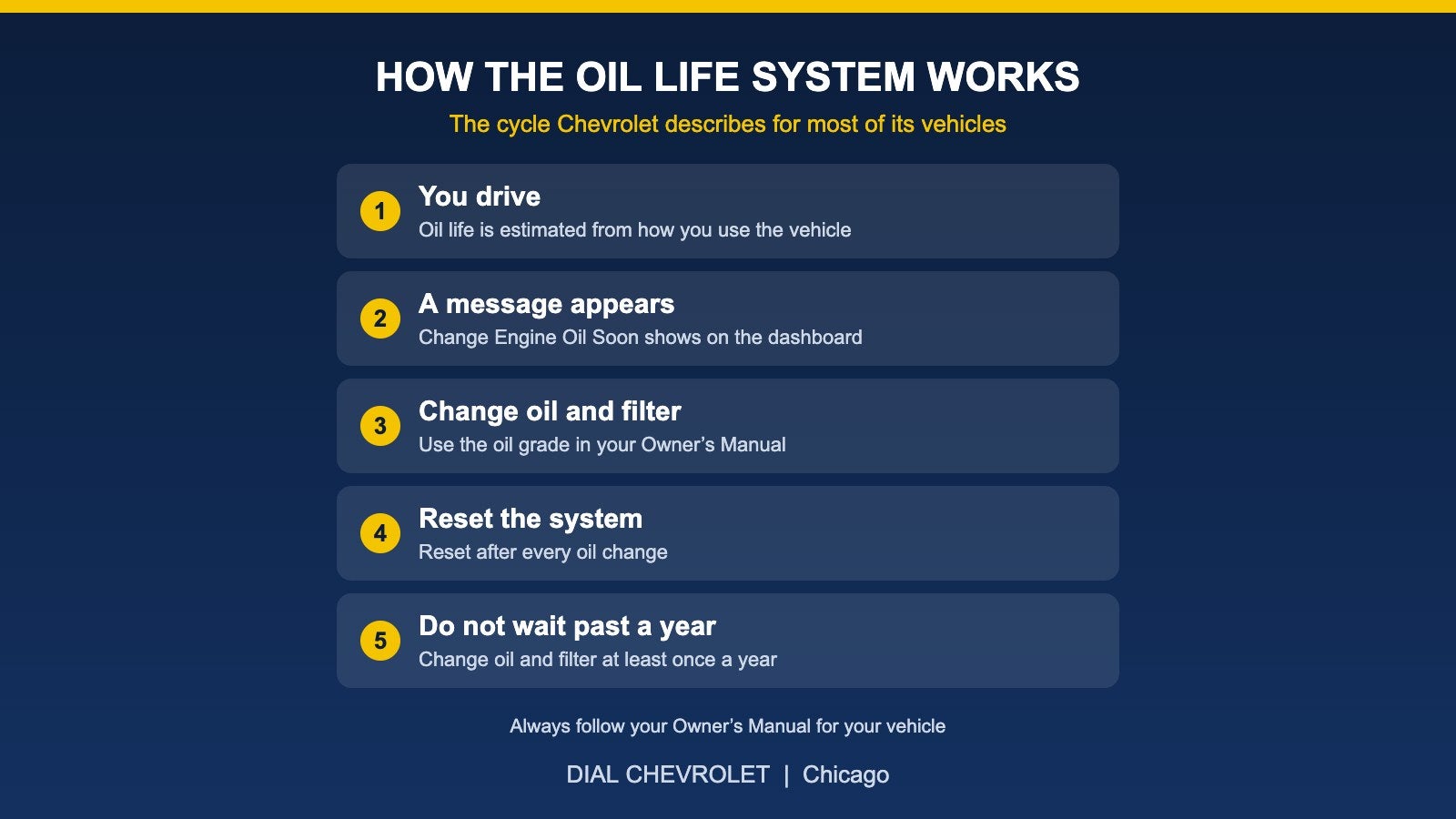
Five-step cycle of the Chevrolet Engine Oil Life System: you drive, a message appears, change oil and filter, reset the system and do not wait past a year

Short answer: Chevrolet says most of its vehicles have an Engine Oil Life System that tells you when to change the oil, so the old rule of changing it every 3,000 miles does not apply to many newer vehicles. You should still change the oil and filter at least once a year, and you need to reset the system after every oil change. Always check your Owner’s Manual for the details that apply to your exact vehicle.

What the Oil Life System Does

Chevrolet describes the Engine Oil Life System as a feature on most of its vehicles. Instead of counting only miles, the system estimates how long your oil will last based on how you use your vehicle. When it is time, a “Change Engine Oil Soon” message appears on your dashboard. When you see it, have the oil and filter changed as soon as you can.

Why 3,000 Miles Is Not the Rule for Every Chevy

Chevrolet says many older vehicles, including those built before the Oil Life System existed, needed oil changes at 3,000-mile intervals, while newer models can go much longer between changes thanks to advances in engine technology. Your Owner’s Manual gives the interval for your specific vehicle, so treat it as the source of truth.

Reset the System After Every Oil Change

The system can only track the new oil if it is reset when the oil is changed. If you recently had your oil changed and the message is still showing, the system may not have been reset. Your Owner’s Manual explains how to reset it on your vehicle, and the shop doing your oil change can do it for you.

Do Not Skip the Yearly Change

Even if you drive gently and the system does not call for service, Chevrolet says the engine oil and filter must be changed at least once a year. Short trips, long periods of parking and Chicago winters can all affect how your vehicle is used, so do not rely on the calendar alone, and do not ignore it either.

Check the Oil Level, Too

Chevrolet advises checking your engine oil level regularly, even if your vehicle has the Oil Life System. For an accurate reading, the engine should be off and the vehicle on level ground. Your Owner’s Manual explains how to check the level on your vehicle. If you ever see an “Oil Pressure Low/Stop Engine” type of warning, follow the instructions in your Owner’s Manual and contact a service expert.

Use the Right Oil

The correct oil grade depends on your engine. Check your Owner’s Manual or ask a service advisor so you use the grade your vehicle calls for.

Quick Checklist

  1. Watch for the “Change Engine Oil Soon” message and act on it promptly.
  2. Change the oil and filter at least once a year.
  3. Reset the Oil Life System after every oil change.
  4. Check the oil level regularly.
  5. Use the oil grade listed in your Owner’s Manual.

Heading into colder weather? See our Chicago winter prep checklist for your Chevy.

Schedule Service With Dial Chevrolet

You can schedule an appointment online, browse current service and parts specials on our site, order parts, or contact the Dial Chevrolet team with questions. If it is time to think about a different vehicle, you can also get a trade-in estimate or browse new inventory.

Sources

Published by Dial Chevrolet, 6603 S Western Ave, Chicago, IL. This guide is general information based on Chevrolet’s published guidance and is not a substitute for your Owner’s Manual. This guide does not list prices or offers.
Posted in:

Related Posts

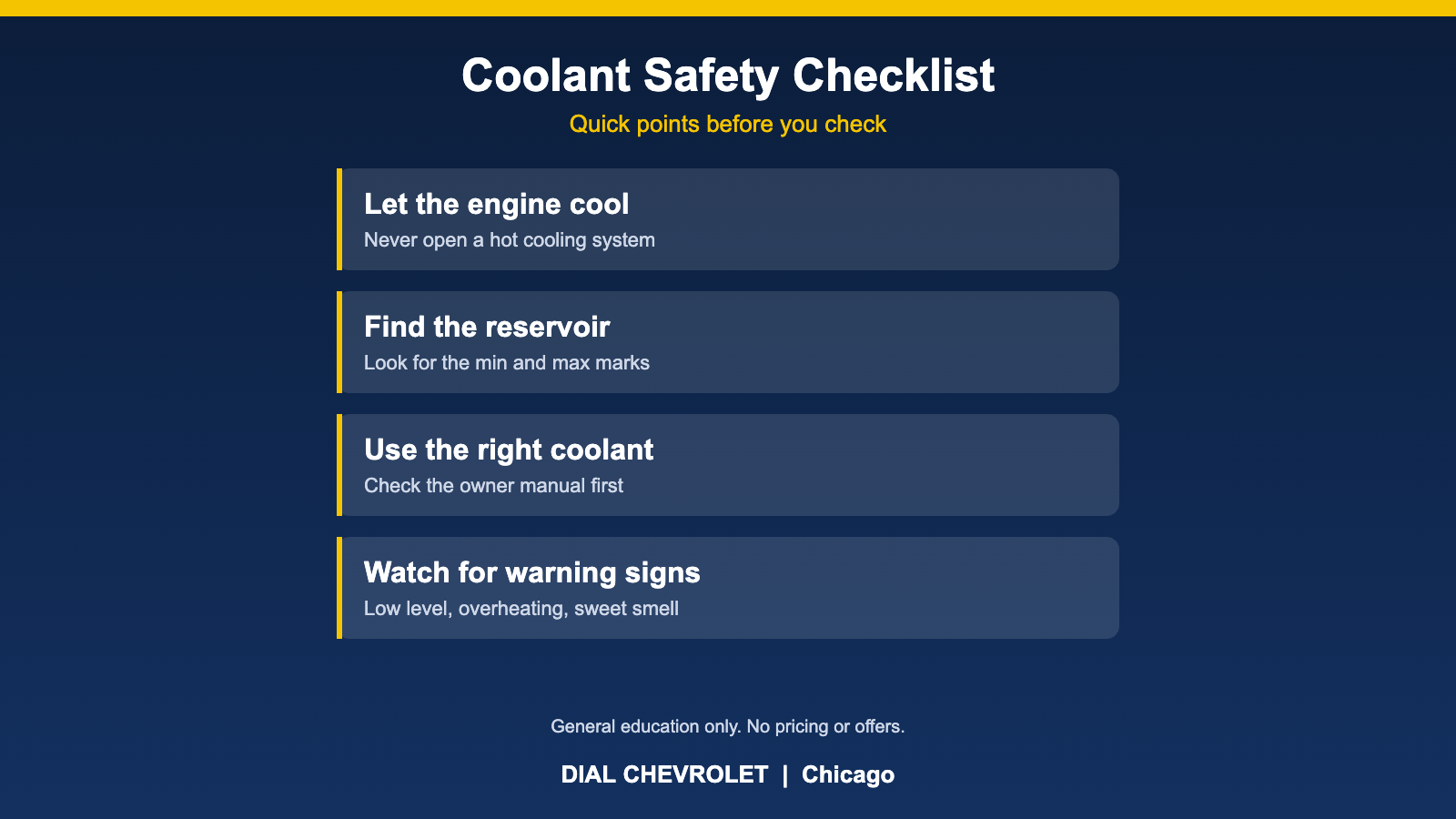
Graphic listing coolant safety checklist points

Engine Coolant Basics: Checking Level Safely

Short answer: check coolant only when the engine is completely cool, look at the level in the reservoir against its marks, and use the coolant type your owner's manual specifies. A level that keeps dropping, overheating or a sweet smell from the engine bay are reasons to have the cooling system inspected. What coolant does Coolant, also called antifreeze, carries heat away from the engine and helps protect against freezing and corrosion. It circulates between the engine and the radiator, so a problem in the cooling system can lead to overheating and engine damage. Safety first Never open the radiator or reservoir cap on a hot engine. Hot, pressurized coolant can spray out and cause serious burns. Let the engine cool completely before you check the level, and many sources suggest the best time is after the vehicle has sat for a while. Do not add coolant to a hot engine. Keep coolant away from children and pets, and clean up spills. How to check the level Park on level ground and let the engine cool. Open the hood and find the translucent coolant reservoir. It is often marked with a warning not to open when hot. Read the level against the minimum and maximum marks. With a cold engine it should sit between them. Do not overfill. Extra coolant can simply overflow. Check your owner's manual for the exact location and marks on your vehicle. Using the right coolant Different coolant types do not always mix well, so use the type and mixture your owner's manual calls for. If you are not sure what is in your system, ask a technician before topping it off. Signs the cooling system needs attention The level keeps dropping, which can point to a leak. The engine overheats or the temperature warning appears. A sweet, syrupy smell from the engine bay. Steam from under the hood. Pull over safely and shut the engine off. Weak heat from the vents, which can be linked to low coolant. Visible leaks, cracked hoses or a worn radiator cap. When coolant is replaced A coolant flush drains and replaces the fluid in the cooling system. The timing depends on your vehicle, so follow the maintenance schedule in your owner's manual. See our maintenance schedule guide for how fluid checks fit into regular service. Before winter and summer Many guides suggest checking the level before the hottest and coldest months. That fits Chicago well; our winter prep checklist covers other cold-weather checks. Talk to the Dial Chevrolet Team If the level is low, the temperature gauge is climbing or you smell coolant, schedule service or contact us. Our check engine light guide may also help if a warning light is on. Sources Kelley Blue Book: Do I Need a Coolant System Flush? Cars.com: How to Check Your Car's Engine Coolant RepairPal: How to Check Your Car's Coolant System Published by Dial Chevrolet, 6603 S Western Ave, Chicago. General education only. Follow your owner's manual and have a qualified technician service the cooling system.

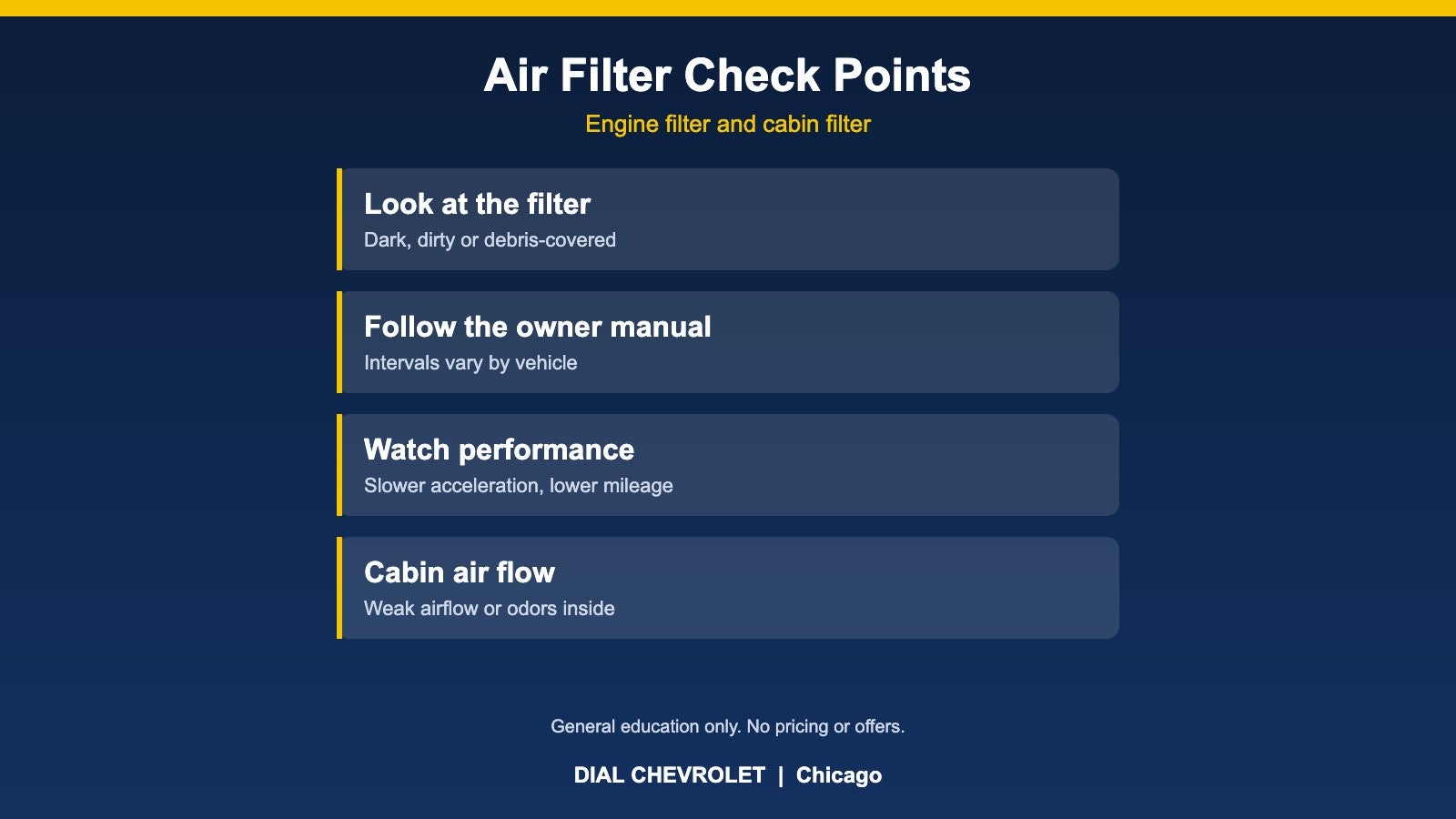
Graphic listing air filter check points

Engine and Cabin Air Filters: When to Check

Short answer: check your engine air filter by looking at it, follow the interval in your owner's manual, and replace it when it is dirty enough to restrict airflow. Cabin air filters are separate parts that also need periodic changes. What the two filters do The engine air filter cleans the air that goes into the engine. The cabin air filter cleans the air that comes into the passenger compartment through the heating and air conditioning system. Most vehicles have both, and they are replaced on their own schedules. How often to replace them Manufacturers list intervals in the owner's manual or maintenance schedule, and those intervals differ by vehicle. Several sources also point out that conditions matter more than a fixed number: dusty roads, construction areas and winter salt spray can load a filter faster. Inspecting the filter regularly is a more reliable habit than relying on a single mileage figure. Signs an engine air filter may be dirty The filter looks dark or gray, or has visible debris on it. Slower acceleration or a sluggish feel, especially with a turbocharged engine. A drop in fuel economy when your driving has not changed. Unusual engine sounds or rough running. A check engine light. Many things can cause one, so see our check engine light guide before assuming it is the filter. Signs a cabin air filter may need attention Weaker airflow from the vents. Musty or unpleasant odors when the fan or A/C runs. More dust inside the vehicle than usual. Checking it yourself The housing location varies, so use the owner's manual to find it. Some housings use clips and others use screws. If you are not comfortable inspecting it, ask a technician to check the filters during a service visit. Why Chicago driving matters Winter salt and spring construction can add grit and moisture to the air your vehicle breathes. That is a good reason to look at the filters at least when you service the vehicle for other reasons, such as the visits listed in our maintenance schedule guide. Talk to the Dial Chevrolet Team If you want filters inspected, you can schedule service or contact us. You may also like our guide to genuine GM parts versus aftermarket. Sources Cars.com: How Often Should You Change the Engine Air Filter? Autotrader: Car Air Filter, When to Replace Cars.com: Air Filters, What You Need to Know Published by Dial Chevrolet, 6603 S Western Ave, Chicago. General education only. Follow your owner's manual for your vehicle's intervals.

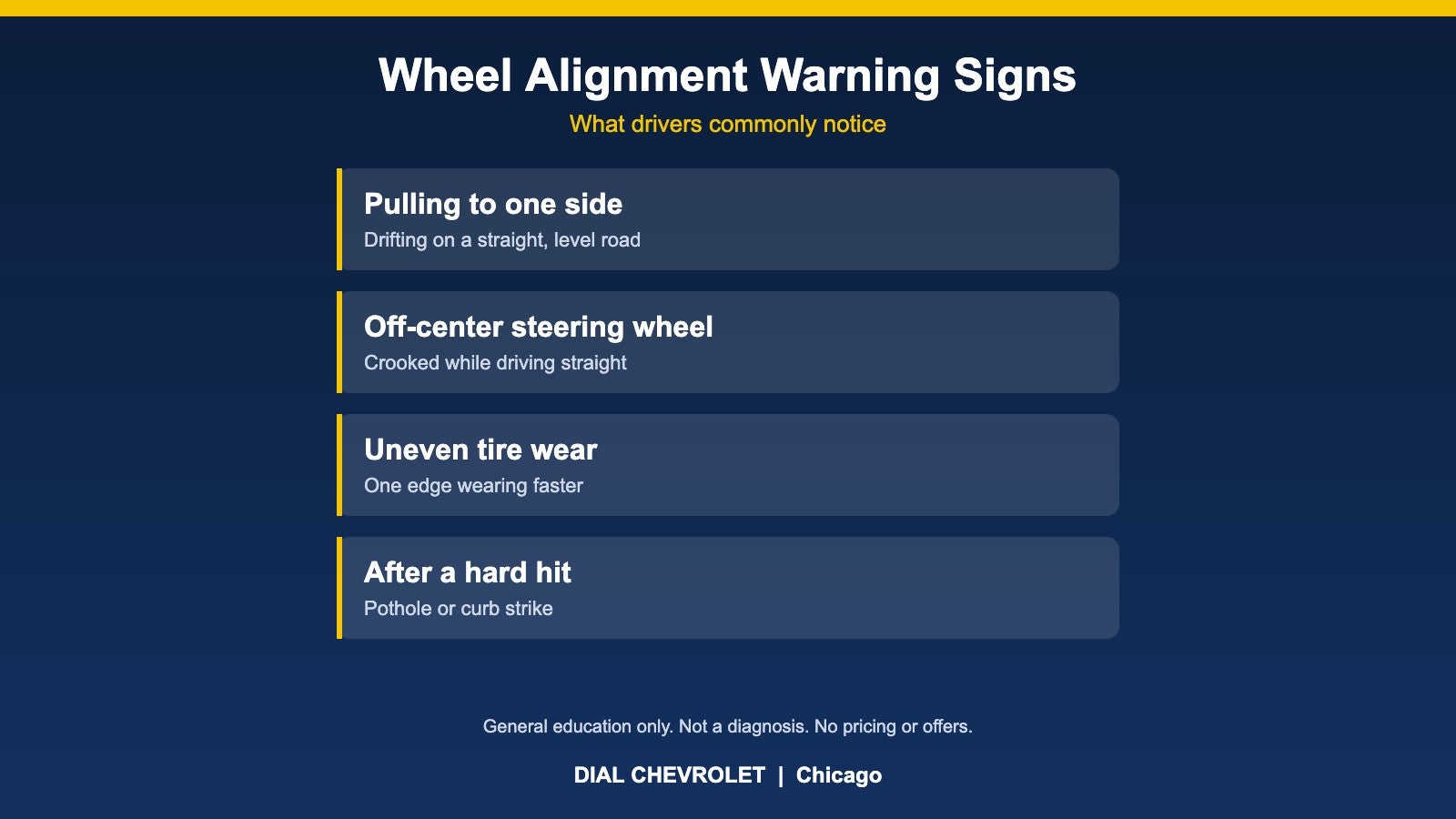
Graphic listing common signs of wheel misalignment

Wheel Alignment: Signs You May Need One

Short answer: the most common signs of a wheel alignment problem are a vehicle that pulls to one side, a steering wheel that sits off-center on a straight road, and tires that wear unevenly. A technician can confirm the cause, because other issues can look similar. What wheel alignment means Wheel alignment adjusts suspension angles, commonly called camber, caster and toe, so the tires meet the road as the vehicle was designed. When those angles drift, handling can change and tires can wear faster than they should. Signs you may need an alignment Pulling: on a straight, level road with little wind, the vehicle drifts left or right and you keep correcting the steering. Off-center steering wheel: the wheel is crooked while the vehicle is going straight. Uneven tire wear: the inner or outer edge of a tire looks more worn than the rest of the tread. Squealing tires: noise during ordinary low-speed turns. Steering that feels loose or does not return to center after a turn. Vibration: a shaking steering wheel can point to alignment, but it can also come from tire balance or worn parts. When to have it checked Many shops suggest an alignment check after a hard pothole or curb hit, after suspension or steering work, and when you install new tires. Chicago streets can be rough after winter, so it is reasonable to pay attention to how the vehicle drives in spring. Other things that feel like bad alignment Uneven tire pressure can make a vehicle pull, so check pressures first. A sticking brake caliper can also cause pulling. Worn tie rods, ball joints or other steering and suspension parts can cause loose steering and uneven wear; they need to be inspected with the vehicle raised. Tire balance problems often show up as vibration instead of pulling. A simple self-check Look at each tire's tread across its full width, and compare the front tires to each other. Wear concentrated on one edge is worth having inspected. Do this regularly, and before long trips. Why it matters Correct alignment helps tires wear evenly, supports steady handling and can protect fuel economy. Ignoring a problem can shorten tire life. Talk to the Dial Chevrolet Team If your vehicle pulls, the steering wheel is crooked or the tires look unevenly worn, you can schedule service or contact us. See also our maintenance schedule guide, brake service warning signs and winter prep checklist. Sources Kelley Blue Book: What Is Wheel Alignment AAA: Vehicle Wheel Alignment and Suspension Continental Tires: Wheel Alignment Published by Dial Chevrolet, 6603 S Western Ave, Chicago. General education only. It is not a diagnosis; have a qualified technician inspect your vehicle.