Blog

All Service and Maintenance Silverado Trucks Used and Trade-Ins Suburban and SUVs
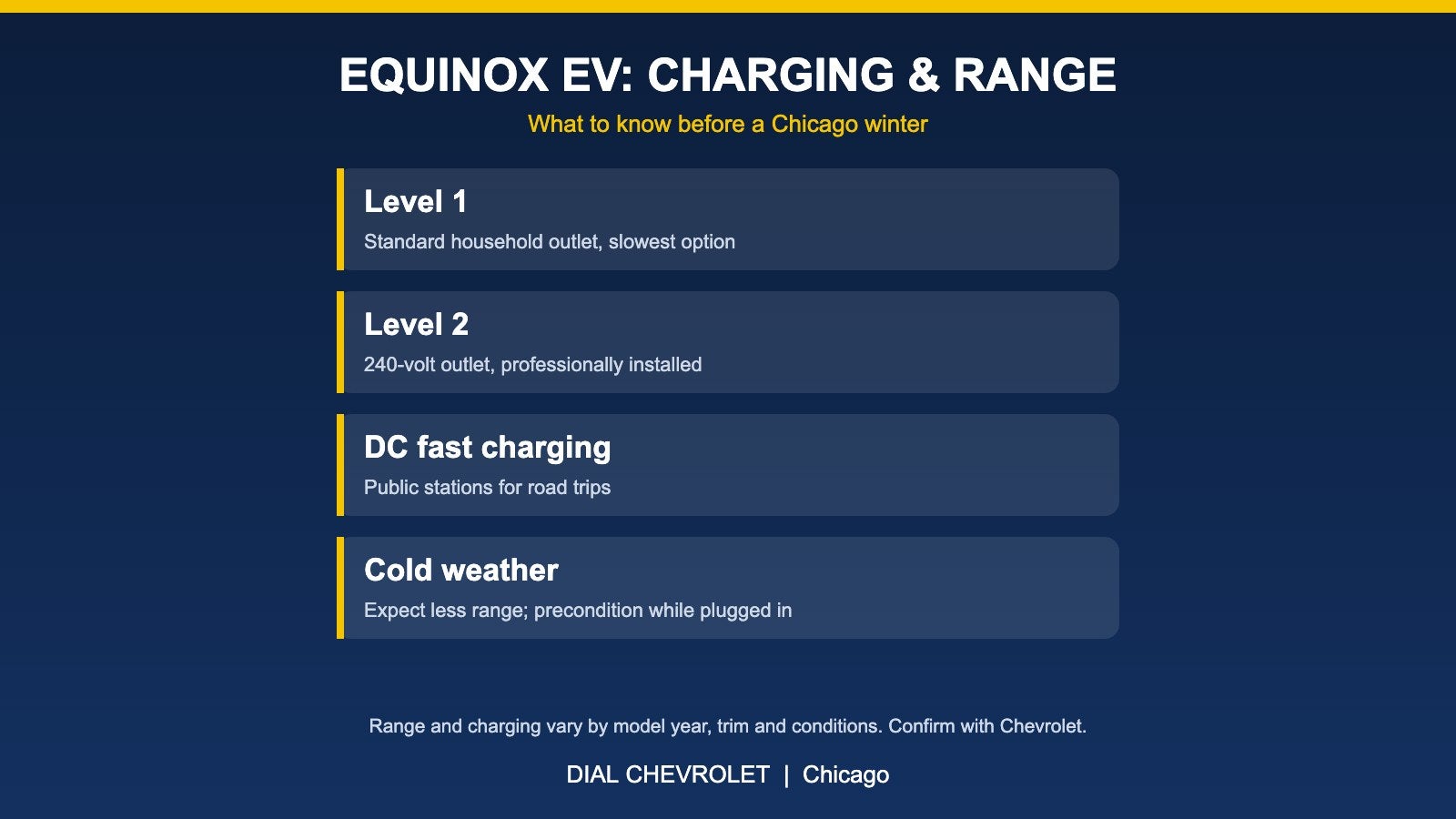
Graphic listing Level 1, Level 2 and DC fast charging options for the Chevy Equinox EV, plus a cold weather range note

Equinox EV Charging and Range: A Chicago Guide

Short answer: the Chevrolet Equinox EV can be charged at home or on the road, and your real-world range will change with the weather and how you drive. For a Chicago winter, plan for less range than the EPA estimate, charge at home when you can and precondition the cabin while the vehicle is plugged in. The ways to charge Level 1: Chevrolet's charging page says you can plug into a standard household three-prong outlet. This is the slowest option but needs no special equipment. Level 2: a professionally installed 240-volt outlet charges faster. Chevrolet lists Level 2 chargers as available equipment. Ask a licensed electrician about what your home or building needs. DC fast charging: public DC fast chargers are meant for road trips and quick stops. Chevrolet publishes how much range a model can add in about 10 minutes, but the figure changes by model year and drivetrain, so check the figure for the exact vehicle you are considering. Chevrolet's charging page also says the myChevrolet app can help you find public chargers and that owners can activate access to Tesla Superchargers through the app, with a GM-approved adapter where needed. Network access and adapters can change, so confirm the current details with Chevrolet. What about range? For the 2026 model year, Chevrolet lists EPA-estimated range of up to 319 miles on front-wheel-drive models and 307 miles on all-wheel-drive models. EPA ratings are a standardized estimate. Your own range depends on speed, temperature, load, terrain, tires and how you use the climate controls. Details can differ for other model years, so confirm the specifications of the exact vehicle. Cold weather and range The U.S. Department of Energy's fueleconomy.gov notes that cold weather reduces battery performance, and that preheating the cabin while the vehicle is still plugged in can extend range. It also says that using seat warmers instead of the cabin heater can save energy. The Department of Energy also suggests parking in a covered space when possible and checking tire pressure regularly. Precondition the cabin while plugged in, if your vehicle supports it. Use seat warmers when they are enough to keep you comfortable. Keep tires properly inflated. See our guide to tire tread depth and winter tires. Plan longer winter trips around charging stops, and leave yourself a cushion instead of arriving with a nearly empty battery. Is an EV right for you? It depends on where you park, how far you drive and whether you can charge at home or work. If you are comparing vehicles, our Chevy SUV buying guide and the buying vs. leasing a Chevrolet guide cover other ways to think about the choice. This article does not list prices, incentives or tax-credit information, which change often. Ask the dealership about current availability. Talk to the Dial Chevrolet Team You can browse new inventory, contact the dealership with questions or value your trade-in. For routine care on any Chevrolet, schedule service and see the maintenance schedule guide. Sources Chevrolet.com, Equinox EV charging Chevrolet.com, 2026 Equinox EV fueleconomy.gov, Fuel Economy in Cold Weather Published by Dial Chevrolet, 6603 S Western Ave, Chicago. This article is general education only and does not include pricing, incentives or offers. Range, charging speed and features vary by model year, trim and conditions, so confirm details with the dealership and Chevrolet.com.
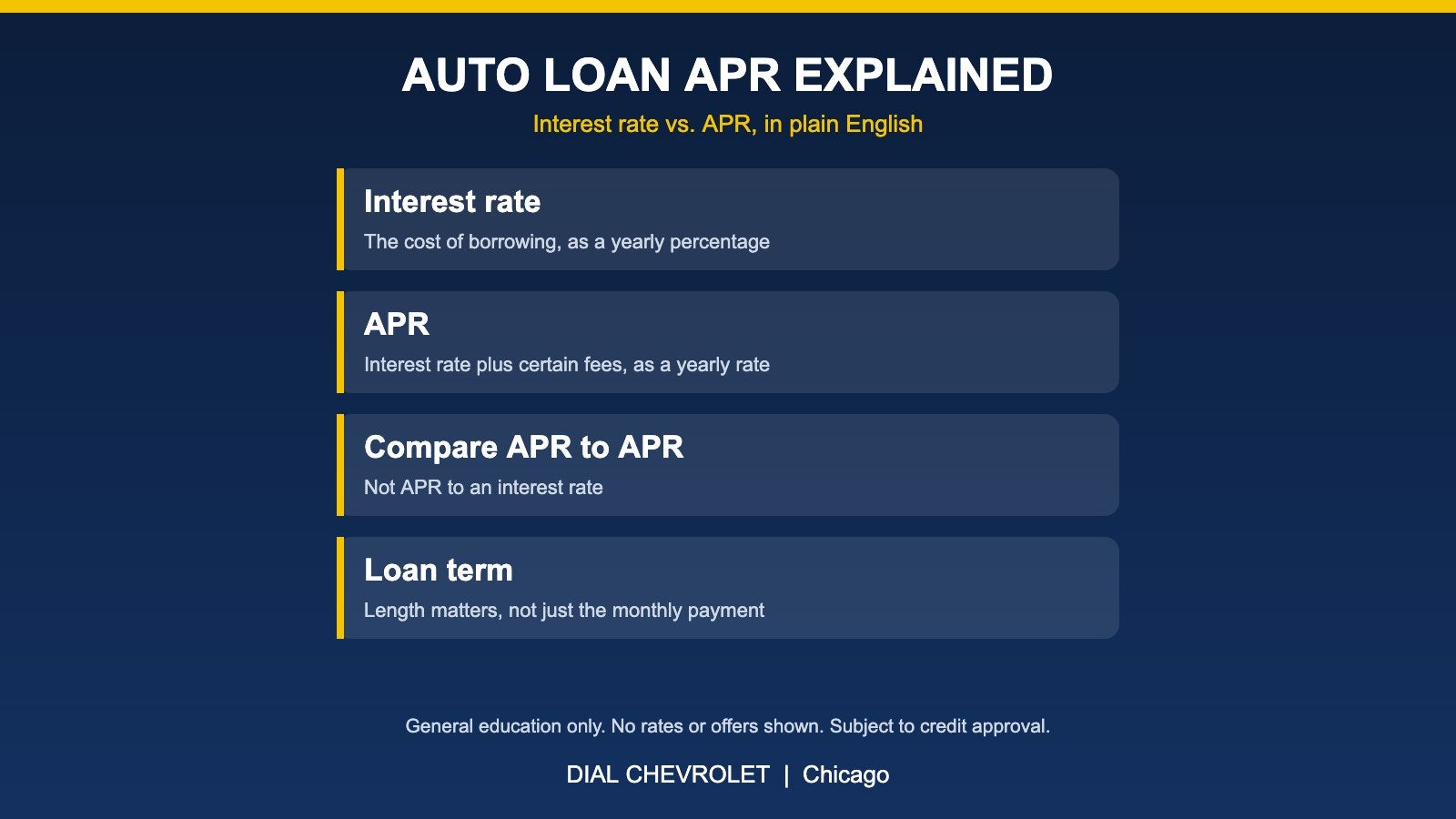
Graphic explaining interest rate versus APR, comparing APR to APR, and why loan term matters when financing a vehicle

Auto Loan APR Explained in Plain English

Short answer: an auto loan's interest rate is the cost of borrowing, and the APR (annual percentage rate) is a broader yearly figure that adds certain fees. When you compare financing offers, compare APR to APR, and look at the loan term and total cost as well as the monthly payment. Interest rate vs. APR The Consumer Financial Protection Bureau (CFPB) explains that the interest rate is the cost you pay each year to borrow money, expressed as a percentage, and it does not include loan fees. The APR reflects the interest rate plus certain fees charged with the loan, also as a yearly percentage. Because the two are not the same, the CFPB says to make sure you compare APRs to APRs and not APRs to interest rates. What else shapes the cost of a loan Loan term: a longer term can lower the monthly payment but usually means more interest over the life of the loan, so look at the total cost, not just the payment. Down payment: the CFPB notes that a larger down payment reduces the amount you borrow and can lower the total cost of the loan. A trade-in can count toward a down payment. Fixed vs. variable rate: with fixed-rate financing the rate does not change over the life of the loan, so the payment stays the same. Add-ons: products such as extended warranties or debt cancellation are optional and affect the amount financed. Ask what each one costs and whether it is required. Negative equity: if you owe more on your current vehicle than it is worth, the CFPB warns that rolling that balance into a new loan can make the new loan more expensive. Our guide to trading in a car with a loan goes through this. Where financing can come from The CFPB describes two common routes: dealer-arranged financing, where the dealership sends your application to one or more lenders, and a loan from a bank or credit union you arrange yourself. The CFPB's advice is to shop around and compare offers, including any quote you already have, so you can see what fits your budget. Federal law also requires lenders and dealers to give you Truth in Lending disclosures, including the APR and finance charge, before you sign. Questions to ask before you sign What is the APR, and what fees are included in it? What is the loan term, and what is the total amount I will pay over that term? Is the rate fixed? Are any add-on products included, and are they optional? Is there a penalty for paying the loan off early? This article does not list rates, payments or offers. Any financing terms depend on the lender, your credit and the specific vehicle, and are subject to credit approval. See our guide to buying vs. leasing a Chevrolet and the comparison of new vs. used Chevrolet for more on how to choose. Talk to the Dial Chevrolet Team To ask about financing options, contact the dealership. You can also browse new inventory, browse used inventory or value your trade-in. Our trade-in preparation guide can help you get ready. Sources CFPB, What is a loan annual percentage rate (APR)? CFPB, Auto loans key terms CFPB, Shopping for your auto loan Published by Dial Chevrolet, 6603 S Western Ave, Chicago. This article is general education only and is not financial or legal advice. It does not include any rates, payments, pricing or offers. Financing is subject to credit approval.

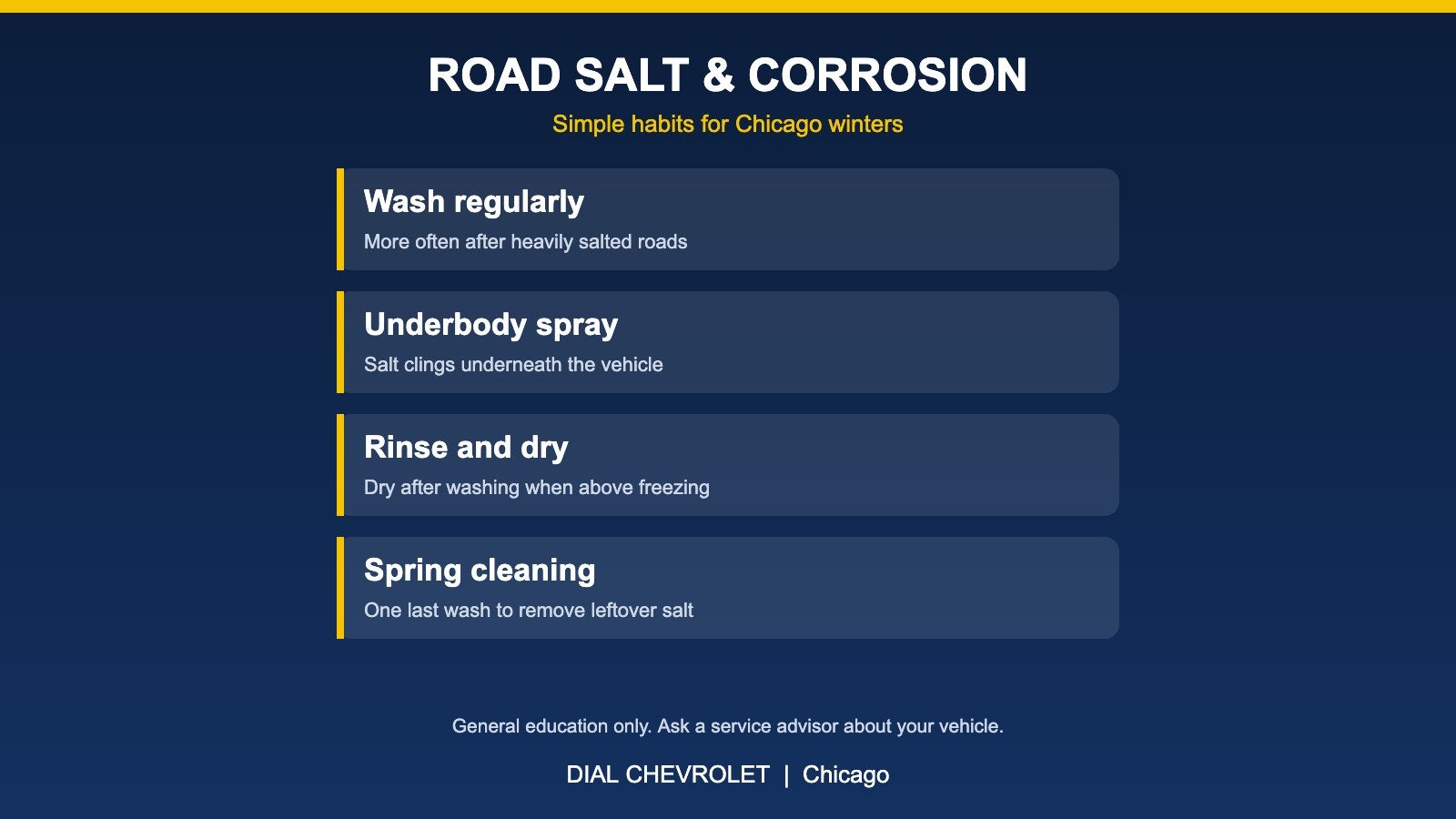
Checklist graphic for fighting road salt corrosion: wash regularly, use underbody spray, rinse and dry, and do a spring cleaning

Road Salt and Your Chevy: How to Fight Corrosion

Short answer: road salt and de-icers help keep Chicago roads safer, but the salty spray that clings to your vehicle can speed up rust, especially underneath where you cannot see it. Regular washing that includes the undercarriage is the habit AAA and Consumer Reports point to most. Why salt matters for your vehicle AAA says salty water that splashes onto a vehicle and sticks to metal parts underneath can accelerate rust and corrosion. Frames, brake lines and exhaust parts are among the components AAA names. Today's vehicles have corrosion-resistant designs, but AAA notes that the undercarriage is still vulnerable, and damage is easy to miss because it happens out of sight. Habits that help Wash regularly in winter. AAA's Auto Club Group recommends washing at least every two weeks, and more often after driving on heavily salted roads. Consumer Reports' experts advise a monthly wash during snow season, or more often if the vehicle is coated in salt. Include the undercarriage. Choose a car wash with underbody sprays, or rinse the underside yourself. Consumer Reports says an underbody spray is a worthwhile add-on if you live where roads are salted. Rinse first. AAA suggests flushing off loose salt before washing to protect the paint. Wax before winter. AAA recommends a fresh coat of wax before winter to help shield paint from salt and moisture. Wash when it is above freezing and dry the vehicle afterward. This helps keep doors, locks and seals from refreezing. Keep floor mats clean and dry. Wet mats can hold moisture against the floor. Do one more thorough wash in spring. AAA says leftover deposits can keep causing corrosion if they are not removed. Signs to have something looked at Bubbling paint, rust spots, rust flaking from underbody parts, or a brake pedal that feels different are good reasons to have a technician take a look. Do not wait to see whether it improves. Brake lines and other underbody parts are safety items, so our brake service warning signs guide is a useful companion. Pair it with other winter checks Salt season is also tough on tires and wheels. See our guides to tire tread depth and winter tires, checking for pothole damage, and the Chicago winter prep checklist. Talk to the Dial Chevrolet Team If you would like your Chevrolet looked over after salt season, you can schedule service. For questions, contact the dealership, or review the Chevy maintenance schedule guide. Sources AAA, Winter Road Salt Can Cause Hidden Vehicle Damage Consumer Reports, How Often Should You Wash Road Salt Off Your Car? Published by Dial Chevrolet, 6603 S Western Ave, Chicago. This article is general education only and does not include pricing or offers. Corrosion protection needs vary by vehicle, so ask a service advisor about your own vehicle and refer to your owner's manual.

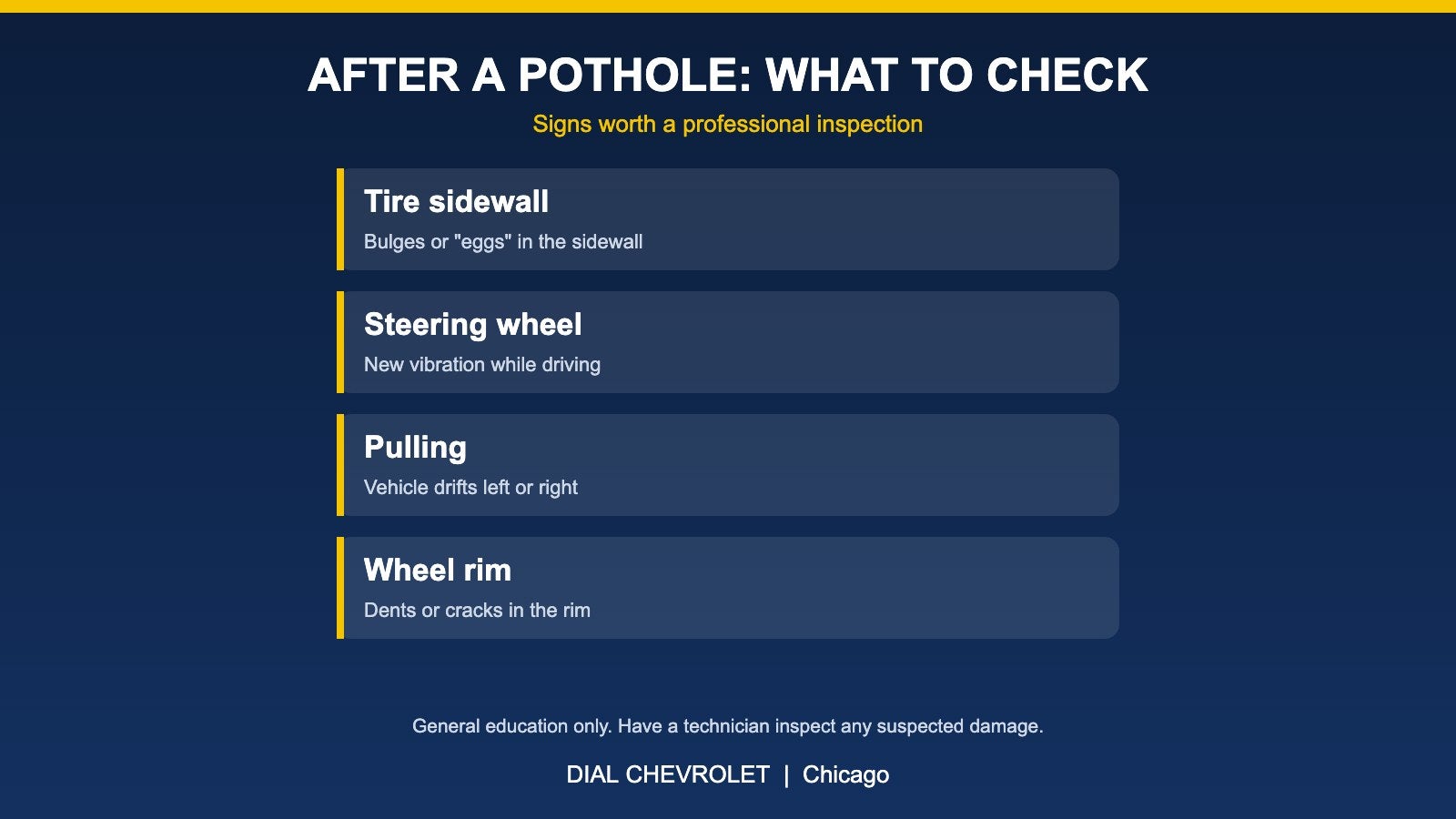
Checklist graphic of signs of pothole damage: tire sidewall bulges, steering wheel vibration, pulling to one side, and dents or cracks in the wheel rim

After a Pothole: Tire, Wheel and Alignment Checks

Short answer: if you hit a pothole hard, pay attention to how the vehicle drives right afterward, and have the tires, wheels and suspension inspected if anything feels or looks different. Damage is not always visible, so a quick check by a technician is worth considering. What a hard pothole hit can damage Tires usually take the first hit. A pothole can pierce a tire or damage its sidewall, and Consumer Reports notes that a tire can have internal structural damage that you cannot see, even if it still holds air. The wheel itself can also be bent or cracked, and suspension and steering parts such as control arms and tie rods can be harmed. A hard strike can also knock the wheel alignment out of position. Signs worth checking Bulges or "eggs" in a tire sidewall. Vibration in the steering wheel that was not there before. The vehicle pulls to one side. AAA says to have a qualified mechanic check the wheel alignment if the vehicle pulls left or right. Dents or cracks in the wheel rim. New noises or vibrations. AAA says to have the suspension inspected if you notice them. Falling tire pressure. Air loss from a damaged tire can take time to show up, so recheck the pressure over the next few days. If you suspect a problem while driving, pull over somewhere safe, ideally on flat ground, and look for visible damage to the tire and wheel. If anything looks wrong, do not keep driving on it. How to lower the risk Keep tires properly inflated and in good condition. AAA notes that worn or underinflated tires raise the risk of wheel or suspension damage in a pothole strike. Our guide to tire tread depth and winter tires explains how to check. Slow down safely if you cannot avoid the pothole. Check your surroundings before swerving or braking, since hitting a vehicle or pedestrian is worse than hitting the hole. Be careful with puddles. A puddle can hide a deep pothole. Do not brake hard into the pothole. Consumer Reports notes that hard braking shifts weight forward and compresses the tires, which can raise the risk of damage. AAA suggests easing off the brakes just before impact if it is safe to do so. Reporting a pothole or damage If a pothole damaged your vehicle on a City of Chicago street, the City Clerk's office has a page about vehicle damage claims. Requirements and outcomes can change, so check the City's current instructions yourself, and keep your repair paperwork. Dial Chevrolet cannot advise on whether a claim will be approved. Our brake service warning signs and Chicago winter prep checklist cover other things worth checking this time of year. Talk to the Dial Chevrolet Team If your Chevrolet feels different after a pothole hit, you can schedule service so a technician can inspect it. For general questions, contact the dealership, or see the Chevy maintenance schedule guide. Sources AAA, How to Avoid Pothole Damage Consumer Reports, Pothole Survival Guide Chicago City Clerk, Claims Published by Dial Chevrolet, 6603 S Western Ave, Chicago. This article is general education only. It does not include pricing or offers and is not legal advice. Have a qualified technician inspect any vehicle you suspect is damaged.

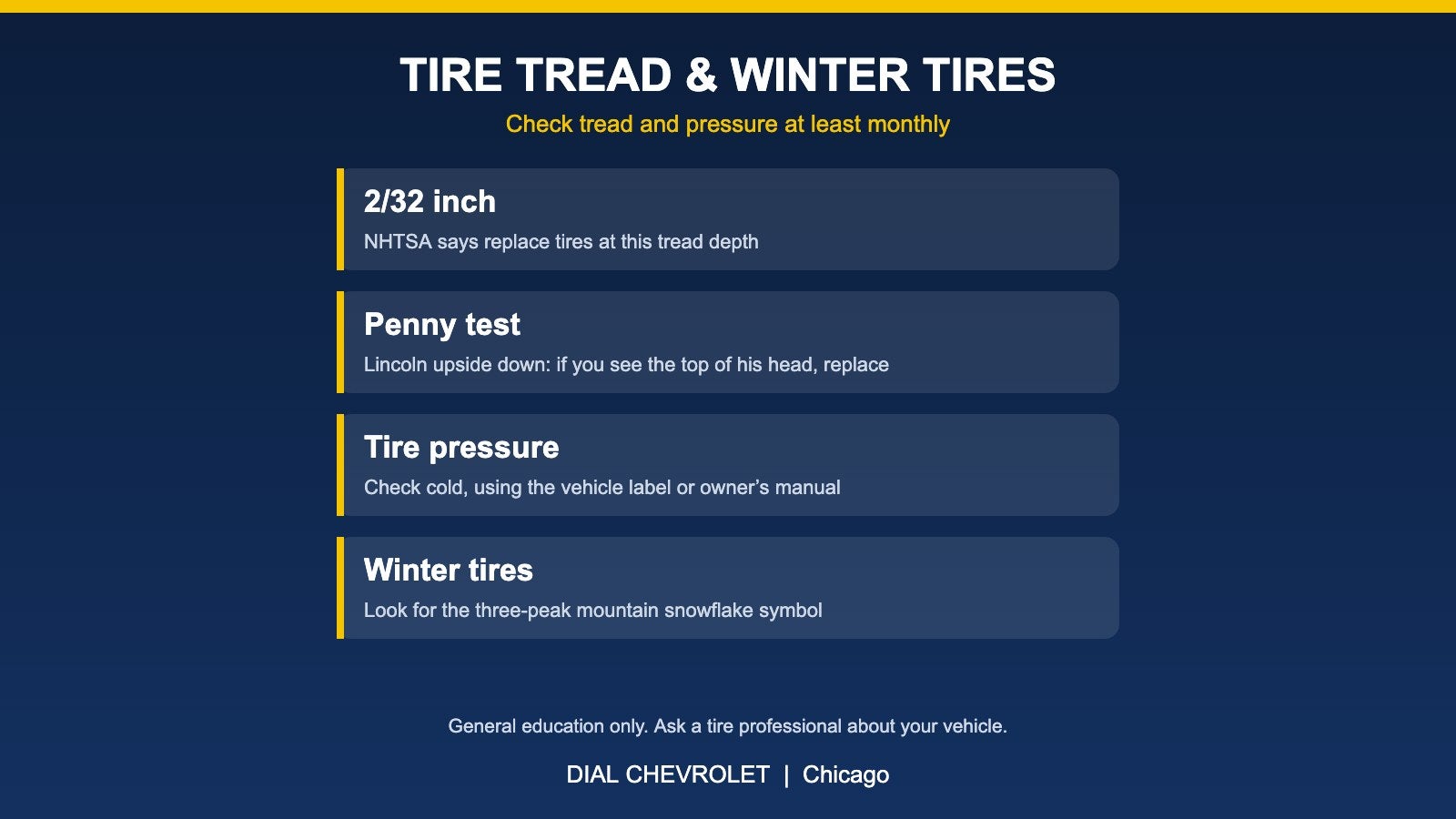
Checklist graphic: replace tires at 2/32 inch tread, penny test, check cold tire pressure, look for the mountain snowflake winter tire symbol

Tire Tread Depth and Winter Tires in Chicago

Short answer: NHTSA says tires should be replaced when the tread wears down to 2/32 of an inch, and it recommends checking tread and tire pressure at least monthly. In a Chicago winter, many drivers also ask whether all-season tires are enough or whether winter tires are worth it. Here is how to check what you have and what to ask a tire professional. How to check tread depth Your tires' tread is what grips the road, especially when it is wet or icy. NHTSA describes a few simple checks you can do at home: Penny test: put a penny into the tread upside down with Lincoln's head facing you. If you can see the top of his head, it is time to replace the tires. Treadwear indicators: raised bars sit between the tread grooves. When the tread is worn level with them, the tire needs replacing. Tread depth gauge: a low-cost gauge gives you an actual measurement, and a service advisor can measure it for you. Check several spots across each tire, because tires can wear unevenly. Uneven wear is also a good reason to ask about alignment and rotation. Our guide to how often to rotate Chevy tires covers the rotation side. Do not stop at 2/32 if winter traction matters 2/32 of an inch is the point where NHTSA says a tire should be replaced. It is a minimum, not a target. Consumer Reports testing has found that all-season tires can lose a noticeable amount of grip on wet, snowy and icy surfaces well before they are worn out, so some drivers choose to replace tires earlier ahead of winter. A tire professional can tell you what makes sense for your vehicle and how you drive. Check tire pressure monthly Check all tires, including the spare, at least once a month when they are cold, meaning the vehicle has not been driven for at least three hours. Use the pressure listed by the vehicle manufacturer on the Tire and Loading Information label or in the owner's manual, not the number printed on the tire. A tire pressure monitoring system (TPMS) only warns you when a tire is significantly underinflated, so it does not replace a manual check. Tire age matters too You cannot judge a tire's age by looking at it. Some manufacturers recommend replacing tires that are six to ten years old regardless of tread wear. The last four digits of the DOT Tire Identification Number on the sidewall show the week and year the tire was made. Age matters most for vehicles that are driven infrequently. All-season vs. winter tires NHTSA notes that all-season tires handle a variety of road conditions and have some mud and snow capability, while winter tires perform better than all-season tires in deep snow. The best choice depends on where you live and the weather you usually drive in. Winter tires that pass a winter traction test carry a symbol of a mountain with a snowflake on the sidewall. If you are unsure, ask a tire professional about your driving habits, your vehicle and how much winter driving you do. Our Chicago winter prep checklist has more ideas for getting a vehicle ready for the season. Talk to the Dial Chevrolet Team If you would like your tires looked over, you can schedule service with the Dial Chevrolet service team. See the Chevy maintenance schedule guide for other routine checks, contact the dealership with questions, or browse new inventory. Sources NHTSA, Tires Consumer Reports, Make sure your tires have enough tread for winter Published by Dial Chevrolet, 6603 S Western Ave, Chicago. This article is general education only and does not include pricing or offers. Tire needs vary by vehicle and driving, so ask a tire professional or your service advisor about your own tires.

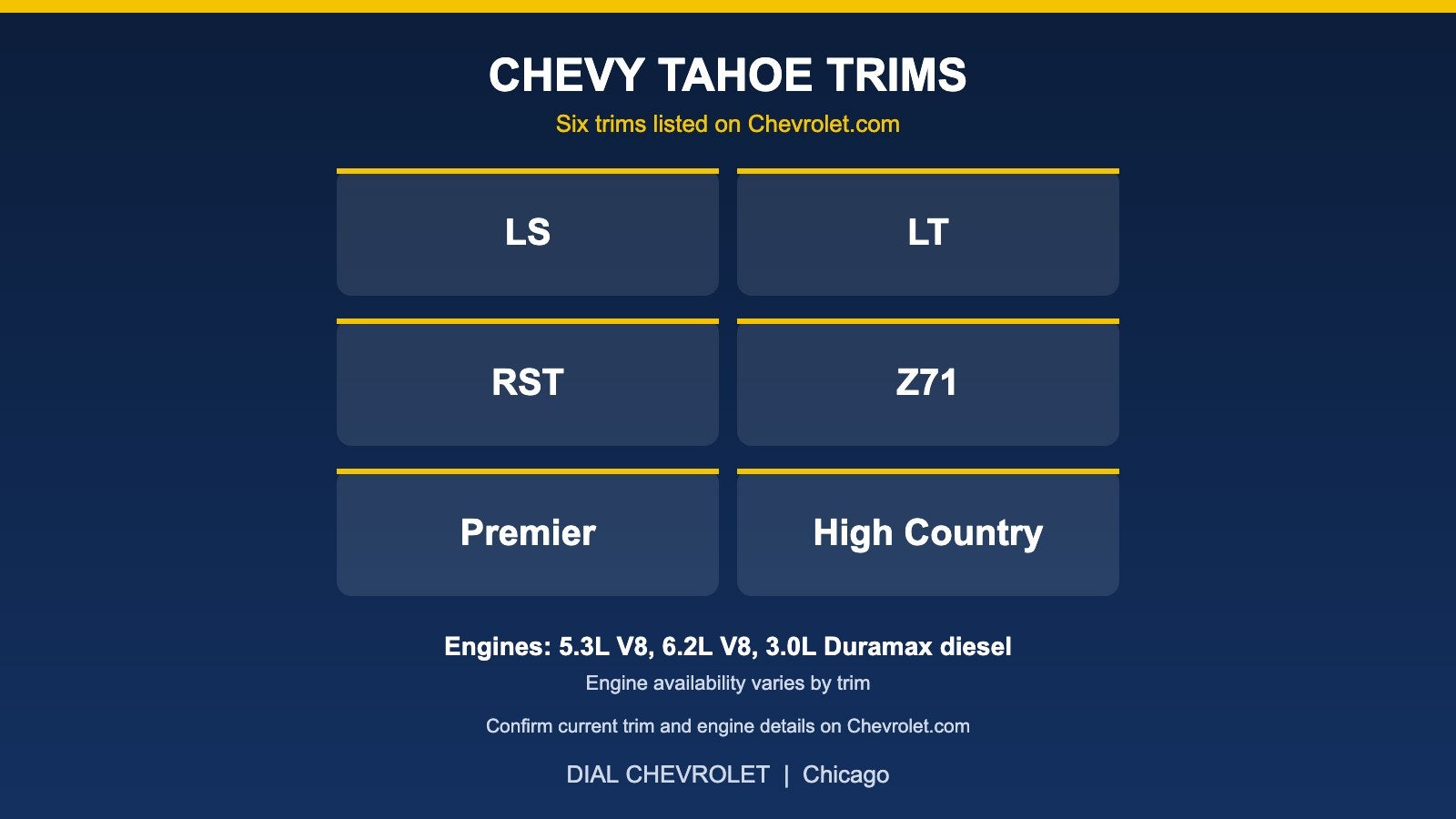
List of the six Chevrolet Tahoe trims, LS, LT, RST, Z71, Premier and High Country, with the three engines listed on Chevrolet.com

Chevy Tahoe Trims Explained: Which One Fits You?

Short answer: the Tahoe comes in six trims, and the right one depends mostly on the seating, engine and features you want. Start with how many people you carry and whether you tow, then compare trims and engines on Chevrolet.com and with the dealership. The six Tahoe trims Chevrolet lists the Tahoe in six models: LS, LT, RST, Z71, Premier and High Country. This guide sticks to details Chevrolet publishes, and trim content can change from one model year to the next, so confirm the current build sheet before you decide. LS: the entry trim. Chevrolet lists seating for up to nine as available on the LS. LT: a step up from the LS. The LT is one of the trims where Chevrolet lists the Duramax 3.0L Turbo-Diesel as available. RST: the sport-styled trim. Chevrolet lists available 24-inch wheels on the RST, and the 6.2L V8 is available on it. Z71: the off-road-oriented trim, with the 6.2L V8 available. Premier: a more upscale trim. Chevrolet lists heated and ventilated front seats on the Premier and High Country, and the 6.2L V8 is available. High Country: the top trim. The 6.2L V8 is standard, and Chevrolet lists leather seating surfaces with perforated inserts in the first and second rows. Engines Chevrolet lists three engines across the Tahoe lineup. The 5.3L V8 is the base engine, rated at 355 hp and 383 lb-ft of torque. The 6.2L V8 is rated at 420 hp and 460 lb-ft, standard on the High Country and available on the RST, Z71 and Premier. The Duramax 3.0L Turbo-Diesel is rated at 305 hp and 495 lb-ft and is listed as available on the LT, RST, Z71, Premier and High Country. Towing ratings depend on the engine, drive and equipment, so check the rating for the exact vehicle. How to narrow it down Passengers: decide how many seats you need and how the second row is configured. Towing: if you tow, compare engine choices and ask for the rating of the specific Tahoe. Our guide to towing fundamentals explains how ratings work. Driving mix: think about how much city, highway and trip driving you do. Features: list the features you will use every day, then see which trim includes them. Tahoe or Suburban? If you need more cargo room behind the third row, compare the Tahoe with the Suburban in our Suburban vs. Tahoe guide, and see the Chevy SUV buying guide for the wider lineup. Talk to the Dial Chevrolet Team The team at Dial Chevrolet can help you compare Tahoe trims and available inventory. You can browse new inventory, contact the dealership, value your trade-in or schedule service. Sources Chevrolet.com, Tahoe Chevrolet.com, Tahoe features Published by Dial Chevrolet, 6603 S Western Ave, Chicago. This article is general education only and does not include pricing or offers. Trims, engines and features change by model year, so confirm details with the dealership and Chevrolet.com.
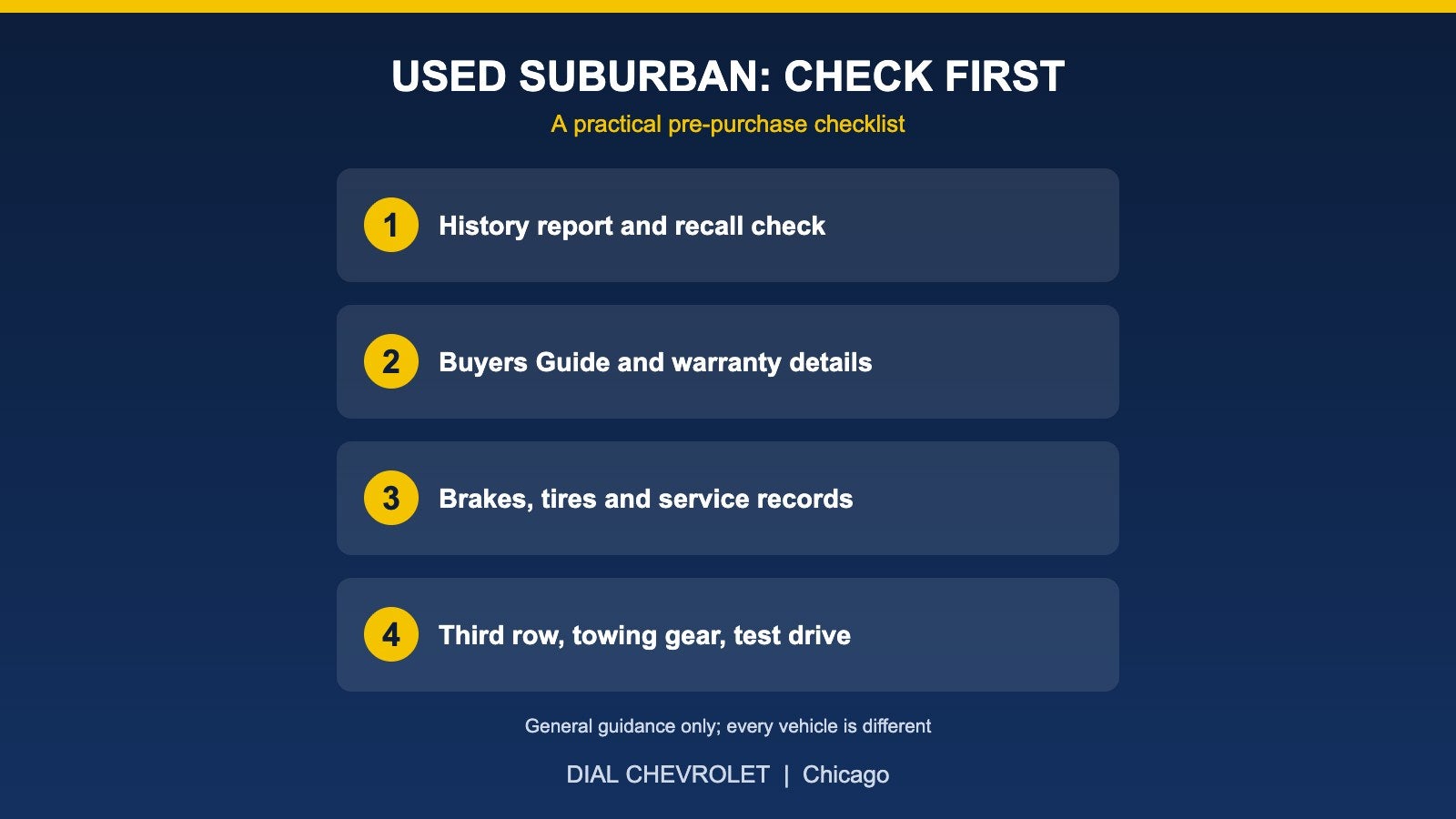
Four-step checklist for buying a used Chevrolet Suburban: history report and recall check, Buyers Guide and warranty details, brakes tires and service records, third row towing gear and test drive

Buying a Used Chevy Suburban: What to Check First

Short answer: before you buy a used Suburban, check its history and recalls, read the Buyers Guide, inspect the wear items and service records, and drive it the way you will actually use it. A careful checklist helps you compare vehicles on facts instead of appearances. 1. Start with the paperwork Federal rules require dealers to display a Buyers Guide on the used vehicles they offer for sale. The FTC says the guide includes the dealer's contact information and warranty details, and it recommends getting a vehicle history report and checking for safety recalls before you buy. Ask for the history report and read the warranty section closely. The FTC also notes that spoken promises are difficult to enforce, so ask the dealer to put promises in writing. You can check any vehicle for open safety recalls using its 17-character VIN. NHTSA's recall lookup shows unrepaired recalls for a VIN, and our guide to checking a Chevy recall by VIN walks through the steps. 2. Review the service records Ask what service records are available and what the dealership inspected or reconditioned before putting the vehicle up for sale. Compare the records with the schedule in the owner's manual, and see our overview of the Chevy maintenance schedule for the kinds of items that come up. 3. Inspect the wear items Tires: check tread depth, uneven wear and the age of the tires. See how often to rotate tires. Brakes: listen for noise and feel for vibration or a soft pedal. Our guide to brake service warning signs lists what to watch for. Dashboard lights: make sure none stay on after startup. See Chevy dashboard warning lights. Body and underside: Chicago winters are hard on vehicles, so look for rust and salt damage on the underbody and around the wheel wells. 4. Check the space and the equipment The Suburban is a full-size SUV with three rows of seating, so sit in every row, fold and raise the seats, and load something bulky to see how the cargo area works for you. If you plan to tow, ask about the hitch and trailer wiring on that specific vehicle and confirm its towing rating rather than assuming. Our Suburban vs. Tahoe guide and 2027 Suburban trims, engines and cargo space article explain the differences you may care about. 5. Take a real test drive Drive on city streets and on the highway. Check steering, braking, acceleration, ride quality, noise and how the climate controls and screens work. Bring the people you carry most often so you can see how the vehicle fits everyone. Compare new and used If you are weighing a used Suburban against a new one, see our guide on new vs. used Chevrolet. If you plan to trade in a vehicle, our trade-in preparation checklist can help. Talk to the Dial Chevrolet Team The team at Dial Chevrolet can help you compare vehicles and answer questions about any vehicle you are considering. You can browse used inventory, contact the dealership, value your trade-in or schedule service. Sources FTC, Buying a Used Car From a Dealer NHTSA, Recalls Published by Dial Chevrolet, 6603 S Western Ave, Chicago. This article is general education only and does not include pricing or offers. Every vehicle is different, so confirm details with the dealership and the owner's manual.

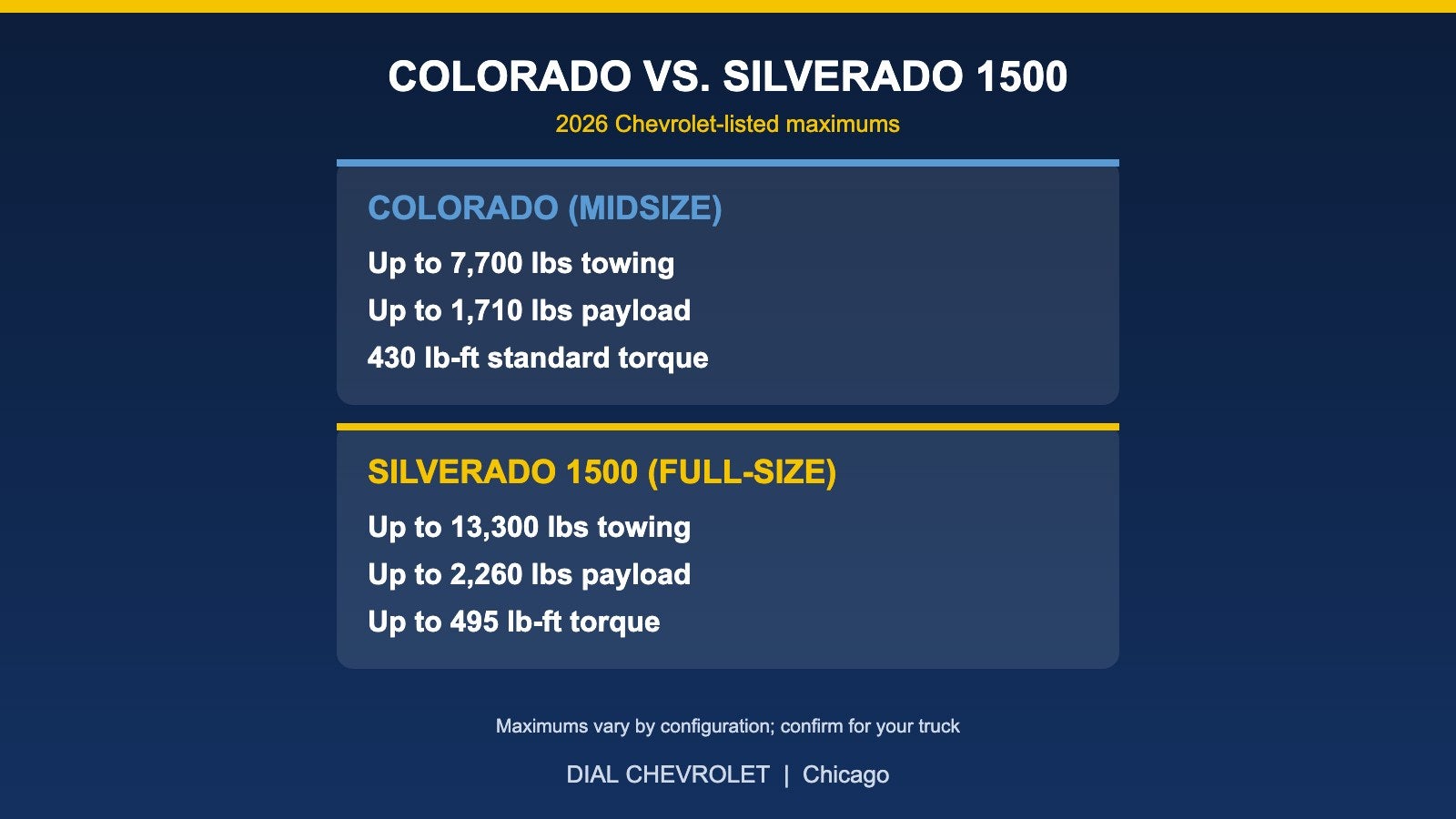
Comparison of 2026 Chevrolet Colorado and Silverado 1500 maximum towing, payload and torque as listed by Chevrolet

Chevy Colorado vs. Silverado 1500: Which Truck Size Fits?

Short answer: choose the Colorado if you want a midsize truck for lighter towing and everyday use, and the Silverado 1500 if you need more towing and payload room. Compare the ratings for the exact configuration you plan to buy, because the maximums depend on how each truck is equipped. What Chevrolet lists for each truck For the 2026 model year, Chevrolet lists the Colorado with a 2.7L TurboMax engine rated at 310 hp and 430 lb-ft of torque, up to 7,700 lbs of maximum available towing and up to 1,710 lbs of maximum available payload. The Silverado 1500 page lists up to 13,300 lbs of maximum available trailering, up to 2,260 lbs of maximum available payload and up to 495 lb-ft of maximum available torque, with four engine choices. Chevrolet's current Colorado page lists a higher engine output of 350 hp and 450 lb-ft, so confirm which model year and rating apply to the truck you are looking at. Size and daily driving The Colorado is a midsize pickup and the Silverado 1500 is a full-size pickup, so the Silverado is generally larger overall. If you park on the street, use a tight garage or drive in dense areas of Chicago, measure your space and test drive both trucks before deciding. Cab style and bed length change the size of either truck, which our guide to Silverado cab sizes and bed lengths explains. When the Colorado is a good fit You tow smaller trailers or loads well within its rating. You want a truck bed for weekend projects, bikes or gear without the size of a full-size pickup. Easier parking and maneuvering matter to you. When the Silverado 1500 is a better fit You regularly tow heavier trailers or want more margin under the truck's limits. You carry heavy cargo or use the truck for work. You want a wider choice of engines, cab and bed combinations and trims. See Silverado 1500 trim levels explained. Check the numbers that apply to you Weigh what you actually tow and carry, then compare it with the ratings for the exact truck, including the payload sticker. Our guides on towing fundamentals and how payload works show how to read those limits. Talk to the Dial Chevrolet Team The team at Dial Chevrolet can help you compare available trucks side by side. You can browse new inventory, contact the dealership or value your trade-in. More truck guides are in our Silverado Trucks category. Sources Chevrolet.com, Colorado Chevrolet.com, Silverado 1500 Chevrolet.com, Colorado comparison page Published by Dial Chevrolet, 6603 S Western Ave, Chicago. This article is general education only and does not include pricing or offers. Ratings are manufacturer maximums and vary by configuration; confirm details with the dealership and the owner's manual.

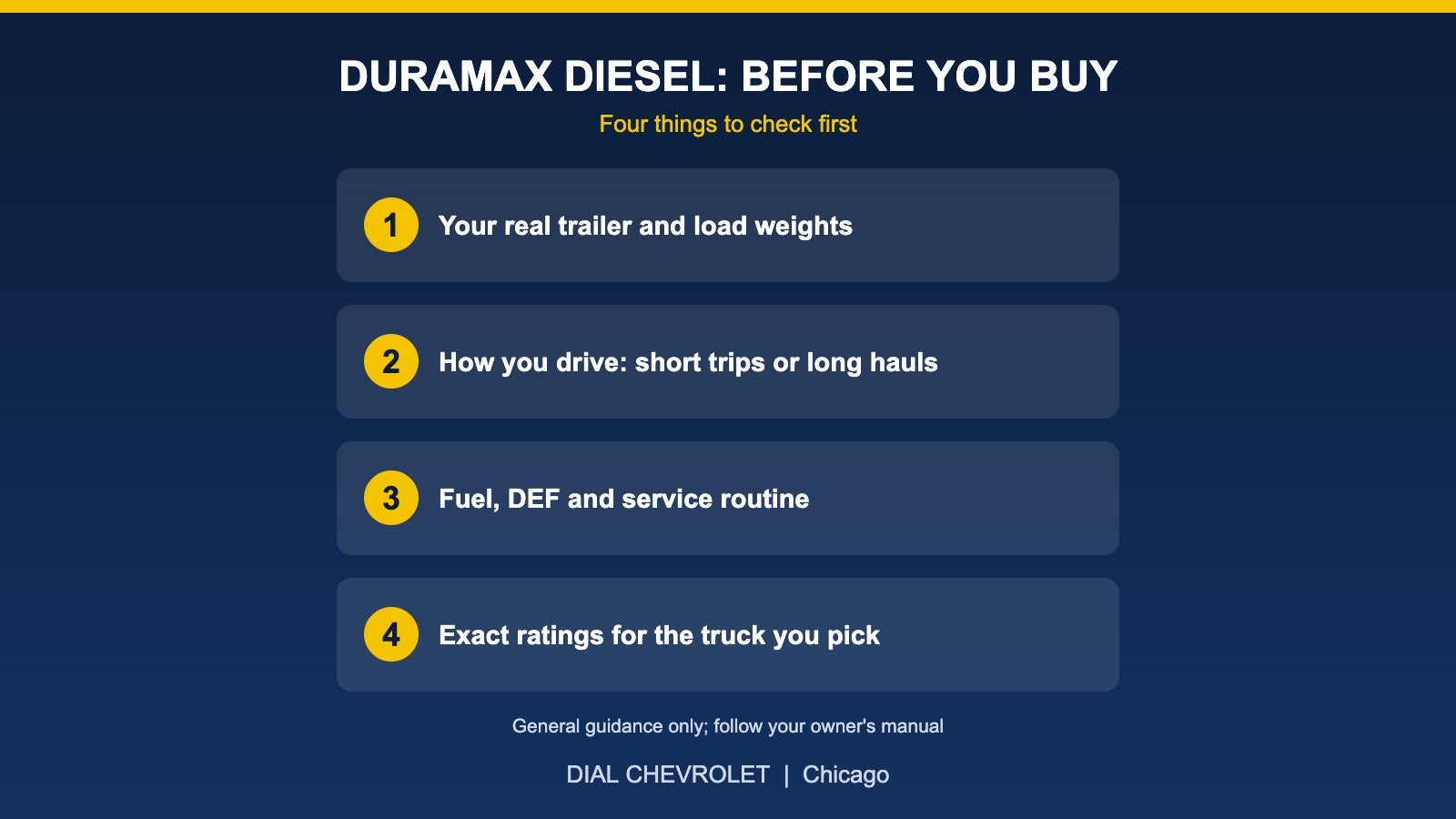
Checklist of four things to review before buying a Duramax diesel Chevrolet Silverado: trailer weight, driving pattern, fuel and service routine, and exact truck ratings

Duramax Diesel: What to Consider Before You Buy a Silverado

Short answer: a Duramax diesel can be a strong fit for heavy, frequent towing, but it is not the right choice for every driver. Start with your real trailer weight, your driving pattern and the ratings of the exact truck, then compare the gas and diesel options side by side. What Chevrolet lists for Duramax diesels Chevrolet offers Duramax diesel engines across the Silverado lineup. The Silverado 1500 offers an available Duramax 3.0L Turbo-Diesel. For the heavy duty trucks, Chevrolet's Silverado HD page lists a 6.6L Duramax rated at 470 hp and 975 lb-ft with up to 36,000 lbs of towing for the 2026 model year, and a Duramax 8.3L Turbo-Diesel V8 rated at 555 hp and 1,230 lb-ft with up to 38,000 lbs of towing for the 2027 model year. Chevrolet lists the 2027 HD under upcoming vehicles, so confirm availability with the dealership. These are manufacturer maximums, and the rating for a given truck depends on how it is equipped. 1. Start with your real towing and hauling weights Weigh your trailer and the gear you load into it, and note the tongue weight. Diesel makes the most sense when you regularly pull heavy loads or work close to a truck's ratings. If most of your towing is light or occasional, a gas engine may cover it. Our guide on Silverado 2500HD gas vs. diesel compares the two engine families in more detail. 2. Think about how you drive Diesel trucks are built for work, but daily driving matters too. Ask the dealership how a diesel's emissions system behaves with mostly short trips versus longer highway drives, and read the owner's manual for guidance on how it should be driven and maintained. 3. Plan the fuel and service routine Diesel trucks use diesel fuel, and modern diesels generally use diesel exhaust fluid (DEF) as part of their emissions system. Maintenance items and service intervals can differ from a gas truck. Use the owner's manual to see what each engine requires, and ask the service department what a typical routine looks like. You can schedule service with the Dial Chevrolet team once you own the truck. 4. Check the exact truck, not just the engine Towing and payload depend on cab, bed, drive, axle ratio and equipment as well as the engine. Ask for the ratings and the payload sticker for the specific truck. Our guides on towing fundamentals and how payload works explain what those numbers mean, and Silverado 1500 vs. 2500HD helps you decide on the right truck class. Talk to the Dial Chevrolet Team If you are considering a Duramax Silverado, the team at Dial Chevrolet can help you compare configurations and check ratings against your trailer. You can browse new inventory, contact the dealership or value your trade-in. More truck guides are in our Silverado Trucks category. Sources Chevrolet.com, Silverado 2500HD Chevrolet.com, Silverado 1500 Published by Dial Chevrolet, 6603 S Western Ave, Chicago. This article is general education only and does not include pricing or offers. Specifications and availability can change, so confirm details with the dealership and the owner's manual.

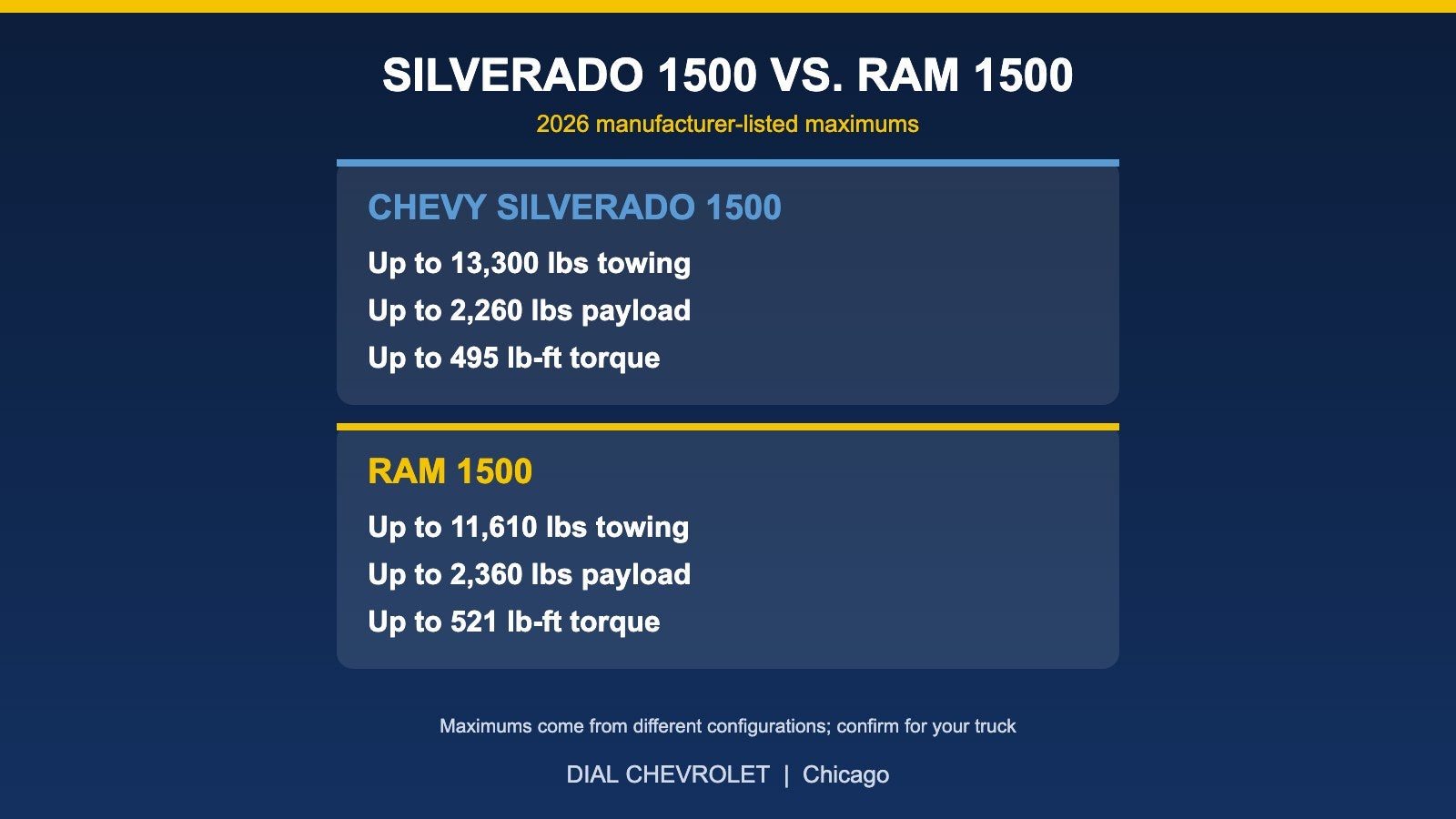
Side-by-side comparison of 2026 Chevrolet Silverado 1500 and Ram 1500 maximum towing, payload and torque as listed by each manufacturer

Silverado 1500 vs. Ram 1500: How to Compare Fairly

Short answer: the two half-ton trucks are closer than most ads suggest, and the best choice depends on the exact cab, bed, engine and equipment you pick. Compare them using each manufacturer's own ratings for the specific configuration, not the headline maximums. What each manufacturer lists For the 2026 model year, Chevrolet's Silverado 1500 page lists up to 13,300 lbs of maximum available trailering, up to 2,260 lbs of maximum available payload and up to 495 lb-ft of maximum available torque. Ram's 2026 Ram 1500 page lists up to 11,610 lbs of maximum towing and up to 2,360 lbs of maximum payload when properly equipped. Ram's pages list four engines for the 2026 Ram 1500: a 3.6L Pentastar V6, a standard-output 3.0L Hurricane inline-six, a high-output 3.0L Hurricane rated at up to 540 hp and 521 lb-ft, and the 5.7L HEMI V8 with eTorque. Chevrolet describes four engine choices for the 2026 Silverado 1500, including the available Duramax 3.0L Turbo-Diesel. Why headline numbers can mislead Each maximum is reached by a particular combination of cab, drive, engine, axle ratio and equipment. Ram's own engine pages show that its highest towing rating and its highest payload rating belong to different engines, so no single Ram 1500 delivers every maximum at once. The same is true of the Silverado. A truck built for maximum towing is usually not the one with maximum payload. How to compare fairly Start with the job: the heaviest trailer you pull, the heaviest load you carry in the bed, and how many passengers ride along. Compare the same cab style, bed length, drive type and trim level on both trucks. Ask for the towing and payload ratings of the exact truck, including its payload sticker, rather than a maximum from a brochure. Check engine and transmission details, and read the owner's manual sections on towing for each brand. Look at the whole ownership picture, including service, warranty coverage and how each truck fits your daily driving. What to check on a test drive Drive both trucks on roads you use every day. Check visibility, seating position, ride over rough pavement, cabin noise and how the towing and camera features work. If you tow, bring your trailer's weight and tongue weight so the ratings can be checked against real numbers. Learn the basics first Our guides on towing fundamentals and how payload works explain the ratings behind these numbers. If you are also weighing another brand, see Silverado 1500 vs. Ford F-150, and compare trims in Silverado 1500 trim levels explained. Talk to the Dial Chevrolet Team The team at Dial Chevrolet can walk through the ratings for the Silverado 1500 configurations available. You can browse new inventory, contact the dealership, value your trade-in or schedule service. More truck guides are in our Silverado Trucks category. Sources Chevrolet.com, Silverado 1500 RamTrucks.com, 2026 Ram 1500 FAQ RamTrucks.com, 2026 Ram 1500 Published by Dial Chevrolet, 6603 S Western Ave, Chicago. This article is general education only and does not include pricing or offers. Ratings are manufacturer maximums for the 2026 model year and vary by configuration; confirm details with each manufacturer and the dealership.

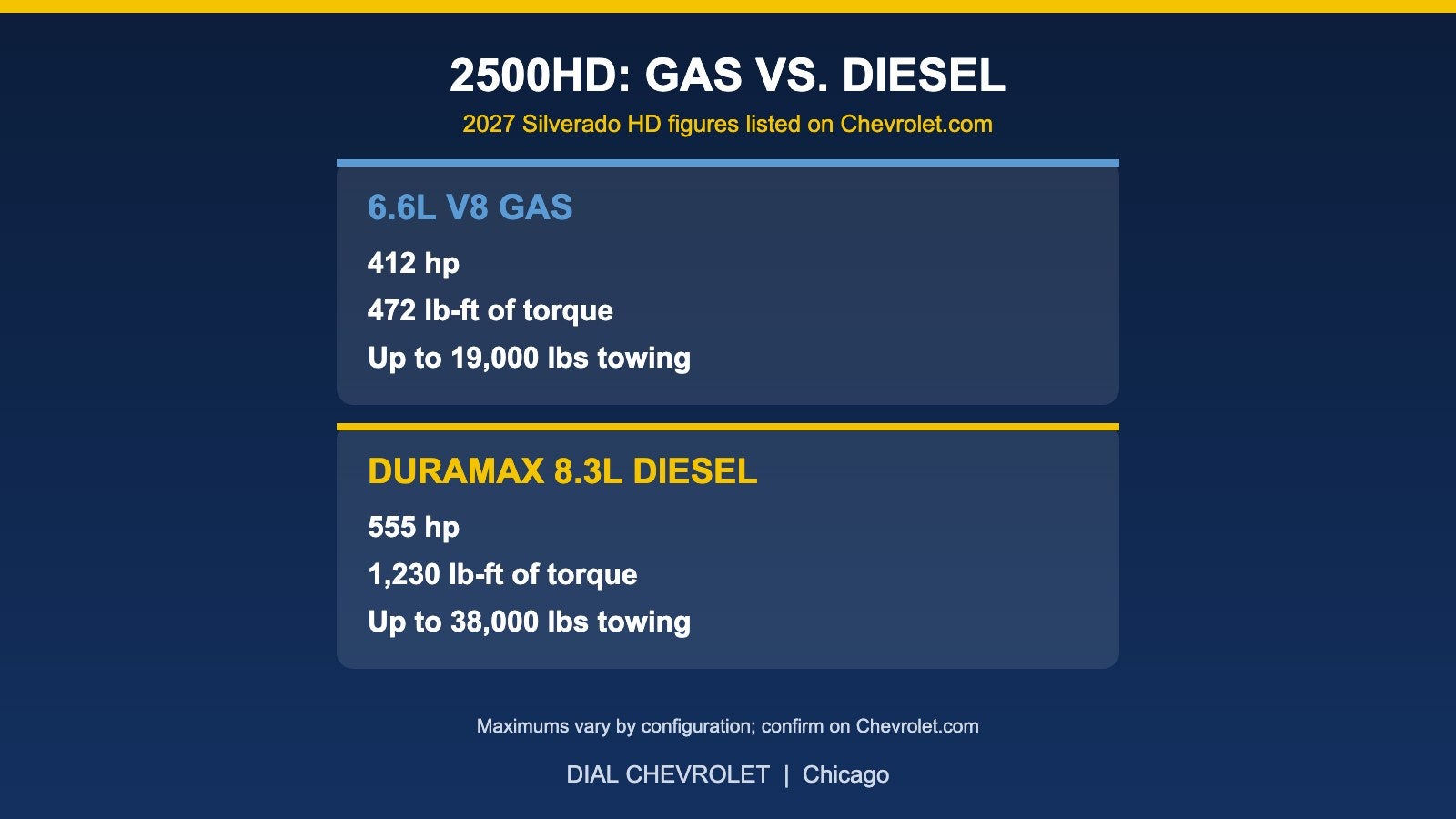
Comparison of the 6.6L V8 gas and Duramax 8.3L diesel engines for the 2027 Silverado HD, with horsepower, torque and maximum towing listed on Chevrolet.com

Silverado 2500HD Gas vs. Diesel: Which Engine Fits Your Towing?

Short answer: choose the gas 6.6L V8 if your towing is occasional and moderate, and look at the Duramax diesel when you regularly pull heavy trailers or run near the top of the truck's ratings. Always check the exact ratings for the specific truck you are considering. What Chevrolet lists for the 2027 Silverado HD engines Chevrolet's Silverado HD page lists two engine choices for the 2027 model year: a 6.6L V8 gas engine rated at 412 hp and 472 lb-ft of torque, and the Duramax 8.3L Turbo-Diesel V8 rated at 555 hp and 1,230 lb-ft. The page lists maximum towing of up to 19,000 lbs with the gas engine and up to 38,000 lbs with the diesel. Those are maximums, so the number that applies to a given truck depends on its cab, drive, axle ratio and equipment. Chevrolet lists the 2027 Silverado HD under upcoming vehicles, so availability and final specifications should be confirmed with the dealership before you plan around them. For context, Chevrolet's page for the current 2026 model lists the gas V8 at 401 hp and 464 lb-ft with up to 19,080 lbs of towing, and the 6.6L Duramax at 470 hp and 975 lb-ft with up to 36,000 lbs. When the gas engine is usually enough You tow a few times a year, such as a camper, boat or equipment trailer, and stay well under the truck's rating. Most of your driving is around town or short trips, where a diesel may not get the chance to work the way it was designed to. You want the simpler ownership profile of a gasoline engine and the fueling habits you already have. When the diesel makes sense You regularly pull heavy trailers, including long hauls or loads close to the top of the rating. You carry a heavy payload and a heavy trailer at the same time, where torque and exhaust braking support matter. The truck is a working tool for a business and the towing is part of the weekly routine. Ownership trade-offs to think through Engine choice affects more than towing numbers. Diesel and gas trucks differ in fuel type, fueling stops, maintenance items and service intervals. Modern diesel trucks generally use diesel exhaust fluid (DEF) as part of their emissions system, and the owner's manual lists the fluids, schedules and requirements for each engine. Compare the maintenance schedule for both engines in the manual, and ask the dealership how each is serviced, rather than assuming costs from general rules of thumb. Check the whole towing picture The engine is only one part of the answer. Payload, tongue weight, hitch type, axle ratio and the combined weight of the truck, passengers, cargo and trailer all count. Our guides on towing fundamentals and how payload works walk through those limits, and Silverado 1500 vs. 2500HD helps you decide whether you need a heavy duty truck at all. Talk to the Dial Chevrolet Team If you are weighing a gas or diesel Silverado HD, the team at Dial Chevrolet can help you compare the configurations available and check the ratings for your trailer. You can browse new inventory, contact the dealership, value your trade-in or schedule service. See more truck guides in our Silverado Trucks category. Sources Chevrolet.com, Silverado 2500HD Published by Dial Chevrolet, 6603 S Western Ave, Chicago. This article is general education only and does not include pricing or offers. Specifications and availability can change, so confirm details with the dealership and the owner's manual.

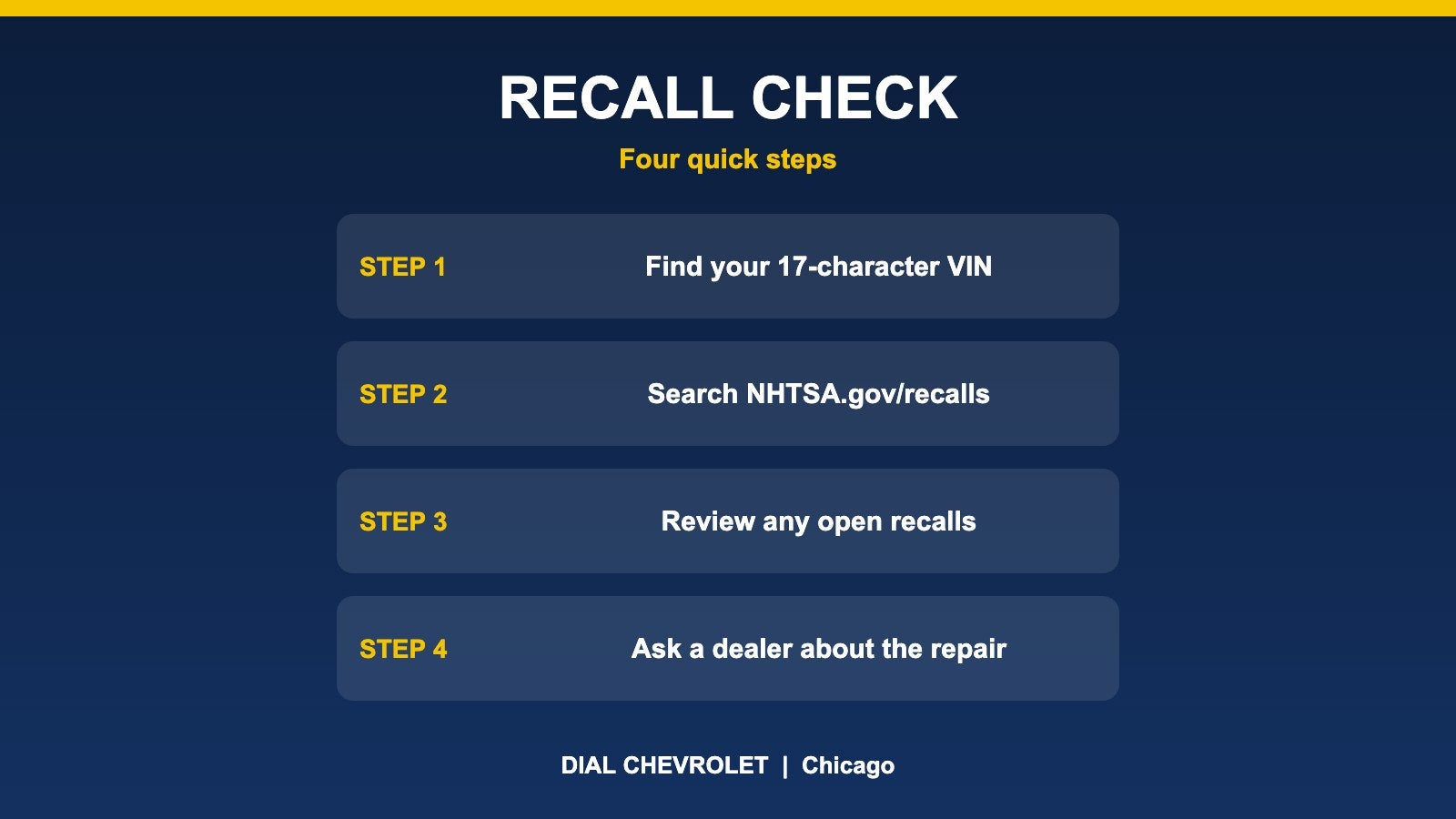
Recall check graphic: find your VIN, search NHTSA recalls, review open recalls, ask a dealer about the repair

Check Your Chevy for Recalls by VIN

Short answer: Enter your 17-character VIN at NHTSA.gov/recalls, or ask a Chevrolet dealer to look it up. If the search shows an open safety recall, NHTSA says to get the vehicle repaired for free at a local dealership. NHTSA also recommends checking for recalls at least twice a year. This guide is general information and lists no prices or offers. Step 1: Find your VIN NHTSA says the 17-character vehicle identification number (VIN) is on the lower left corner of the windshield, on the label inside the driver’s side door jamb, and on your registration or insurance documents. Step 2: Search for recalls Go to NHTSA.gov/recalls. Enter your VIN. NHTSA also lets you search by license plate. Read the result. If there are no unrepaired recalls, NHTSA’s search says so. If there is an open recall, it shows what the issue is and what steps to take. Kelley Blue Book notes that dealers also check for open recalls during routine maintenance such as oil changes, so it is worth asking at your next service visit. See our Chevrolet maintenance schedule guide for how routine visits fit together. What the VIN search does and does not show Shows: unrepaired safety recalls for your specific vehicle. Does not show: a safety recall that has already been repaired. New recalls: NHTSA notes that for some recently announced recalls, not every affected VIN has been identified yet, and VINs are added continuously, so check again later. Searching by year, make and model gives general results for recalls, investigations, complaints and manufacturer communications. Only the VIN or license plate search tells you about one specific vehicle. If your Chevrolet has an open recall Note the recall details shown in the search. Contact a Chevrolet dealer to schedule the repair. NHTSA says recall repairs are done for free. Follow any instructions in the recall notice about driving the vehicle until it is repaired. You can schedule service at Dial Chevrolet or contact us with your questions. Checking before you buy a used vehicle A recall check takes a minute and is easy to include when you compare vehicles. Recall status can change, so consider checking again close to the day you buy. Our used Silverado checklist and new vs used guide cover other points to review, and you can browse used inventory or new inventory when you are ready. Other ways to stay informed NHTSA’s SaferCar app can send an alert if a safety recall is issued for a vehicle, tire or car seat you add. NHTSA also lists recalls for car seats, tires and equipment, not only vehicles. If a warning light appears, our dashboard warning lights guide explains what the colors generally mean. A warning light is not the same thing as a recall, so use the VIN search for recall status. Schedule service at Dial Chevrolet Schedule service View service and parts specials Order parts Value your trade-in Contact Dial Chevrolet Sources NHTSA: recalls and VIN search NHTSA: check for recalls in two steps NHTSA: Vehicle Safety Recalls Week NHTSA: vehicle recalls handout Kelley Blue Book: everything you need to know about recalls Published by Dial Chevrolet, 6603 S Western Ave, Chicago, IL. General education only. NHTSA’s tools and wording can change; check NHTSA.gov/recalls for current information about your vehicle. This guide does not list prices or offers.

Contact Us

Fill out this form below and we'll contact you shortly
*Required Fields