Blog / Suburban and SUVs

Buying a Used Chevy Suburban: What to Check First

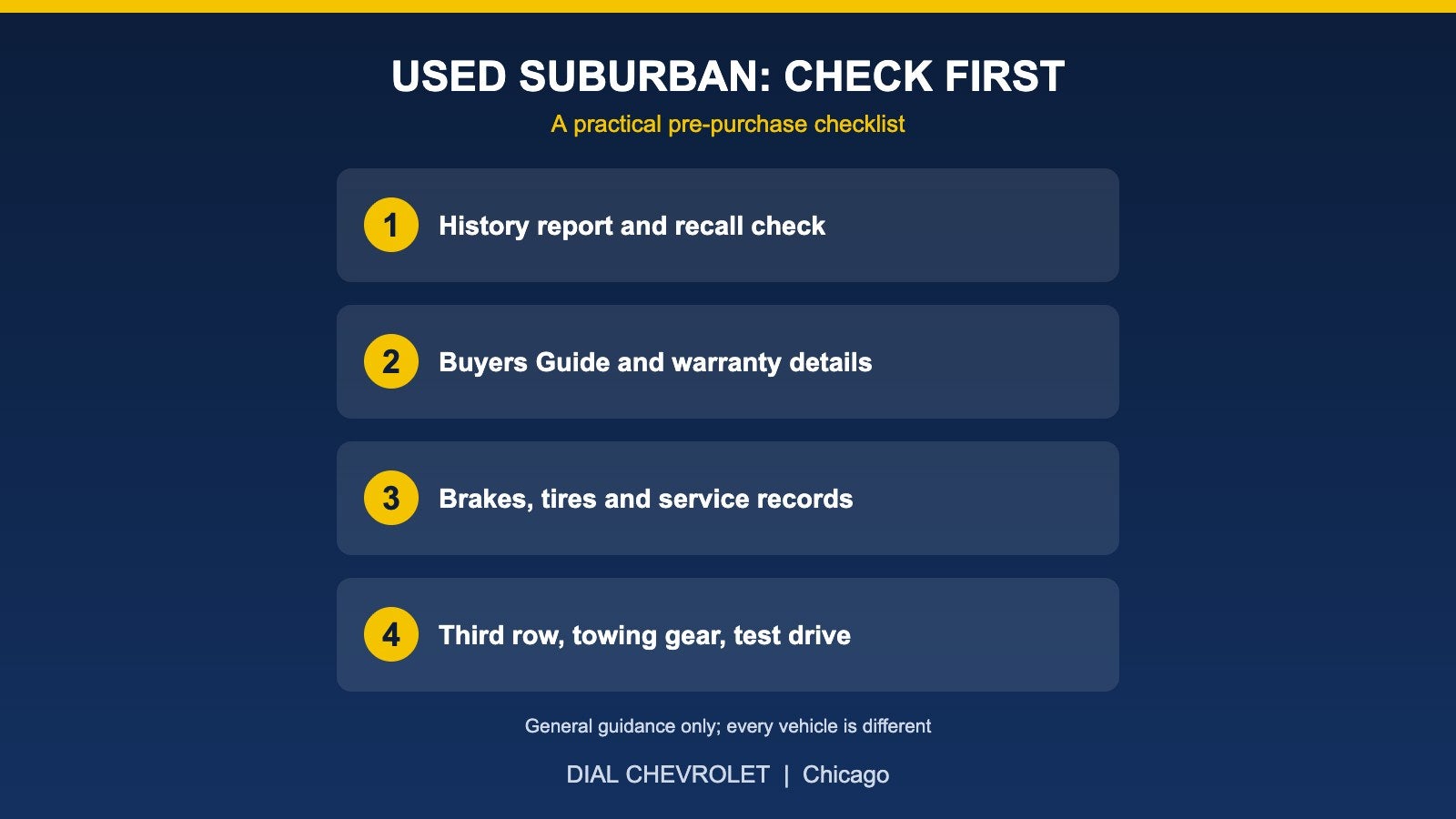
Four-step checklist for buying a used Chevrolet Suburban: history report and recall check, Buyers Guide and warranty details, brakes tires and service records, third row towing gear and test drive

Short answer: before you buy a used Suburban, check its history and recalls, read the Buyers Guide, inspect the wear items and service records, and drive it the way you will actually use it. A careful checklist helps you compare vehicles on facts instead of appearances.

1. Start with the paperwork

Federal rules require dealers to display a Buyers Guide on the used vehicles they offer for sale. The FTC says the guide includes the dealer's contact information and warranty details, and it recommends getting a vehicle history report and checking for safety recalls before you buy. Ask for the history report and read the warranty section closely. The FTC also notes that spoken promises are difficult to enforce, so ask the dealer to put promises in writing.

You can check any vehicle for open safety recalls using its 17-character VIN. NHTSA's recall lookup shows unrepaired recalls for a VIN, and our guide to checking a Chevy recall by VIN walks through the steps.

2. Review the service records

Ask what service records are available and what the dealership inspected or reconditioned before putting the vehicle up for sale. Compare the records with the schedule in the owner's manual, and see our overview of the Chevy maintenance schedule for the kinds of items that come up.

3. Inspect the wear items

  • Tires: check tread depth, uneven wear and the age of the tires. See how often to rotate tires.
  • Brakes: listen for noise and feel for vibration or a soft pedal. Our guide to brake service warning signs lists what to watch for.
  • Dashboard lights: make sure none stay on after startup. See Chevy dashboard warning lights.
  • Body and underside: Chicago winters are hard on vehicles, so look for rust and salt damage on the underbody and around the wheel wells.

4. Check the space and the equipment

The Suburban is a full-size SUV with three rows of seating, so sit in every row, fold and raise the seats, and load something bulky to see how the cargo area works for you. If you plan to tow, ask about the hitch and trailer wiring on that specific vehicle and confirm its towing rating rather than assuming. Our Suburban vs. Tahoe guide and 2027 Suburban trims, engines and cargo space article explain the differences you may care about.

5. Take a real test drive

Drive on city streets and on the highway. Check steering, braking, acceleration, ride quality, noise and how the climate controls and screens work. Bring the people you carry most often so you can see how the vehicle fits everyone.

Compare new and used

If you are weighing a used Suburban against a new one, see our guide on new vs. used Chevrolet. If you plan to trade in a vehicle, our trade-in preparation checklist can help.

Talk to the Dial Chevrolet Team

The team at Dial Chevrolet can help you compare vehicles and answer questions about any vehicle you are considering. You can browse used inventory, contact the dealership, value your trade-in or schedule service.

Sources

Published by Dial Chevrolet, 6603 S Western Ave, Chicago. This article is general education only and does not include pricing or offers. Every vehicle is different, so confirm details with the dealership and the owner's manual.
Posted in:

Related Posts

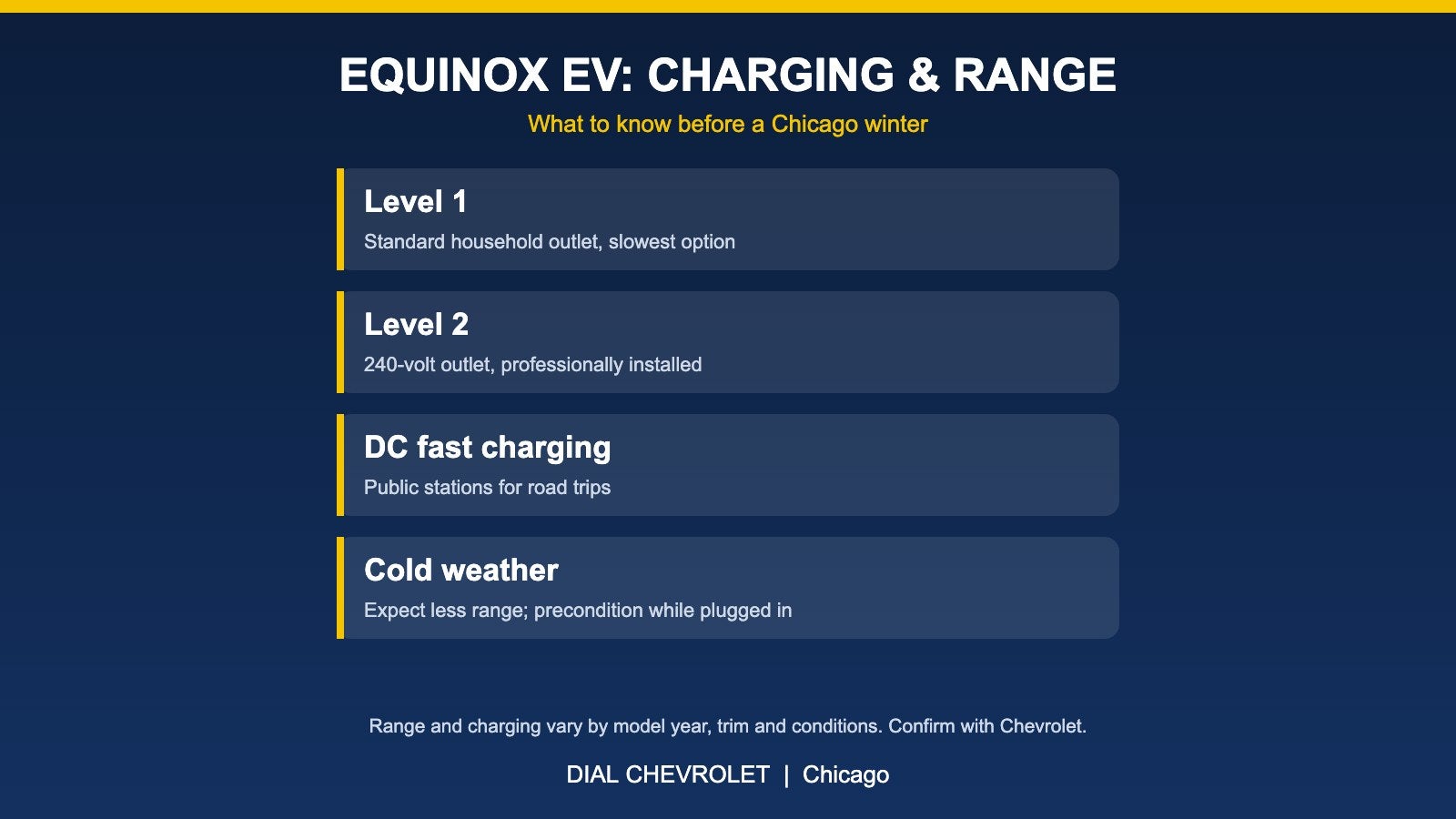
Graphic listing Level 1, Level 2 and DC fast charging options for the Chevy Equinox EV, plus a cold weather range note

Equinox EV Charging and Range: A Chicago Guide

Short answer: the Chevrolet Equinox EV can be charged at home or on the road, and your real-world range will change with the weather and how you drive. For a Chicago winter, plan for less range than the EPA estimate, charge at home when you can and precondition the cabin while the vehicle is plugged in. The ways to charge Level 1: Chevrolet's charging page says you can plug into a standard household three-prong outlet. This is the slowest option but needs no special equipment. Level 2: a professionally installed 240-volt outlet charges faster. Chevrolet lists Level 2 chargers as available equipment. Ask a licensed electrician about what your home or building needs. DC fast charging: public DC fast chargers are meant for road trips and quick stops. Chevrolet publishes how much range a model can add in about 10 minutes, but the figure changes by model year and drivetrain, so check the figure for the exact vehicle you are considering. Chevrolet's charging page also says the myChevrolet app can help you find public chargers and that owners can activate access to Tesla Superchargers through the app, with a GM-approved adapter where needed. Network access and adapters can change, so confirm the current details with Chevrolet. What about range? For the 2026 model year, Chevrolet lists EPA-estimated range of up to 319 miles on front-wheel-drive models and 307 miles on all-wheel-drive models. EPA ratings are a standardized estimate. Your own range depends on speed, temperature, load, terrain, tires and how you use the climate controls. Details can differ for other model years, so confirm the specifications of the exact vehicle. Cold weather and range The U.S. Department of Energy's fueleconomy.gov notes that cold weather reduces battery performance, and that preheating the cabin while the vehicle is still plugged in can extend range. It also says that using seat warmers instead of the cabin heater can save energy. The Department of Energy also suggests parking in a covered space when possible and checking tire pressure regularly. Precondition the cabin while plugged in, if your vehicle supports it. Use seat warmers when they are enough to keep you comfortable. Keep tires properly inflated. See our guide to tire tread depth and winter tires. Plan longer winter trips around charging stops, and leave yourself a cushion instead of arriving with a nearly empty battery. Is an EV right for you? It depends on where you park, how far you drive and whether you can charge at home or work. If you are comparing vehicles, our Chevy SUV buying guide and the buying vs. leasing a Chevrolet guide cover other ways to think about the choice. This article does not list prices, incentives or tax-credit information, which change often. Ask the dealership about current availability. Talk to the Dial Chevrolet Team You can browse new inventory, contact the dealership with questions or value your trade-in. For routine care on any Chevrolet, schedule service and see the maintenance schedule guide. Sources Chevrolet.com, Equinox EV charging Chevrolet.com, 2026 Equinox EV fueleconomy.gov, Fuel Economy in Cold Weather Published by Dial Chevrolet, 6603 S Western Ave, Chicago. This article is general education only and does not include pricing, incentives or offers. Range, charging speed and features vary by model year, trim and conditions, so confirm details with the dealership and Chevrolet.com.

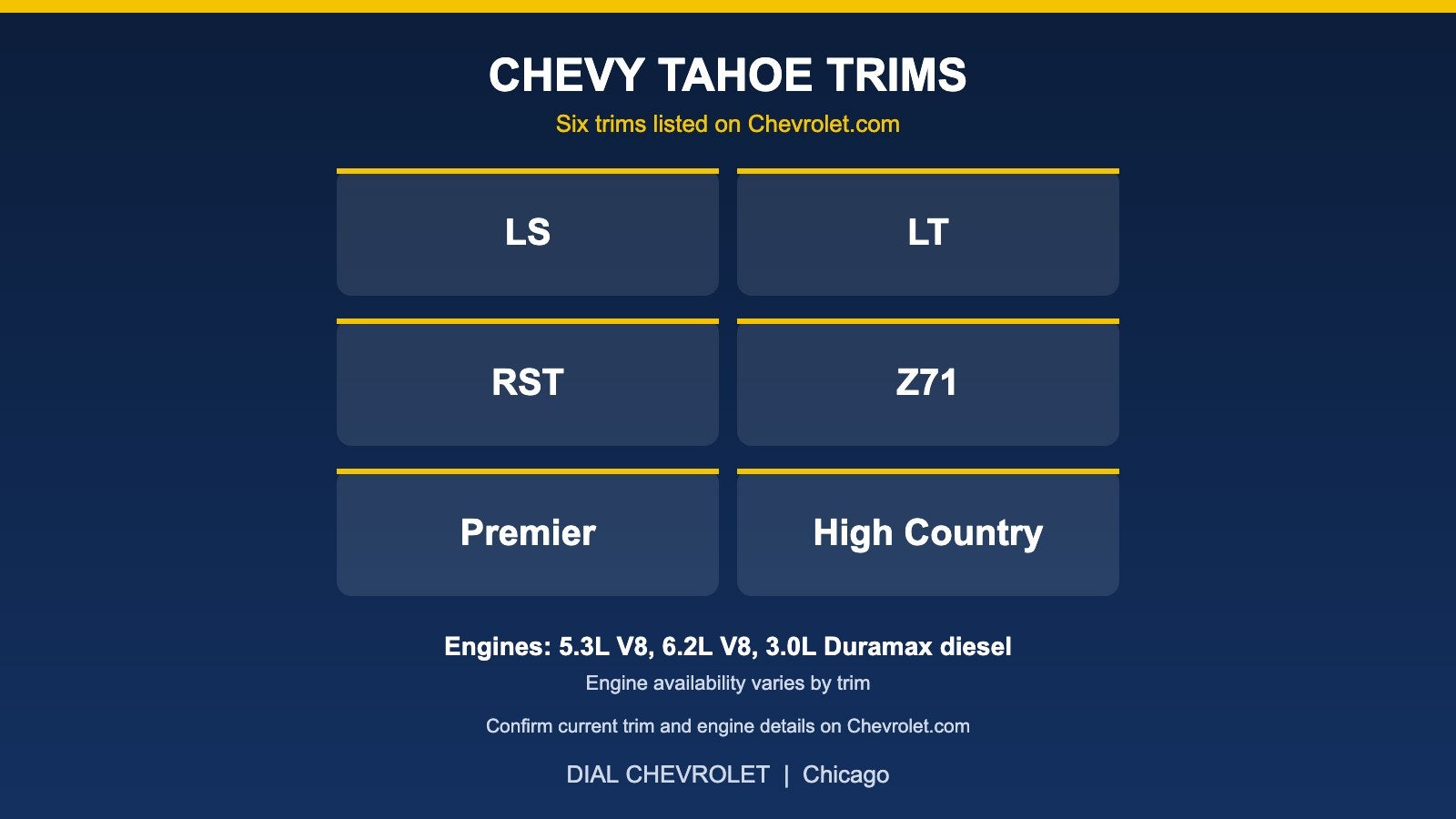
List of the six Chevrolet Tahoe trims, LS, LT, RST, Z71, Premier and High Country, with the three engines listed on Chevrolet.com

Chevy Tahoe Trims Explained: Which One Fits You?

Short answer: the Tahoe comes in six trims, and the right one depends mostly on the seating, engine and features you want. Start with how many people you carry and whether you tow, then compare trims and engines on Chevrolet.com and with the dealership. The six Tahoe trims Chevrolet lists the Tahoe in six models: LS, LT, RST, Z71, Premier and High Country. This guide sticks to details Chevrolet publishes, and trim content can change from one model year to the next, so confirm the current build sheet before you decide. LS: the entry trim. Chevrolet lists seating for up to nine as available on the LS. LT: a step up from the LS. The LT is one of the trims where Chevrolet lists the Duramax 3.0L Turbo-Diesel as available. RST: the sport-styled trim. Chevrolet lists available 24-inch wheels on the RST, and the 6.2L V8 is available on it. Z71: the off-road-oriented trim, with the 6.2L V8 available. Premier: a more upscale trim. Chevrolet lists heated and ventilated front seats on the Premier and High Country, and the 6.2L V8 is available. High Country: the top trim. The 6.2L V8 is standard, and Chevrolet lists leather seating surfaces with perforated inserts in the first and second rows. Engines Chevrolet lists three engines across the Tahoe lineup. The 5.3L V8 is the base engine, rated at 355 hp and 383 lb-ft of torque. The 6.2L V8 is rated at 420 hp and 460 lb-ft, standard on the High Country and available on the RST, Z71 and Premier. The Duramax 3.0L Turbo-Diesel is rated at 305 hp and 495 lb-ft and is listed as available on the LT, RST, Z71, Premier and High Country. Towing ratings depend on the engine, drive and equipment, so check the rating for the exact vehicle. How to narrow it down Passengers: decide how many seats you need and how the second row is configured. Towing: if you tow, compare engine choices and ask for the rating of the specific Tahoe. Our guide to towing fundamentals explains how ratings work. Driving mix: think about how much city, highway and trip driving you do. Features: list the features you will use every day, then see which trim includes them. Tahoe or Suburban? If you need more cargo room behind the third row, compare the Tahoe with the Suburban in our Suburban vs. Tahoe guide, and see the Chevy SUV buying guide for the wider lineup. Talk to the Dial Chevrolet Team The team at Dial Chevrolet can help you compare Tahoe trims and available inventory. You can browse new inventory, contact the dealership, value your trade-in or schedule service. Sources Chevrolet.com, Tahoe Chevrolet.com, Tahoe features Published by Dial Chevrolet, 6603 S Western Ave, Chicago. This article is general education only and does not include pricing or offers. Trims, engines and features change by model year, so confirm details with the dealership and Chevrolet.com.

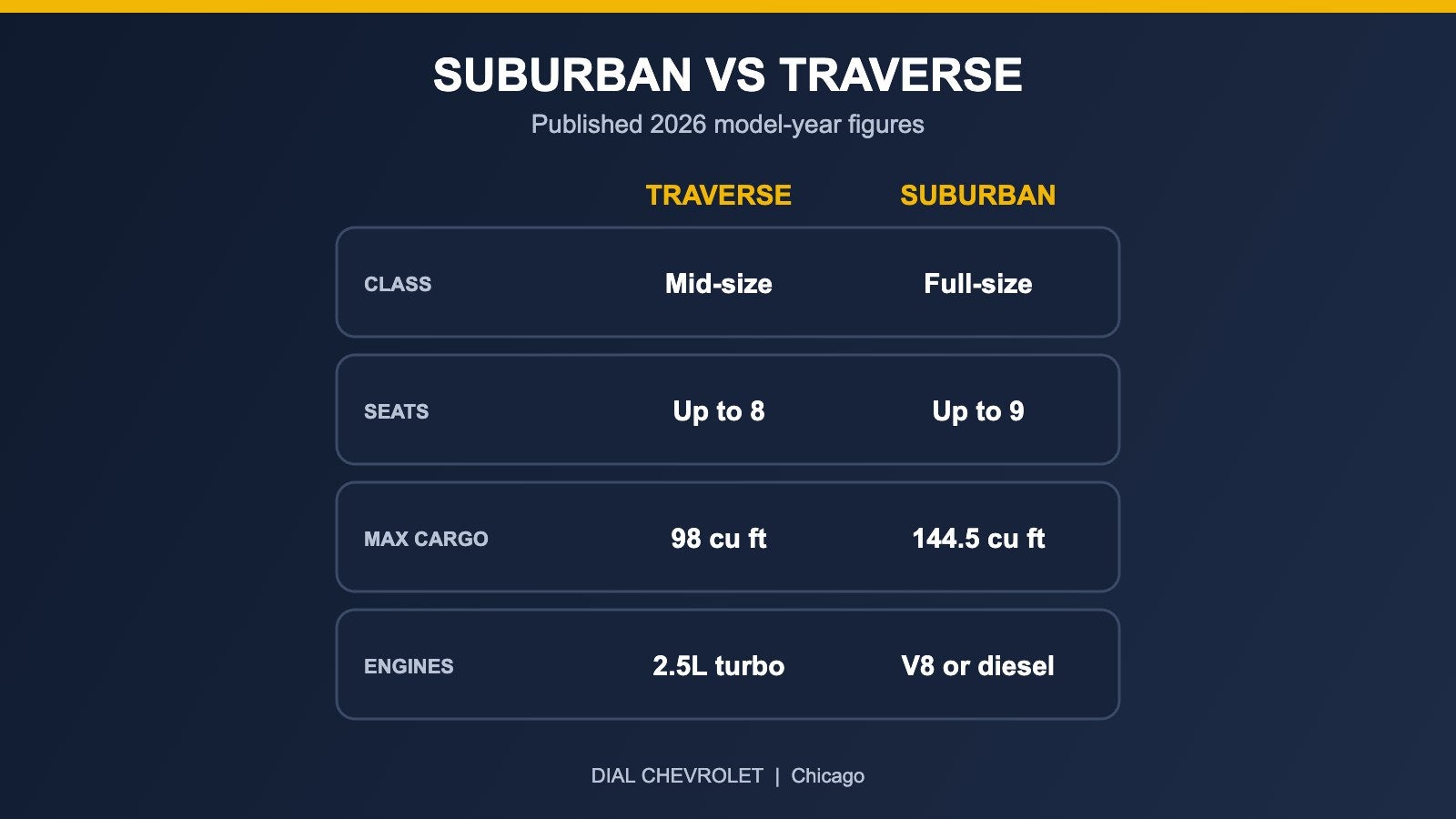
Suburban vs Traverse at a glance graphic: class, seating, max cargo and engines

Chevy Suburban vs Traverse: Size, Seating, Cargo and Towing

Short answer: The Traverse is Chevrolet’s mid-size three-row SUV and the Suburban is its extra-long full-size SUV. Choose the Traverse if you want three rows in a smaller, easier-to-park vehicle. Choose the Suburban if you regularly carry big loads, need real room behind the third row, or tow trailers heavier than the Traverse’s rating. Figures below are published 2026 model-year numbers from Chevrolet and third-party spec sites, so confirm them for the exact vehicle and model year you are considering. Size and parking Edmunds describes the Suburban as nearly 19 feet long and almost 7 feet wide, and Cars.com lists a 226-inch length and a 134-inch wheelbase. That is a lot of vehicle for a tight garage or a Chicago street spot. The Traverse is a mid-size SUV, so it is easier to maneuver, but measure your garage and parking spaces for either one before you decide. Seating and third row Suburban: Chevrolet lists seating for up to nine. Cars.com lists about 37 inches of third-row legroom. Traverse: Chevrolet lists seating for up to eight, with a choice of bench seats or captain’s chairs in the second row. Cars.com lists about 32 inches of third-row legroom. That is about five inches more third-row legroom in the Suburban, so the practical difference is who sits in the back row. The best test is to sit in the third row yourself. Cargo space Suburban: Chevrolet lists 41.5 cubic feet behind the third row, 93.8 behind the second row and 144.5 with both rear rows folded, which it describes as best in class. Traverse: Edmunds lists about 22.9 cubic feet behind the third row, and Chevrolet lists up to 98 cubic feet of maximum cargo volume, which it also describes as best in class for its segment. If you use all three rows often and still need luggage or gear room, the Suburban’s space behind the third row is the main reason to step up. Engines and fuel economy Traverse: a 2.5L turbocharged four-cylinder with 328 hp and 326 lb-ft of torque and an 8-speed automatic, with front- or all-wheel drive. Chevrolet lists 20 city and 26 highway mpg for front-wheel drive. Suburban: three engines. A 5.3L V8 (355 hp) is standard on most trims, a 6.2L V8 (420 hp) is standard on High Country and available on some trims, and a 3.0L Duramax turbo-diesel (305 hp, 495 lb-ft) is available on most trims. All use a 10-speed automatic. Cars.com lists 15 city and 20 highway mpg for the base 5.3L with rear-wheel drive. Larger engines cost more to fuel. If most of your driving is short trips around the city, the Traverse’s numbers are easier on the budget. Towing Kelley Blue Book and Edmunds list a 5,000-pound maximum towing capacity for the 2026 Traverse. Ratings for the Suburban are higher and vary by engine, drive type and equipment; Edmunds, for example, lists 8,200 pounds for a 5.3L LT with rear-wheel drive. Whatever you tow, check the rating for the exact vehicle, and learn how trailer weight and tongue weight work in our towing fundamentals guide. How to choose Pick the Traverse if: you want three rows for family use, drive mostly in town, tow light loads, and want a smaller footprint. Pick the Suburban if: you need to seat many people and still carry luggage, tow heavier trailers, or want the V8 or diesel options. Still undecided: compare both against the Tahoe in our Suburban vs Tahoe guide, browse the Chevy SUV buying guide, or see the 2027 Suburban trims, engines and cargo guide if you are shopping the newer model year. See both at Dial Chevrolet Browse new inventory Browse used inventory Value your trade-in Schedule service Contact Dial Chevrolet Sources Chevrolet: Suburban Chevrolet: 2026 Traverse Edmunds: 2026 Suburban specs Edmunds: 2026 Traverse specs Kelley Blue Book: 2026 Traverse specs Cars.com: 2026 Suburban specs Cars.com: 2026 Traverse specs Published by Dial Chevrolet, 6603 S Western Ave, Chicago, IL. General education only. Specifications are manufacturer- and third-party-published for the 2026 model year and may change; confirm details for the specific vehicle. This guide does not list prices or offers.