Blog / Used and Trade-Ins

Auto Loan APR Explained in Plain English

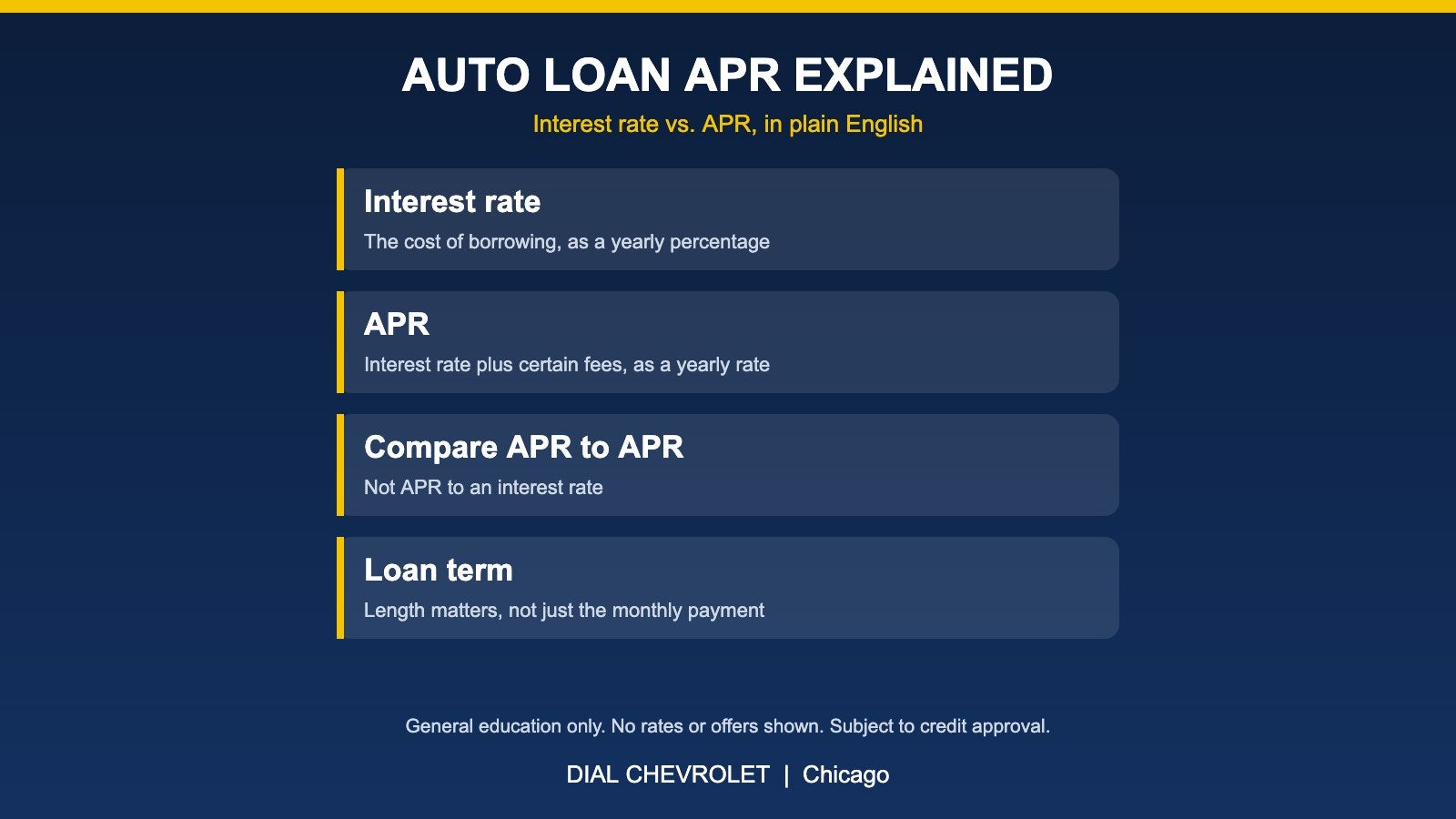
Graphic explaining interest rate versus APR, comparing APR to APR, and why loan term matters when financing a vehicle

Short answer: an auto loan's interest rate is the cost of borrowing, and the APR (annual percentage rate) is a broader yearly figure that adds certain fees. When you compare financing offers, compare APR to APR, and look at the loan term and total cost as well as the monthly payment.

Interest rate vs. APR

The Consumer Financial Protection Bureau (CFPB) explains that the interest rate is the cost you pay each year to borrow money, expressed as a percentage, and it does not include loan fees. The APR reflects the interest rate plus certain fees charged with the loan, also as a yearly percentage. Because the two are not the same, the CFPB says to make sure you compare APRs to APRs and not APRs to interest rates.

What else shapes the cost of a loan

  • Loan term: a longer term can lower the monthly payment but usually means more interest over the life of the loan, so look at the total cost, not just the payment.
  • Down payment: the CFPB notes that a larger down payment reduces the amount you borrow and can lower the total cost of the loan. A trade-in can count toward a down payment.
  • Fixed vs. variable rate: with fixed-rate financing the rate does not change over the life of the loan, so the payment stays the same.
  • Add-ons: products such as extended warranties or debt cancellation are optional and affect the amount financed. Ask what each one costs and whether it is required.
  • Negative equity: if you owe more on your current vehicle than it is worth, the CFPB warns that rolling that balance into a new loan can make the new loan more expensive. Our guide to trading in a car with a loan goes through this.

Where financing can come from

The CFPB describes two common routes: dealer-arranged financing, where the dealership sends your application to one or more lenders, and a loan from a bank or credit union you arrange yourself. The CFPB's advice is to shop around and compare offers, including any quote you already have, so you can see what fits your budget. Federal law also requires lenders and dealers to give you Truth in Lending disclosures, including the APR and finance charge, before you sign.

Questions to ask before you sign

  • What is the APR, and what fees are included in it?
  • What is the loan term, and what is the total amount I will pay over that term?
  • Is the rate fixed?
  • Are any add-on products included, and are they optional?
  • Is there a penalty for paying the loan off early?

This article does not list rates, payments or offers. Any financing terms depend on the lender, your credit and the specific vehicle, and are subject to credit approval. See our guide to buying vs. leasing a Chevrolet and the comparison of new vs. used Chevrolet for more on how to choose.

Talk to the Dial Chevrolet Team

To ask about financing options, contact the dealership. You can also browse new inventory, browse used inventory or value your trade-in. Our trade-in preparation guide can help you get ready.

Sources

Published by Dial Chevrolet, 6603 S Western Ave, Chicago. This article is general education only and is not financial or legal advice. It does not include any rates, payments, pricing or offers. Financing is subject to credit approval.
Posted in:

Related Posts

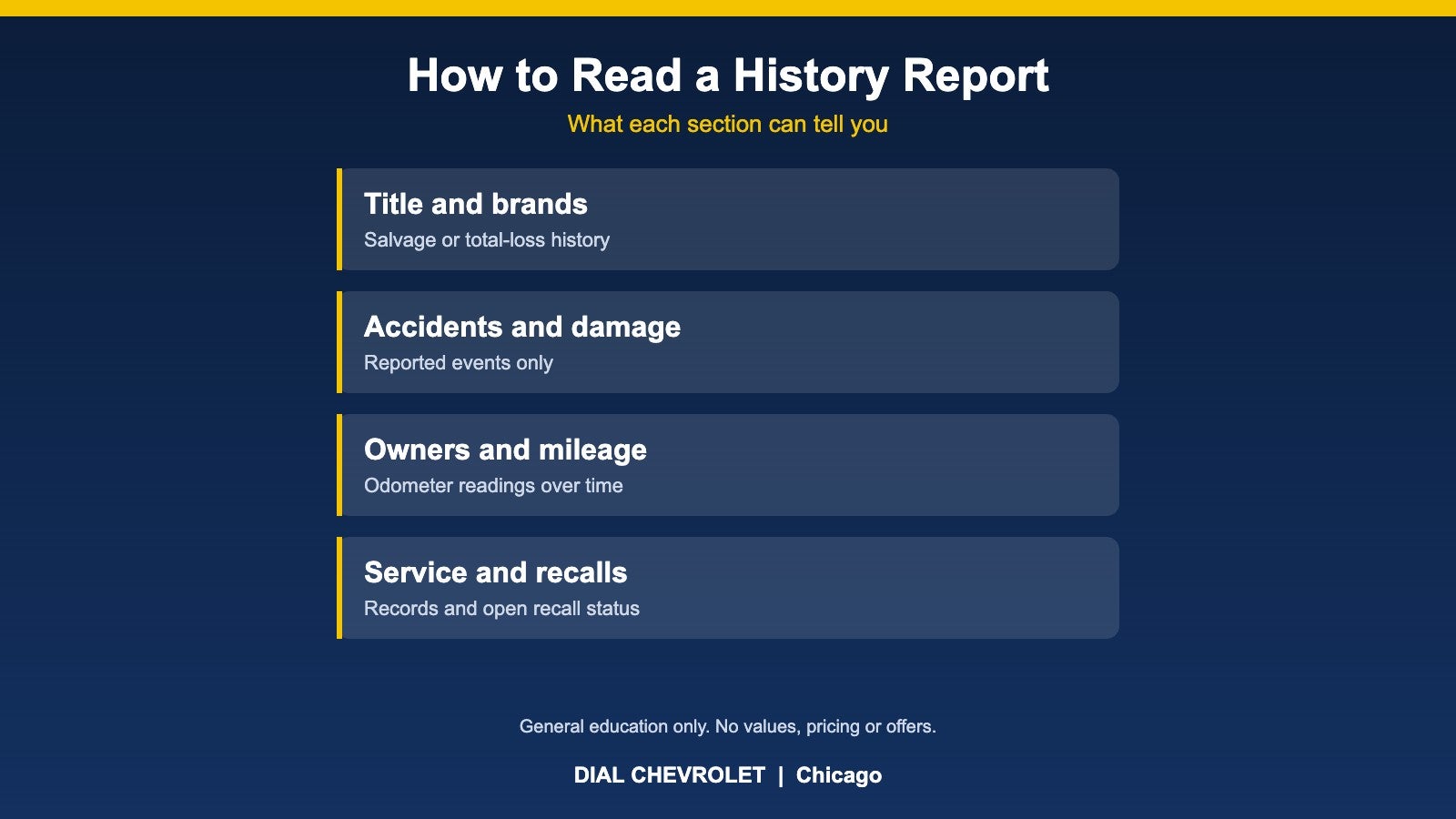
Graphic listing the main sections of a vehicle history report

How to Read a Used Car History Report

Short answer: a vehicle history report is a record of what has been reported about a used vehicle: title status, accidents or damage, owners, odometer readings, service entries and recalls. It is a helpful starting point, but it only covers what was reported, so it should be paired with an in-person inspection. Where the Report Comes From The Federal Trade Commission recommends getting a vehicle history report before buying a used car and notes that reports may include ownership history, accidents, repair records and whether the vehicle was ever declared salvage. The FTC does not endorse any specific provider. The federal National Motor Vehicle Title Information System (NMVTIS) is one source of title and brand data, and commercial report providers combine several sources. Reports differ in layout and in what they include, so the sections below are a general guide. Title and Brand Status Read this first. A brand such as salvage or total loss means the vehicle was declared a loss at some point and may need a closer look. Without knowing the brand history, a buyer may pay more than a vehicle is worth or buy one that was not properly repaired. A clean title only means that no brand was reported. Accidents and Damage Look at whether any accident or damage events were reported and how they are described. Not every collision is reported, and a report cannot show the quality of a repair. If you see a reported accident, ask for repair records and point it out to the inspecting mechanic. Our used SUV inspection checklist shows what to check in person. Owners, Registration and Use The report may show how many owners a vehicle has had and where and when it was titled. A report generally cannot show exactly how a prior owner used the vehicle. Frequent ownership changes are worth asking about, but they are not proof of a problem on their own. Odometer Readings Readings recorded at title transfers, inspections or service visits should rise over time. A reading that drops or stays unusually flat can be a sign of an error or a rollback, and is worth questioning. Service Records and Recalls Service entries can support the story a seller tells about maintenance, but many routine services never appear on a report. Check open recalls by VIN as well; our recall check guide explains how. What a Report Cannot Tell You Reports do not measure wear and tear, and they can be incomplete. Treat the report as one input, then add a test drive and an independent inspection. If you are comparing vehicles, our total cost of ownership guide can help with the bigger picture. Talk to the Dial Chevrolet Team You can browse used inventory or contact us to ask what documentation is available for a specific vehicle. Sources Federal Trade Commission: Used cars NMVTIS: Understanding a vehicle history report Chase: What is a vehicle history report? Published by Dial Chevrolet, 6603 S Western Ave, Chicago. General education only. No vehicle values, pricing, report-provider endorsements or offers are stated.

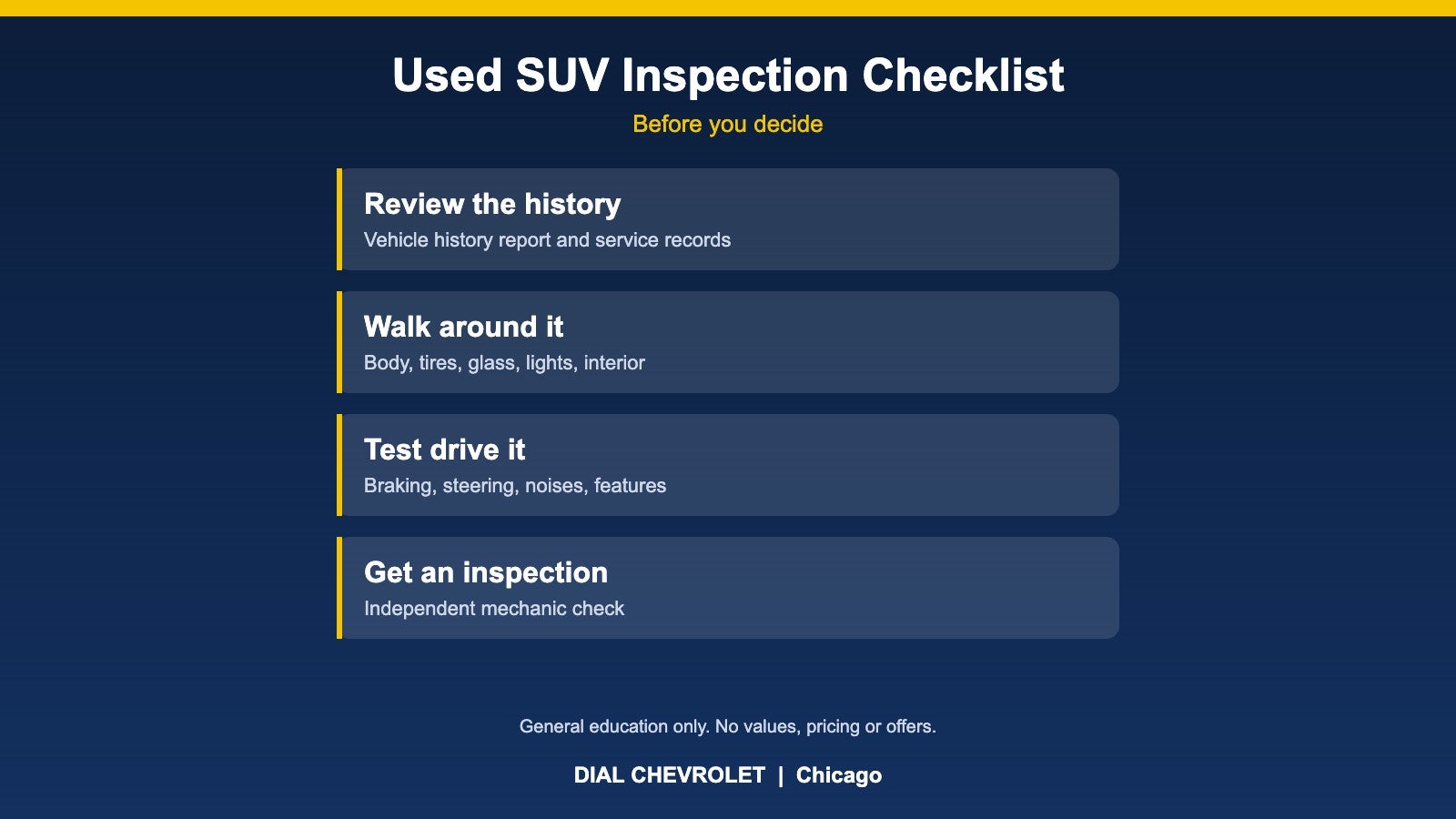
Checklist graphic for inspecting a used SUV before buying

Used SUV Inspection Checklist for Buyers

Short answer: before buying a used SUV, review its vehicle history report and service records, inspect it carefully in person, take a thorough test drive, and have an independent mechanic perform a pre-purchase inspection. Each step catches different problems, so it helps to do all of them. Start With the History Ask for a vehicle history report, which can show ownership changes, reported accidents, service entries and open recalls. Reports are a useful starting point but are not guaranteed to be complete, so treat them as one input. Service records matter too: be cautious when maintenance is claimed but cannot be documented. Walk Around the Exterior Look for mismatched paint, uneven gaps between panels or signs of past repairs. Check tires for even wear and ask how old they are. Inspect glass, lights and mirrors for damage. In Chicago, look underneath and along the lower body for rust, since road salt is hard on metal. Our road salt corrosion guide explains why. Check the Interior and Features Test every window, lock, seat adjustment, climate control setting and the infotainment system. Look for water stains, musty smells or worn areas that do not match the mileage. Confirm all warning lights turn on at start-up and go off. A light that stays on needs explaining; see our check engine light guide. For a three-row SUV, check that the second and third rows fold and latch properly, and that child-seat anchors work if you need them. Take a Real Test Drive Drive on a mix of roads that includes bumps, a highway stretch and some stop-and-go. Listen for unusual noises, feel for pulling or vibration, and test the brakes firmly in a safe place. If you plan to tow, ask about the vehicle's towing equipment and confirm capability for that exact vehicle in its documentation rather than assuming it. Get a Pre-Purchase Inspection Automotive guides consistently recommend an independent inspection by a qualified mechanic before you finalize a purchase, because many used vehicles are sold as-is and a technician can spot issues a walk-around may miss. An inspection usually covers the engine, transmission, suspension, brakes and underbody. It will not catch everything, but it improves your odds. Private sellers may be less willing to allow one, which is itself something to weigh. Compare the Total Picture Condition is only part of the decision. Think about ownership costs as well; our total cost of ownership guide and the new vs. used comparison can help. Talk to the Dial Chevrolet Team You can browse used inventory, start a trade-in request, or contact us to ask what documentation is available for a specific vehicle. Sources Edmunds: What to look for when buying a used car CarGurus: The ultimate used car buying checklist RepairPal: Pre-purchase inspection Published by Dial Chevrolet, 6603 S Western Ave, Chicago. General education only. No vehicle values, pricing, warranty terms or offers are stated.

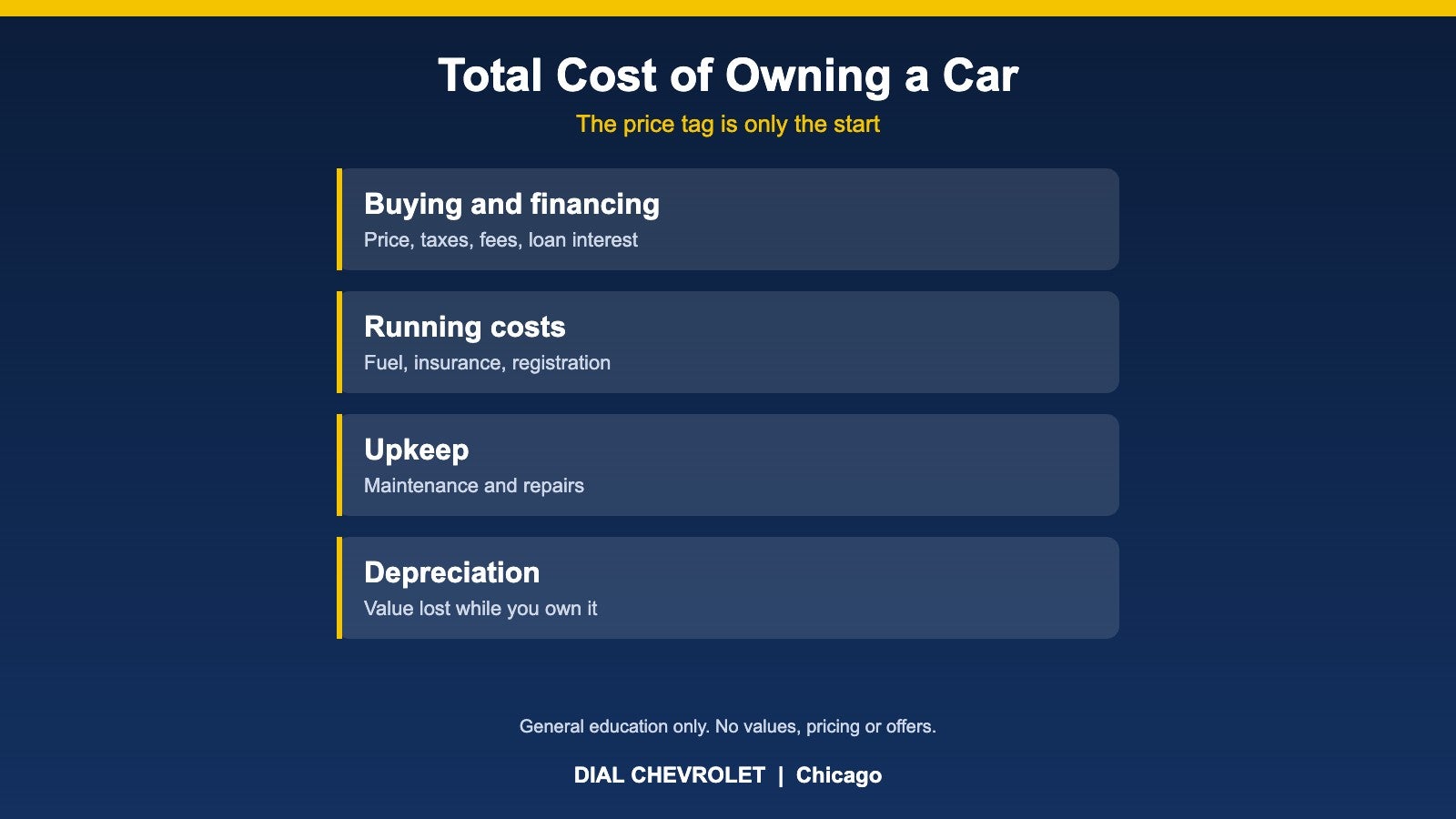
Graphic listing the main costs of owning a car

Total Cost of Owning a Car: What to Count

Short answer: the total cost of owning a car is the purchase price plus everything you pay or lose while you keep it: financing, taxes and fees, insurance, fuel, maintenance and repairs, and depreciation. Looking at all of them together gives a more realistic picture than the monthly payment alone. The Main Cost Categories Consumer guides from sources such as Edmunds, Kelley Blue Book and AAA describe ownership cost in a similar way. The common pieces are: Buying and financing: the price, sales tax, title and registration fees, and loan interest if you finance. Insurance: premiums vary by vehicle, driver and location, so a quote for the specific model is more useful than an average. Fuel: depends on fuel economy, driving habits and fuel prices. Maintenance and repairs: routine service plus repairs that come up as the vehicle ages. Depreciation: the value a vehicle loses over time. It is not a bill you pay, but it affects what you get when you sell or trade, and it is often described as one of the largest ownership costs. How to Build Your Own Estimate List the vehicles you are considering, including a new and a used option. Request insurance quotes for each specific model. Estimate fuel from your typical weekly driving and the vehicle's rated fuel economy. Check the maintenance schedule for what service is due and when. Our maintenance schedule guide is a starting point. Consider how long you plan to keep the vehicle, since depreciation and repair costs change with ownership length. Fixed and Changing Costs Loan payments and insurance premiums tend to be predictable. Fuel, maintenance and repairs change with how much you drive and how the vehicle ages. In Chicago, winter driving and road salt can add wear, so it is sensible to keep some room in a budget for upkeep. See our guides on road salt corrosion and winter preparation. New or Used A newer vehicle usually has more of its value left to lose, while an older vehicle may need more repairs. Neither is always cheaper over time. Our new vs. used comparison and buying vs. leasing guide cover the tradeoffs without quoting prices. Talk to the Dial Chevrolet Team You can browse new and used inventory, or contact us with questions. Any payment or pricing question is best answered by the dealership directly for the specific vehicle. Sources Edmunds: True Cost to Own Kelley Blue Book: Total cost of ownership Chase: How to calculate the total cost of car ownership Published by Dial Chevrolet, 6603 S Western Ave, Chicago. General education only, not financial advice. No vehicle values, pricing or offers are stated.