Blog / Service and Maintenance

Blog

All Service and Maintenance Silverado Trucks Used and Trade-Ins Suburban and SUVs
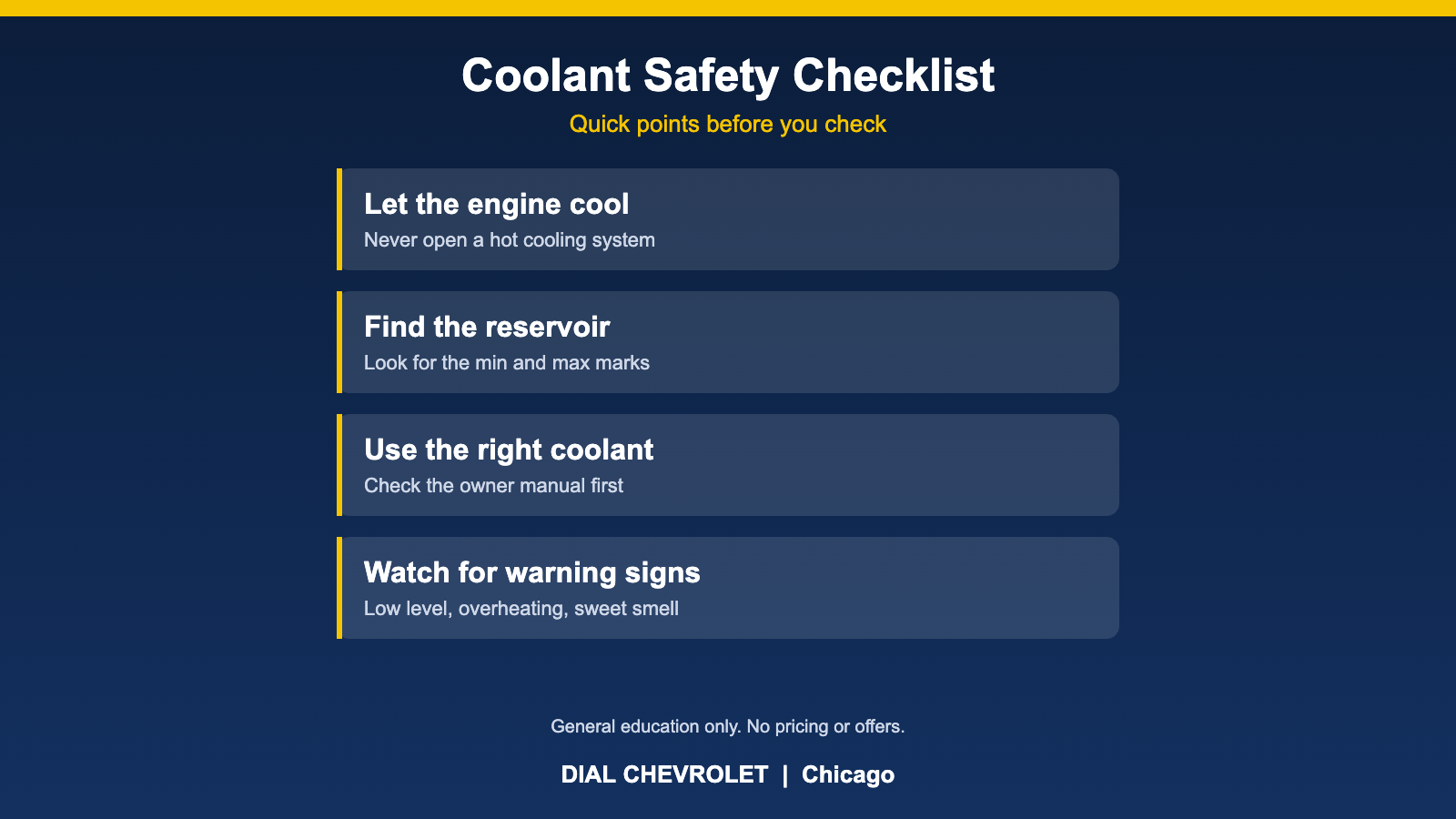
Graphic listing coolant safety checklist points

Engine Coolant Basics: Checking Level Safely

Short answer: check coolant only when the engine is completely cool, look at the level in the reservoir against its marks, and use the coolant type your owner's manual specifies. A level that keeps dropping, overheating or a sweet smell from the engine bay are reasons to have the cooling system inspected. What coolant does Coolant, also called antifreeze, carries heat away from the engine and helps protect against freezing and corrosion. It circulates between the engine and the radiator, so a problem in the cooling system can lead to overheating and engine damage. Safety first Never open the radiator or reservoir cap on a hot engine. Hot, pressurized coolant can spray out and cause serious burns. Let the engine cool completely before you check the level, and many sources suggest the best time is after the vehicle has sat for a while. Do not add coolant to a hot engine. Keep coolant away from children and pets, and clean up spills. How to check the level Park on level ground and let the engine cool. Open the hood and find the translucent coolant reservoir. It is often marked with a warning not to open when hot. Read the level against the minimum and maximum marks. With a cold engine it should sit between them. Do not overfill. Extra coolant can simply overflow. Check your owner's manual for the exact location and marks on your vehicle. Using the right coolant Different coolant types do not always mix well, so use the type and mixture your owner's manual calls for. If you are not sure what is in your system, ask a technician before topping it off. Signs the cooling system needs attention The level keeps dropping, which can point to a leak. The engine overheats or the temperature warning appears. A sweet, syrupy smell from the engine bay. Steam from under the hood. Pull over safely and shut the engine off. Weak heat from the vents, which can be linked to low coolant. Visible leaks, cracked hoses or a worn radiator cap. When coolant is replaced A coolant flush drains and replaces the fluid in the cooling system. The timing depends on your vehicle, so follow the maintenance schedule in your owner's manual. See our maintenance schedule guide for how fluid checks fit into regular service. Before winter and summer Many guides suggest checking the level before the hottest and coldest months. That fits Chicago well; our winter prep checklist covers other cold-weather checks. Talk to the Dial Chevrolet Team If the level is low, the temperature gauge is climbing or you smell coolant, schedule service or contact us. Our check engine light guide may also help if a warning light is on. Sources Kelley Blue Book: Do I Need a Coolant System Flush? Cars.com: How to Check Your Car's Engine Coolant RepairPal: How to Check Your Car's Coolant System Published by Dial Chevrolet, 6603 S Western Ave, Chicago. General education only. Follow your owner's manual and have a qualified technician service the cooling system.
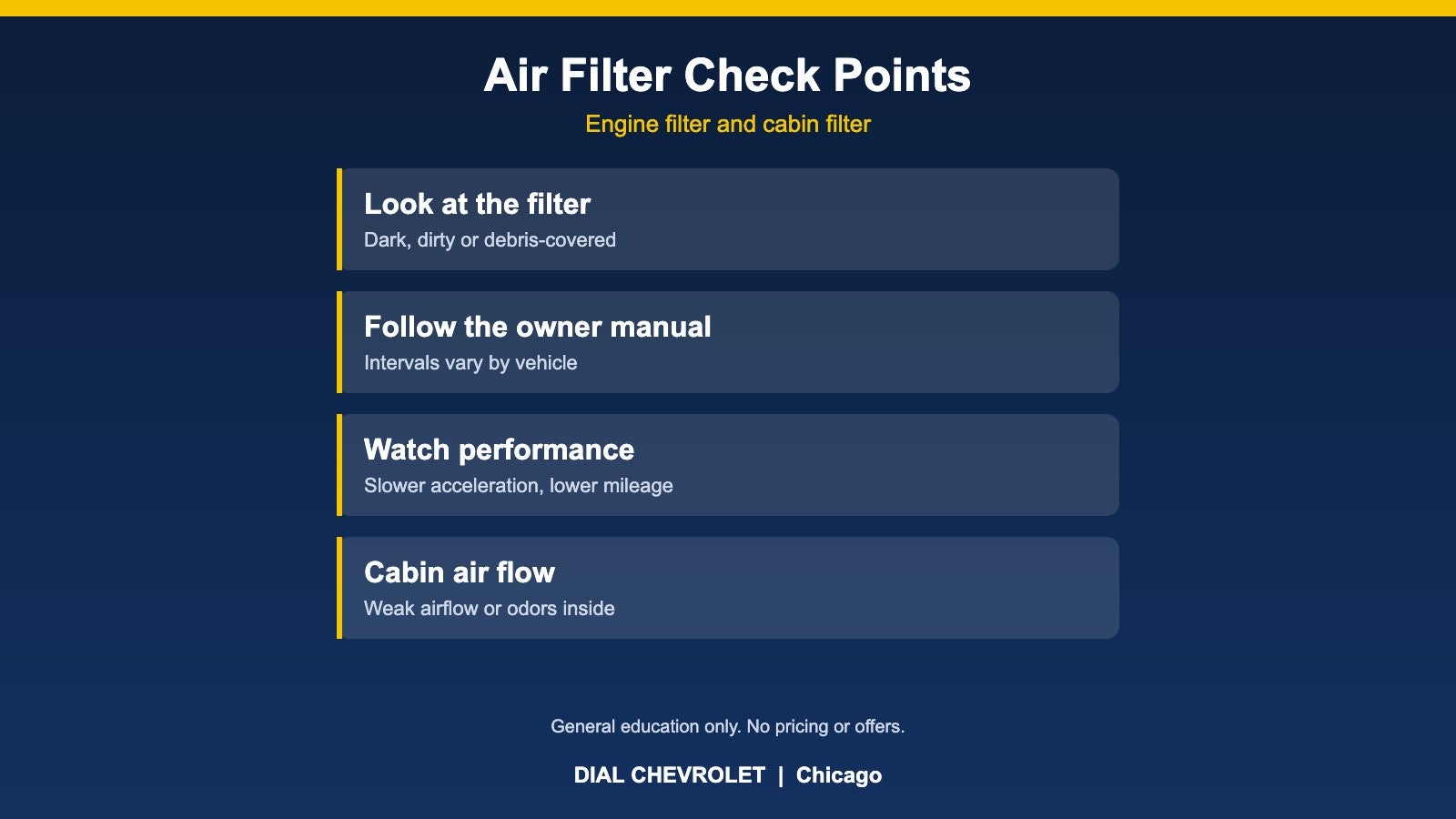
Graphic listing air filter check points

Engine and Cabin Air Filters: When to Check

Short answer: check your engine air filter by looking at it, follow the interval in your owner's manual, and replace it when it is dirty enough to restrict airflow. Cabin air filters are separate parts that also need periodic changes. What the two filters do The engine air filter cleans the air that goes into the engine. The cabin air filter cleans the air that comes into the passenger compartment through the heating and air conditioning system. Most vehicles have both, and they are replaced on their own schedules. How often to replace them Manufacturers list intervals in the owner's manual or maintenance schedule, and those intervals differ by vehicle. Several sources also point out that conditions matter more than a fixed number: dusty roads, construction areas and winter salt spray can load a filter faster. Inspecting the filter regularly is a more reliable habit than relying on a single mileage figure. Signs an engine air filter may be dirty The filter looks dark or gray, or has visible debris on it. Slower acceleration or a sluggish feel, especially with a turbocharged engine. A drop in fuel economy when your driving has not changed. Unusual engine sounds or rough running. A check engine light. Many things can cause one, so see our check engine light guide before assuming it is the filter. Signs a cabin air filter may need attention Weaker airflow from the vents. Musty or unpleasant odors when the fan or A/C runs. More dust inside the vehicle than usual. Checking it yourself The housing location varies, so use the owner's manual to find it. Some housings use clips and others use screws. If you are not comfortable inspecting it, ask a technician to check the filters during a service visit. Why Chicago driving matters Winter salt and spring construction can add grit and moisture to the air your vehicle breathes. That is a good reason to look at the filters at least when you service the vehicle for other reasons, such as the visits listed in our maintenance schedule guide. Talk to the Dial Chevrolet Team If you want filters inspected, you can schedule service or contact us. You may also like our guide to genuine GM parts versus aftermarket. Sources Cars.com: How Often Should You Change the Engine Air Filter? Autotrader: Car Air Filter, When to Replace Cars.com: Air Filters, What You Need to Know Published by Dial Chevrolet, 6603 S Western Ave, Chicago. General education only. Follow your owner's manual for your vehicle's intervals.

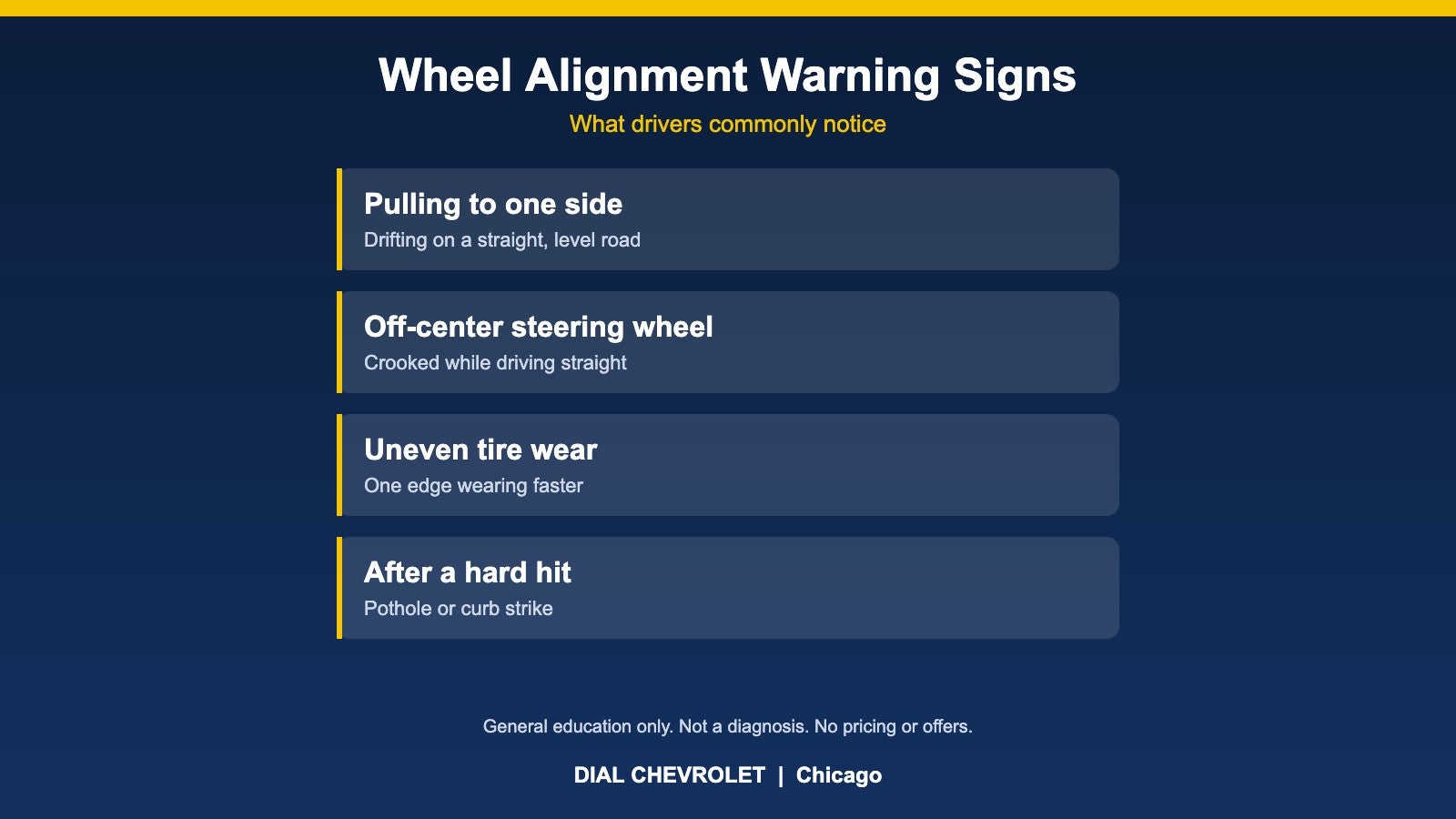
Graphic listing common signs of wheel misalignment

Wheel Alignment: Signs You May Need One

Short answer: the most common signs of a wheel alignment problem are a vehicle that pulls to one side, a steering wheel that sits off-center on a straight road, and tires that wear unevenly. A technician can confirm the cause, because other issues can look similar. What wheel alignment means Wheel alignment adjusts suspension angles, commonly called camber, caster and toe, so the tires meet the road as the vehicle was designed. When those angles drift, handling can change and tires can wear faster than they should. Signs you may need an alignment Pulling: on a straight, level road with little wind, the vehicle drifts left or right and you keep correcting the steering. Off-center steering wheel: the wheel is crooked while the vehicle is going straight. Uneven tire wear: the inner or outer edge of a tire looks more worn than the rest of the tread. Squealing tires: noise during ordinary low-speed turns. Steering that feels loose or does not return to center after a turn. Vibration: a shaking steering wheel can point to alignment, but it can also come from tire balance or worn parts. When to have it checked Many shops suggest an alignment check after a hard pothole or curb hit, after suspension or steering work, and when you install new tires. Chicago streets can be rough after winter, so it is reasonable to pay attention to how the vehicle drives in spring. Other things that feel like bad alignment Uneven tire pressure can make a vehicle pull, so check pressures first. A sticking brake caliper can also cause pulling. Worn tie rods, ball joints or other steering and suspension parts can cause loose steering and uneven wear; they need to be inspected with the vehicle raised. Tire balance problems often show up as vibration instead of pulling. A simple self-check Look at each tire's tread across its full width, and compare the front tires to each other. Wear concentrated on one edge is worth having inspected. Do this regularly, and before long trips. Why it matters Correct alignment helps tires wear evenly, supports steady handling and can protect fuel economy. Ignoring a problem can shorten tire life. Talk to the Dial Chevrolet Team If your vehicle pulls, the steering wheel is crooked or the tires look unevenly worn, you can schedule service or contact us. See also our maintenance schedule guide, brake service warning signs and winter prep checklist. Sources Kelley Blue Book: What Is Wheel Alignment AAA: Vehicle Wheel Alignment and Suspension Continental Tires: Wheel Alignment Published by Dial Chevrolet, 6603 S Western Ave, Chicago. General education only. It is not a diagnosis; have a qualified technician inspect your vehicle.

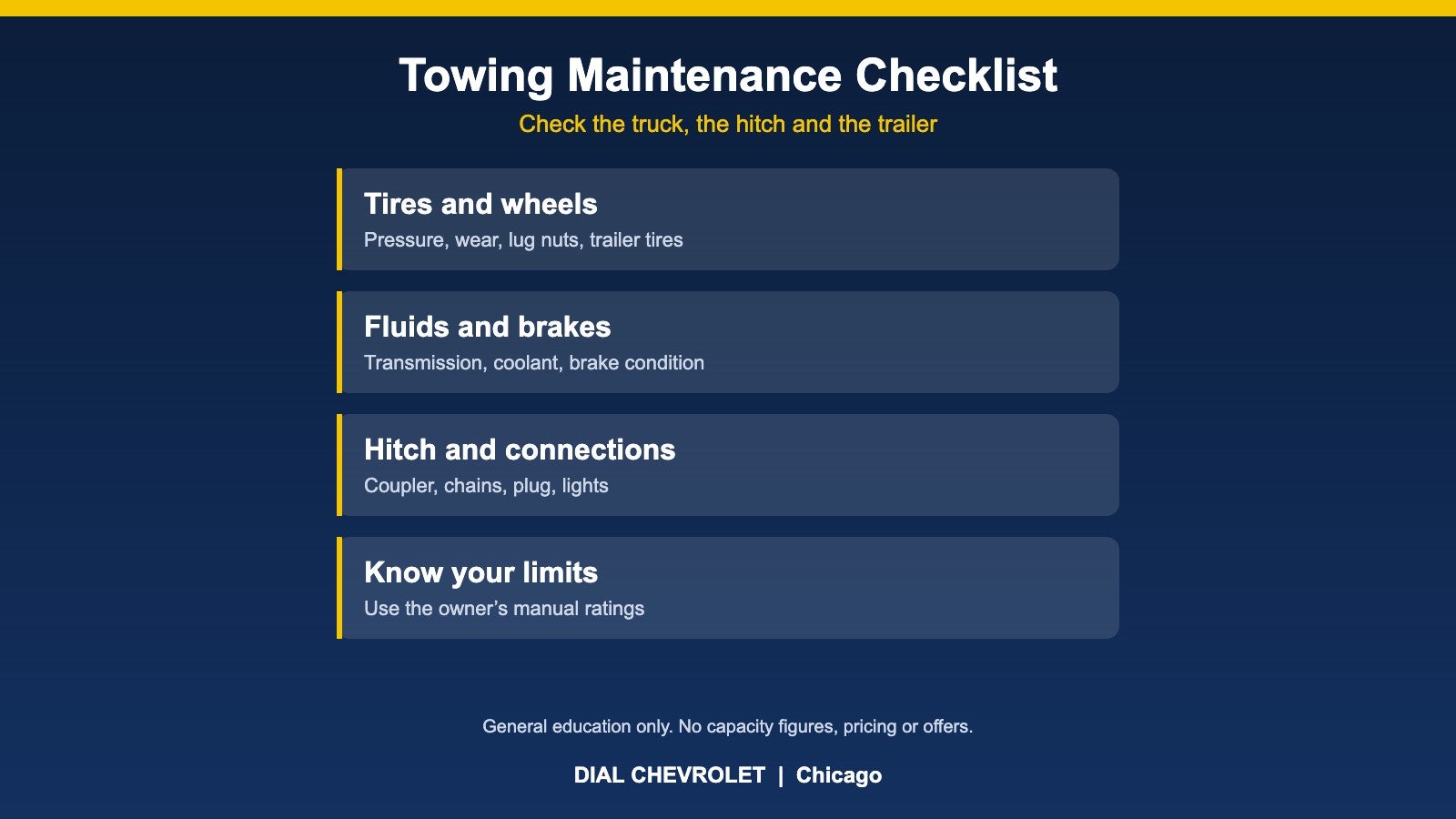
Checklist graphic for towing maintenance checks

Towing Maintenance Checklist for Trucks and SUVs

Short answer: towing puts extra stress on a vehicle, so it helps to confirm that routine maintenance is current, check the tires, fluids and brakes, and inspect the hitch, connections and trailer before every trip. The numbers that matter for your vehicle, such as towing ratings and tire pressures, come from your owner's manual. Start With Routine Maintenance Vehicle manufacturers generally advise that a vehicle used for towing needs service more often than one that is not. Review your maintenance schedule and ask about the service interval for your use. Our maintenance schedule guide covers the basics. Tires and Wheels Check pressure and condition on both the tow vehicle and the trailer, including any spare. Look for cracking or dry rot on trailer tires, especially if the trailer has been stored for months. Tires age even when tread looks good. Your owner's manual may call for a different tire pressure when towing. Confirm that the lug nuts on the vehicle and trailer are tightened to the specified torque. Fluids and Brakes Owner's manuals commonly point to engine oil, automatic transmission fluid, axle lubricant and cooling system fluid as items to watch when towing, and recommend checking transmission fluid more often. Brake condition is another item to check frequently. If your trailer has brakes, make sure they and the brake controller are working. For a related topic, see our brake service warning signs. Hitch, Coupler and Connections Make sure the coupler is fully seated and latched on the ball and that hitch bolts are tight. Inspect safety chains and their attachment points. Plug in the trailer connector and confirm brake lights, turn signals and running lights work with the trailer attached. Adjust mirrors so you can see past the trailer. Know Your Ratings Do not guess at towing capability. Capacity depends on the specific model, engine, axle ratio and equipment, so check the owner's manual and the vehicle's labels. The payload guide explains how weight limits work, and our 1500 vs. 2500HD comparison explains why the model matters. Plan for Chicago Conditions Cold weather, road salt and stop-and-go traffic add wear. A pre-trip walkaround is worth repeating at each stop on a long trip. See our winter prep checklist for seasonal checks. Talk to the Dial Chevrolet Team If you tow regularly, you can schedule a service appointment to have fluids, tires and brakes reviewed, or contact us with questions. Sources Consumer Reports: Preparation and driving tips for safe towing Progressive: Annual hitch and towing system maintenance U.S. EPA: Trailer towing pre-trip safety checklist (PDF) Published by Dial Chevrolet, 6603 S Western Ave, Chicago. General education only, not a substitute for your owner's manual. No towing capacities, pricing or offers are stated.

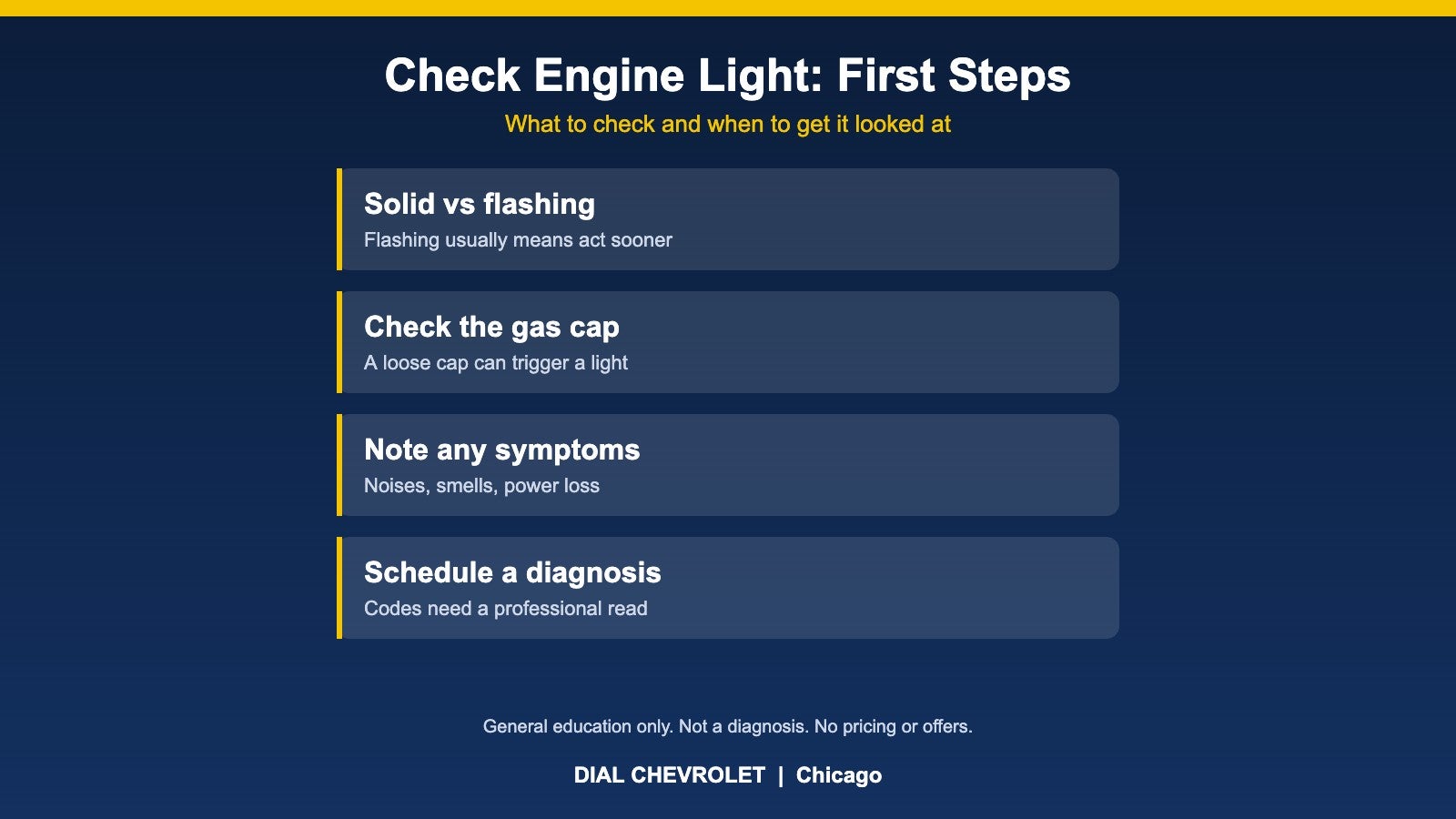
Checklist graphic with first steps when a check engine light comes on

Check Engine Light: First Steps to Take

Short answer: a solid check engine light usually means a fault that should be looked at soon, while a flashing light is more serious and calls for prompt action. Either way, a few simple checks can help you decide what to do next. Solid or Flashing: Start Here Note how the light behaves. Automotive guides generally describe a solid light as a fault affecting emissions or fuel economy that is not an immediate emergency, and a flashing light as a sign of a severe problem such as an engine misfire. A flashing light means you should reduce speed and load, find a safe place to stop, and arrange service rather than keep driving. Your owner's manual explains the warning lights on your specific vehicle. Check the Gas Cap A loose or damaged gas cap is a common trigger because it can cause a leak in the fuel vapor system. If the cap was loose, tighten it until it clicks. It can take several drives for the light to turn off, and if it stays on, something else may be the cause. Pay Attention to Symptoms Notice whether the vehicle runs differently: rough idle, hesitation, loss of power, unusual noises or smells, or a drop in fuel economy. Write down what you notice and when the light came on, because that detail helps a technician. If the temperature or oil pressure warnings are on, or the engine feels unsafe to drive, stop and call for assistance. Get the Codes Read Most causes need a code reader to diagnose, and a code points to the system involved rather than naming the part that has failed. Common causes include the gas cap, oxygen sensors, ignition components and emissions parts, but the list is long. Ignoring even a solid light can lead to reduced performance or more costly damage later. Why Winter Matters in Chicago Cold weather can bring warning lights to the surface, including problems with a weak battery. Our cold weather battery guide and winter prep checklist cover related checks, and the maintenance schedule guide explains routine service. Talk to the Dial Chevrolet Team You can schedule a service appointment or contact us with questions. We can't diagnose a vehicle from an article, and a service visit is the way to find the actual cause. Sources AAA: Check engine light Cars.com: What does the check-engine light mean? Kelley Blue Book: Check engine light quick facts Published by Dial Chevrolet, 6603 S Western Ave, Chicago. General education only, not a diagnosis. No pricing or offers are stated.

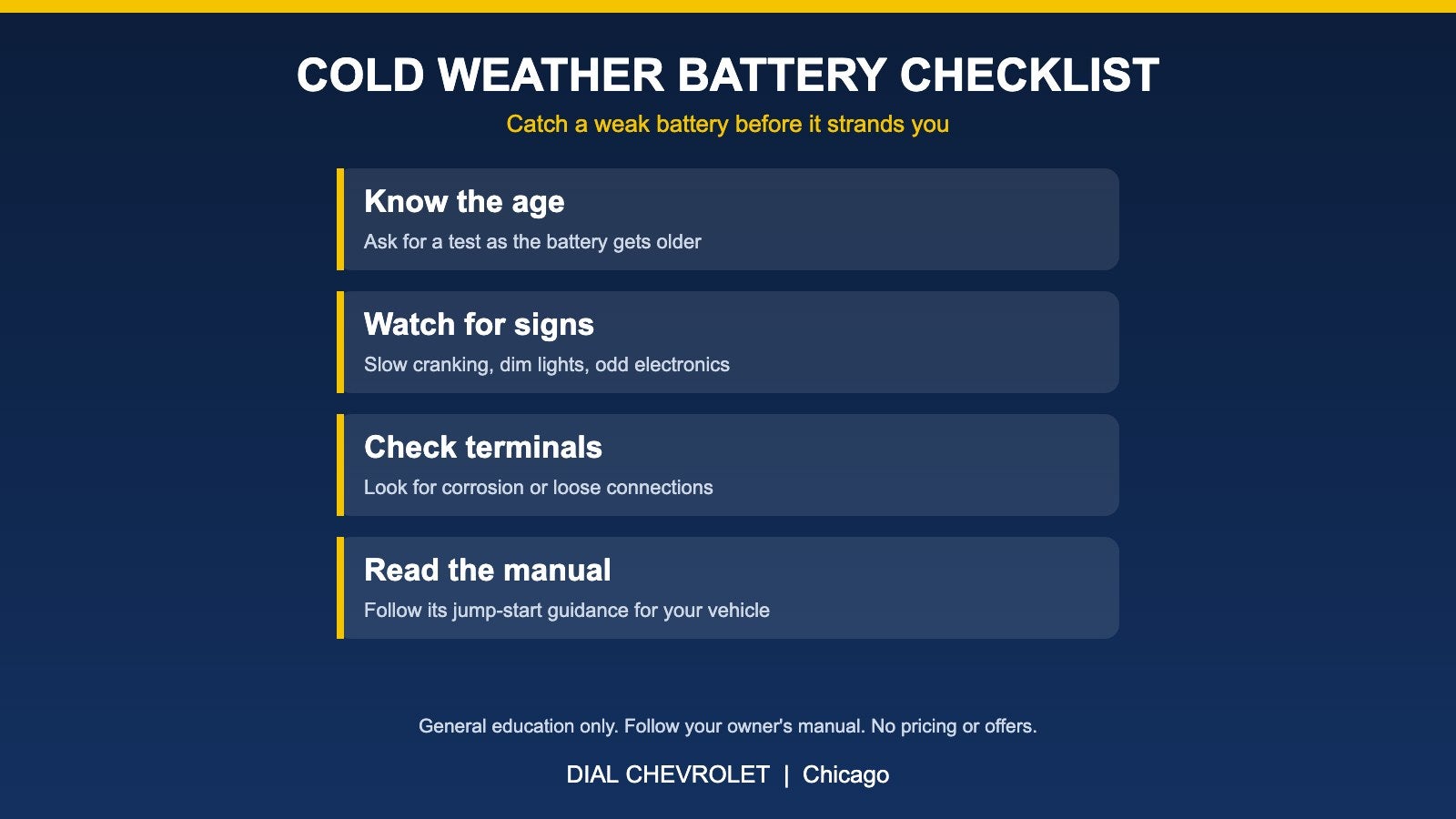
Checklist graphic for checking a car battery before and during cold weather

Cold Weather Car Battery: Signs and Prevention

Short answer: cold weather makes an engine harder to start and reduces what a battery can deliver, so a weak or aging battery often fails on the first very cold morning. A battery test before winter is the best way to find out how much life it has left. Why Cold Weather Is Hard on a Battery AAA says starting a vehicle in cold weather can require up to twice as much current as normal. Cold oil and a cold engine take more effort to turn over, and the heater and defroster add more demand. AAA also notes that heat is actually harder on battery life over time, but cold is when an already weakened battery gets exposed. How Long Do Car Batteries Last? AAA says car batteries typically last three to five years, depending on use, temperature and vibration. As a battery ages, it is more affected by cold. You cannot judge remaining life by looking at it, so ask for a test once the battery is a few years old. Warning Signs of a Weak Battery The engine cranks slowly or hesitates when you start it. Headlights or interior lights look dim, especially at idle. The radio, heated seats or phone charger do not work the way they normally do. The battery case looks swollen, leaks or smells unusual. Whitish or blue-green buildup on the terminals. If you see any of these, have the battery and charging system checked rather than waiting for a no-start. A weak battery is not always the cause of a starting problem, so a proper test helps avoid replacing parts you do not need. Ways to Reduce the Risk Get the battery tested before winter, and again if it is more than a few years old. Keep terminals clean and connections tight. Be aware that many short trips may not fully recharge the battery, especially when the heater and other accessories are running. Turn off lights and accessories before shutting the vehicle off. About Jump-Starting Check your owner's manual first. AAA advises that some newer vehicles, including hybrids and electric vehicles, may require manufacturer-specific procedures, and it warns against trying to charge or jump-start a frozen or damaged battery. Even electric vehicles have a 12-volt battery that can run down. If you are unsure, call roadside assistance or a professional rather than guessing. For a wider winter checklist, see preparing your Chevy for a Chicago winter and road salt and corrosion. For intervals on other service items, see the Chevy maintenance schedule. Talk to the Dial Chevrolet Team If your Chevy is slow to start or the battery is getting older, you can request a service appointment or contact us with questions. Sources AAA: When to replace your car's battery AAA: How long do car batteries last? AAA Northeast: How to jump a car battery safely Published by Dial Chevrolet, 6603 S Western Ave, Chicago. General education only. Follow your owner's manual. No pricing or offers are stated.

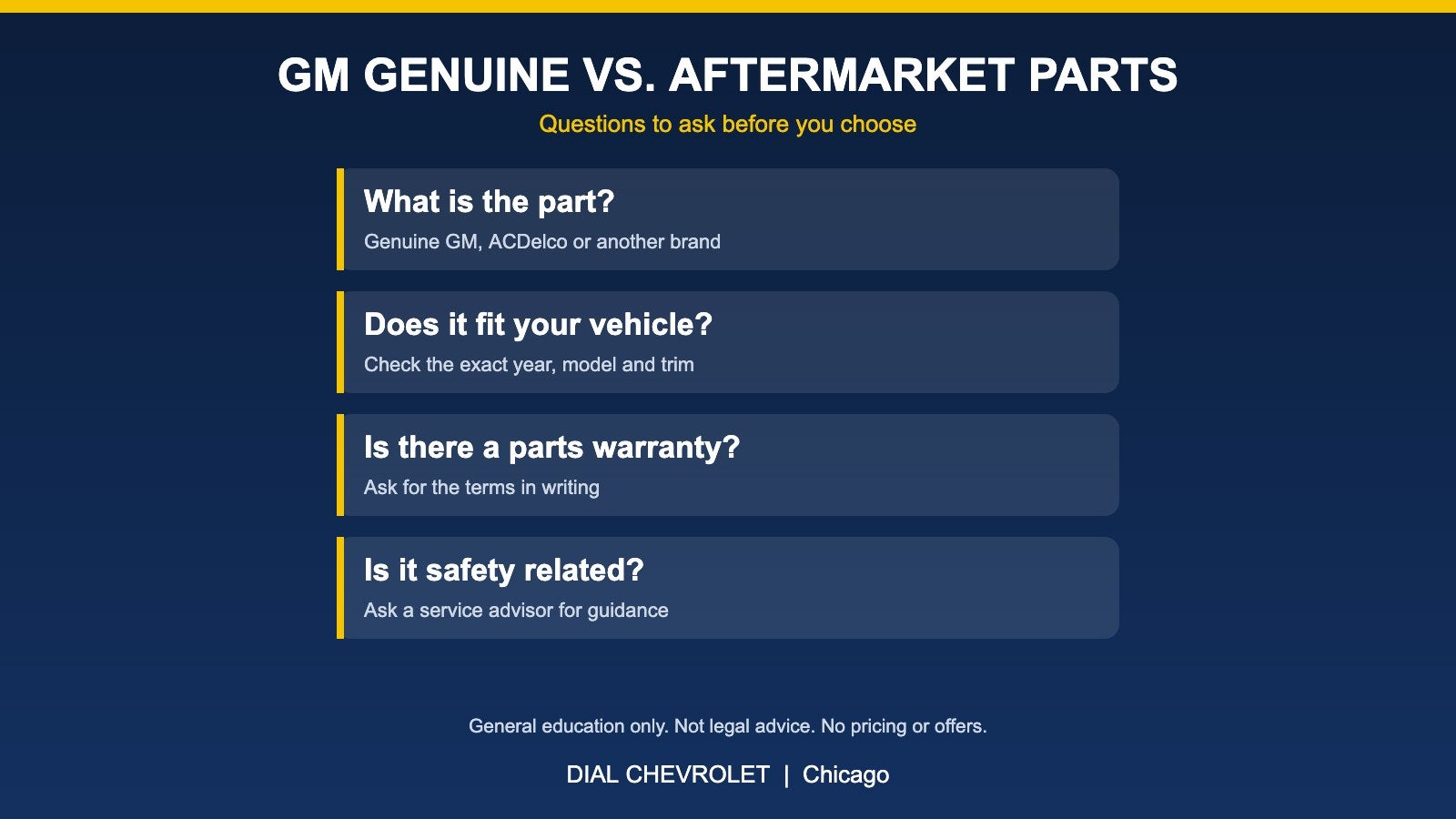
Checklist graphic comparing genuine GM parts and aftermarket parts for Chevrolet owners

Genuine GM Parts vs. Aftermarket: How to Choose

Short answer: genuine GM parts are made or validated by GM for your specific Chevrolet, while aftermarket parts come from other companies and vary in design and quality. Federal consumer guidance says that using an aftermarket part does not, by itself, void your vehicle warranty, so the better question is which part is right for your repair. What Counts as a Genuine GM Part GM describes its parts portfolio in tiers. GM Genuine Parts and ACDelco Original Equipment are the parts installed during production or validated by GM for Chevrolet, Buick, GMC and Cadillac vehicles. GM also sells ACDelco lines aimed at the aftermarket. When you ask about a part, it helps to ask which of these lines it belongs to. What Aftermarket Means An aftermarket part is made by a company other than the vehicle manufacturer. Some are well engineered and some are not, so brand, fit and testing matter more than the label alone. Ask for the exact part number and confirm it lists your model year, model and engine. Does an Aftermarket Part Void a Warranty? The Federal Trade Commission has stated that companies may not tell customers a warranty is void simply because third-party parts or independent repairs were used. That does not mean every claim is covered. If a part causes damage, the repair of that damage may not be. Always read your own warranty booklet for exact terms. Questions to Ask Before You Choose Is this part genuine GM, ACDelco or another brand? Does it fit my exact year, model and trim? What warranty comes with the part, and for how long? Ask for the terms in writing. Is the part safety related, such as brakes or steering? Is the repair covered by my vehicle warranty or a recall? For wear items such as brakes, see our guide to brake service warning signs, and for upkeep timing see the Chevy maintenance schedule article. Talk to the Dial Chevrolet Team If you are unsure which part fits your vehicle, our service team can explain the options. You can request a service appointment or contact us with your questions. Sources GM Parts: Our portfolio, three tiers of parts GM Parts: Repair FTC Consumer Alert: Warranty restrictions Published by Dial Chevrolet, 6603 S Western Ave, Chicago. General education only, not legal advice. Check your own warranty for exact terms.

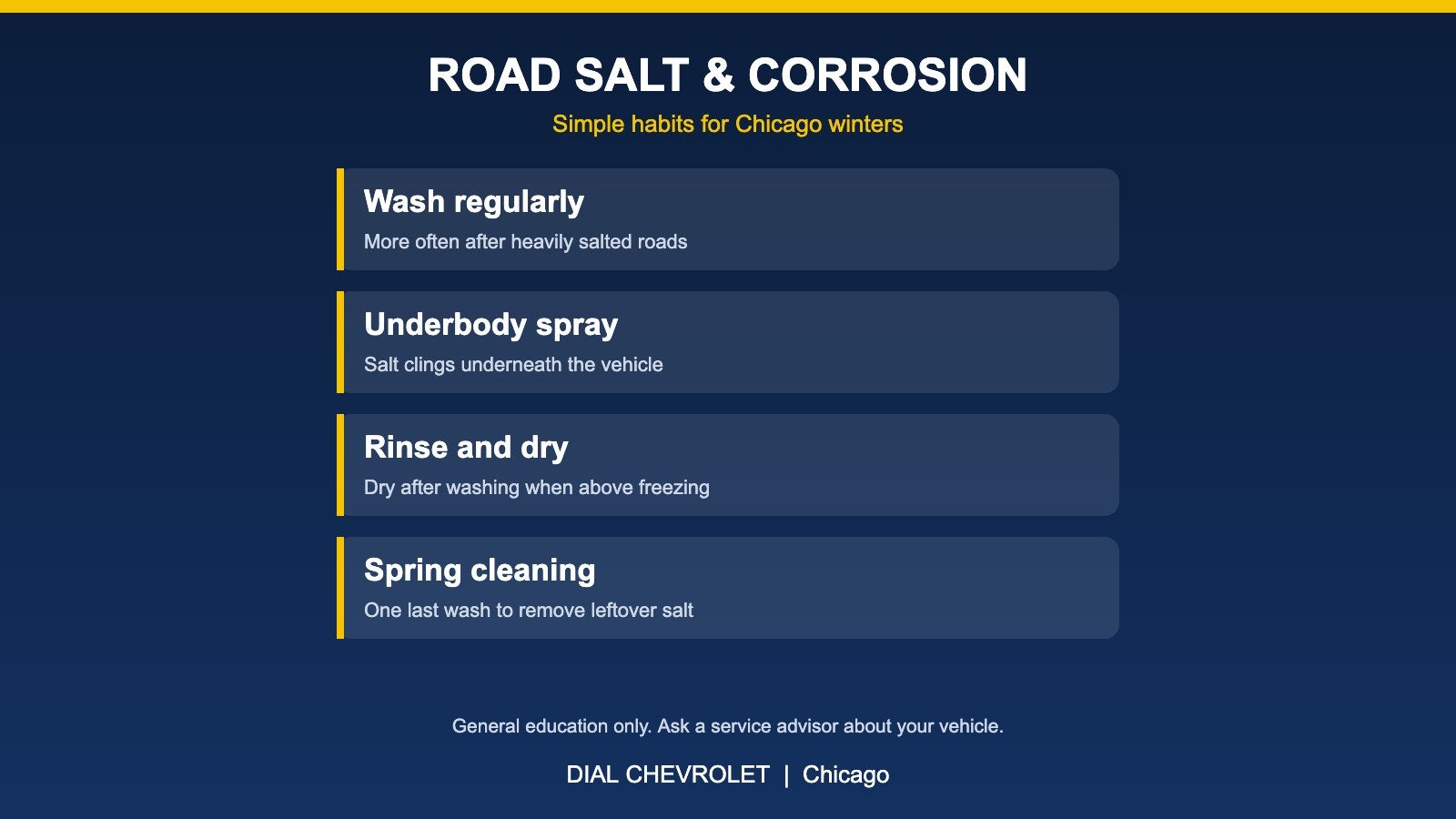
Checklist graphic for fighting road salt corrosion: wash regularly, use underbody spray, rinse and dry, and do a spring cleaning

Road Salt and Your Chevy: How to Fight Corrosion

Short answer: road salt and de-icers help keep Chicago roads safer, but the salty spray that clings to your vehicle can speed up rust, especially underneath where you cannot see it. Regular washing that includes the undercarriage is the habit AAA and Consumer Reports point to most. Why salt matters for your vehicle AAA says salty water that splashes onto a vehicle and sticks to metal parts underneath can accelerate rust and corrosion. Frames, brake lines and exhaust parts are among the components AAA names. Today's vehicles have corrosion-resistant designs, but AAA notes that the undercarriage is still vulnerable, and damage is easy to miss because it happens out of sight. Habits that help Wash regularly in winter. AAA's Auto Club Group recommends washing at least every two weeks, and more often after driving on heavily salted roads. Consumer Reports' experts advise a monthly wash during snow season, or more often if the vehicle is coated in salt. Include the undercarriage. Choose a car wash with underbody sprays, or rinse the underside yourself. Consumer Reports says an underbody spray is a worthwhile add-on if you live where roads are salted. Rinse first. AAA suggests flushing off loose salt before washing to protect the paint. Wax before winter. AAA recommends a fresh coat of wax before winter to help shield paint from salt and moisture. Wash when it is above freezing and dry the vehicle afterward. This helps keep doors, locks and seals from refreezing. Keep floor mats clean and dry. Wet mats can hold moisture against the floor. Do one more thorough wash in spring. AAA says leftover deposits can keep causing corrosion if they are not removed. Signs to have something looked at Bubbling paint, rust spots, rust flaking from underbody parts, or a brake pedal that feels different are good reasons to have a technician take a look. Do not wait to see whether it improves. Brake lines and other underbody parts are safety items, so our brake service warning signs guide is a useful companion. Pair it with other winter checks Salt season is also tough on tires and wheels. See our guides to tire tread depth and winter tires, checking for pothole damage, and the Chicago winter prep checklist. Talk to the Dial Chevrolet Team If you would like your Chevrolet looked over after salt season, you can schedule service. For questions, contact the dealership, or review the Chevy maintenance schedule guide. Sources AAA, Winter Road Salt Can Cause Hidden Vehicle Damage Consumer Reports, How Often Should You Wash Road Salt Off Your Car? Published by Dial Chevrolet, 6603 S Western Ave, Chicago. This article is general education only and does not include pricing or offers. Corrosion protection needs vary by vehicle, so ask a service advisor about your own vehicle and refer to your owner's manual.

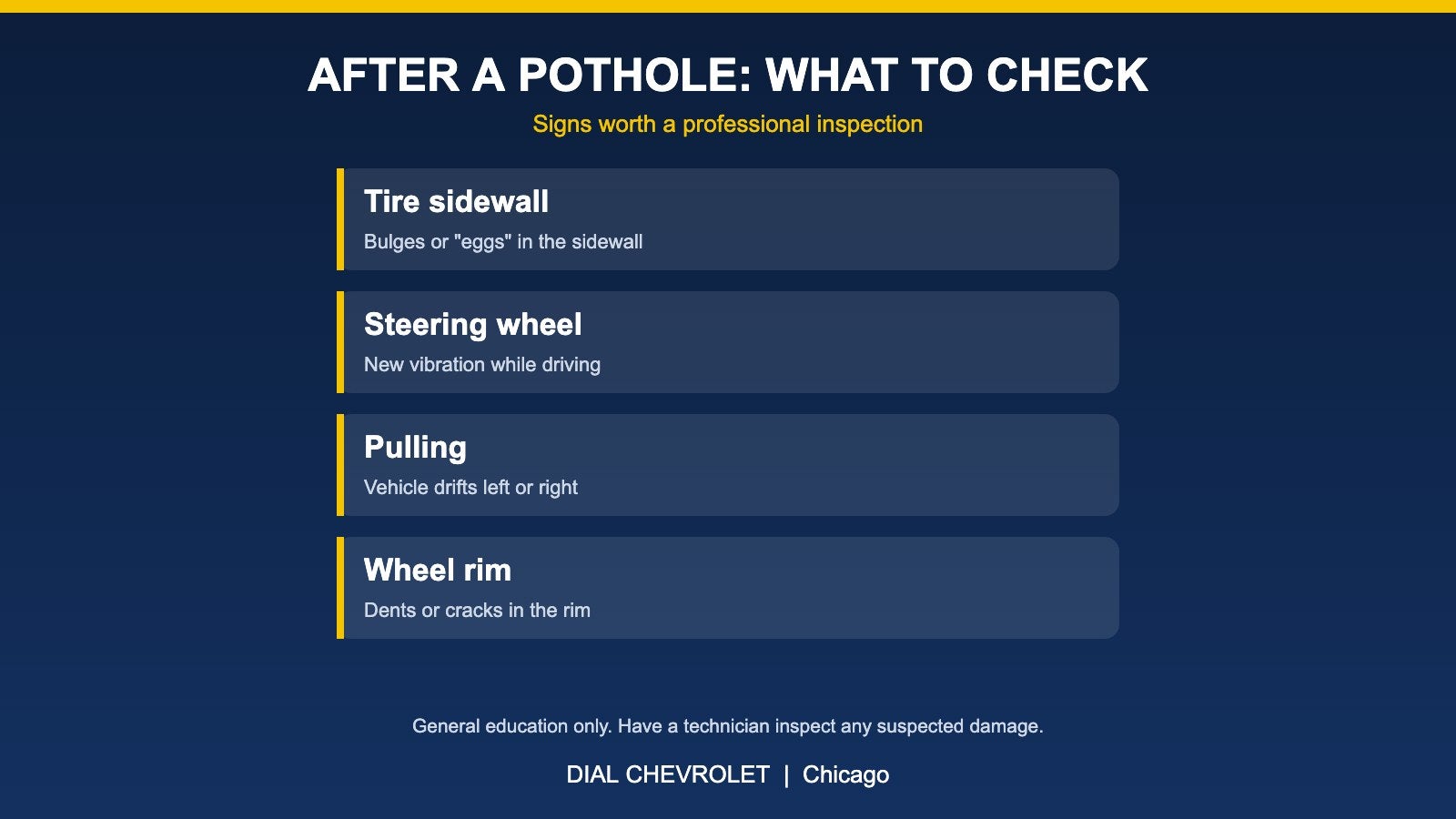
Checklist graphic of signs of pothole damage: tire sidewall bulges, steering wheel vibration, pulling to one side, and dents or cracks in the wheel rim

After a Pothole: Tire, Wheel and Alignment Checks

Short answer: if you hit a pothole hard, pay attention to how the vehicle drives right afterward, and have the tires, wheels and suspension inspected if anything feels or looks different. Damage is not always visible, so a quick check by a technician is worth considering. What a hard pothole hit can damage Tires usually take the first hit. A pothole can pierce a tire or damage its sidewall, and Consumer Reports notes that a tire can have internal structural damage that you cannot see, even if it still holds air. The wheel itself can also be bent or cracked, and suspension and steering parts such as control arms and tie rods can be harmed. A hard strike can also knock the wheel alignment out of position. Signs worth checking Bulges or "eggs" in a tire sidewall. Vibration in the steering wheel that was not there before. The vehicle pulls to one side. AAA says to have a qualified mechanic check the wheel alignment if the vehicle pulls left or right. Dents or cracks in the wheel rim. New noises or vibrations. AAA says to have the suspension inspected if you notice them. Falling tire pressure. Air loss from a damaged tire can take time to show up, so recheck the pressure over the next few days. If you suspect a problem while driving, pull over somewhere safe, ideally on flat ground, and look for visible damage to the tire and wheel. If anything looks wrong, do not keep driving on it. How to lower the risk Keep tires properly inflated and in good condition. AAA notes that worn or underinflated tires raise the risk of wheel or suspension damage in a pothole strike. Our guide to tire tread depth and winter tires explains how to check. Slow down safely if you cannot avoid the pothole. Check your surroundings before swerving or braking, since hitting a vehicle or pedestrian is worse than hitting the hole. Be careful with puddles. A puddle can hide a deep pothole. Do not brake hard into the pothole. Consumer Reports notes that hard braking shifts weight forward and compresses the tires, which can raise the risk of damage. AAA suggests easing off the brakes just before impact if it is safe to do so. Reporting a pothole or damage If a pothole damaged your vehicle on a City of Chicago street, the City Clerk's office has a page about vehicle damage claims. Requirements and outcomes can change, so check the City's current instructions yourself, and keep your repair paperwork. Dial Chevrolet cannot advise on whether a claim will be approved. Our brake service warning signs and Chicago winter prep checklist cover other things worth checking this time of year. Talk to the Dial Chevrolet Team If your Chevrolet feels different after a pothole hit, you can schedule service so a technician can inspect it. For general questions, contact the dealership, or see the Chevy maintenance schedule guide. Sources AAA, How to Avoid Pothole Damage Consumer Reports, Pothole Survival Guide Chicago City Clerk, Claims Published by Dial Chevrolet, 6603 S Western Ave, Chicago. This article is general education only. It does not include pricing or offers and is not legal advice. Have a qualified technician inspect any vehicle you suspect is damaged.

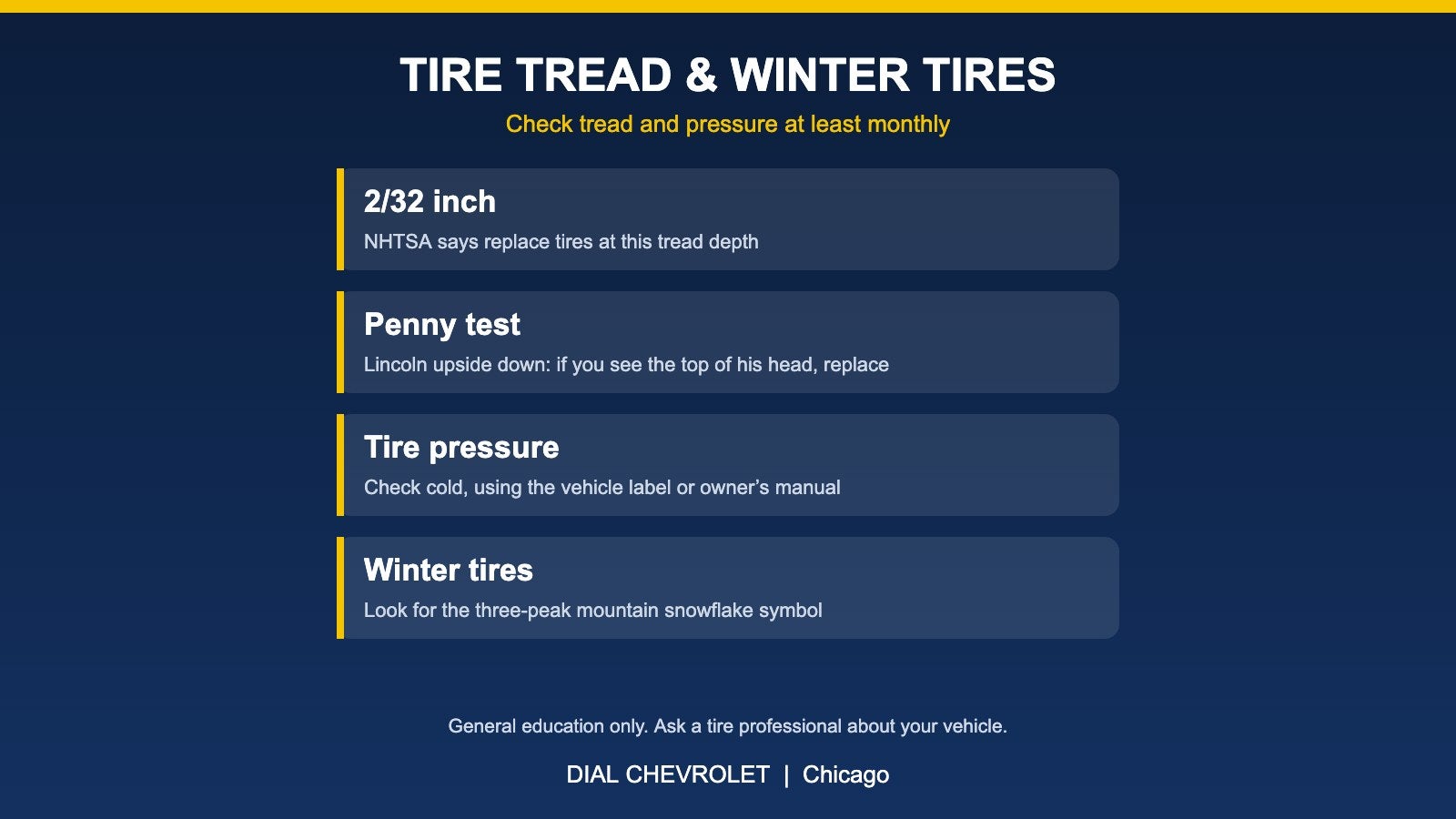
Checklist graphic: replace tires at 2/32 inch tread, penny test, check cold tire pressure, look for the mountain snowflake winter tire symbol

Tire Tread Depth and Winter Tires in Chicago

Short answer: NHTSA says tires should be replaced when the tread wears down to 2/32 of an inch, and it recommends checking tread and tire pressure at least monthly. In a Chicago winter, many drivers also ask whether all-season tires are enough or whether winter tires are worth it. Here is how to check what you have and what to ask a tire professional. How to check tread depth Your tires' tread is what grips the road, especially when it is wet or icy. NHTSA describes a few simple checks you can do at home: Penny test: put a penny into the tread upside down with Lincoln's head facing you. If you can see the top of his head, it is time to replace the tires. Treadwear indicators: raised bars sit between the tread grooves. When the tread is worn level with them, the tire needs replacing. Tread depth gauge: a low-cost gauge gives you an actual measurement, and a service advisor can measure it for you. Check several spots across each tire, because tires can wear unevenly. Uneven wear is also a good reason to ask about alignment and rotation. Our guide to how often to rotate Chevy tires covers the rotation side. Do not stop at 2/32 if winter traction matters 2/32 of an inch is the point where NHTSA says a tire should be replaced. It is a minimum, not a target. Consumer Reports testing has found that all-season tires can lose a noticeable amount of grip on wet, snowy and icy surfaces well before they are worn out, so some drivers choose to replace tires earlier ahead of winter. A tire professional can tell you what makes sense for your vehicle and how you drive. Check tire pressure monthly Check all tires, including the spare, at least once a month when they are cold, meaning the vehicle has not been driven for at least three hours. Use the pressure listed by the vehicle manufacturer on the Tire and Loading Information label or in the owner's manual, not the number printed on the tire. A tire pressure monitoring system (TPMS) only warns you when a tire is significantly underinflated, so it does not replace a manual check. Tire age matters too You cannot judge a tire's age by looking at it. Some manufacturers recommend replacing tires that are six to ten years old regardless of tread wear. The last four digits of the DOT Tire Identification Number on the sidewall show the week and year the tire was made. Age matters most for vehicles that are driven infrequently. All-season vs. winter tires NHTSA notes that all-season tires handle a variety of road conditions and have some mud and snow capability, while winter tires perform better than all-season tires in deep snow. The best choice depends on where you live and the weather you usually drive in. Winter tires that pass a winter traction test carry a symbol of a mountain with a snowflake on the sidewall. If you are unsure, ask a tire professional about your driving habits, your vehicle and how much winter driving you do. Our Chicago winter prep checklist has more ideas for getting a vehicle ready for the season. Talk to the Dial Chevrolet Team If you would like your tires looked over, you can schedule service with the Dial Chevrolet service team. See the Chevy maintenance schedule guide for other routine checks, contact the dealership with questions, or browse new inventory. Sources NHTSA, Tires Consumer Reports, Make sure your tires have enough tread for winter Published by Dial Chevrolet, 6603 S Western Ave, Chicago. This article is general education only and does not include pricing or offers. Tire needs vary by vehicle and driving, so ask a tire professional or your service advisor about your own tires.

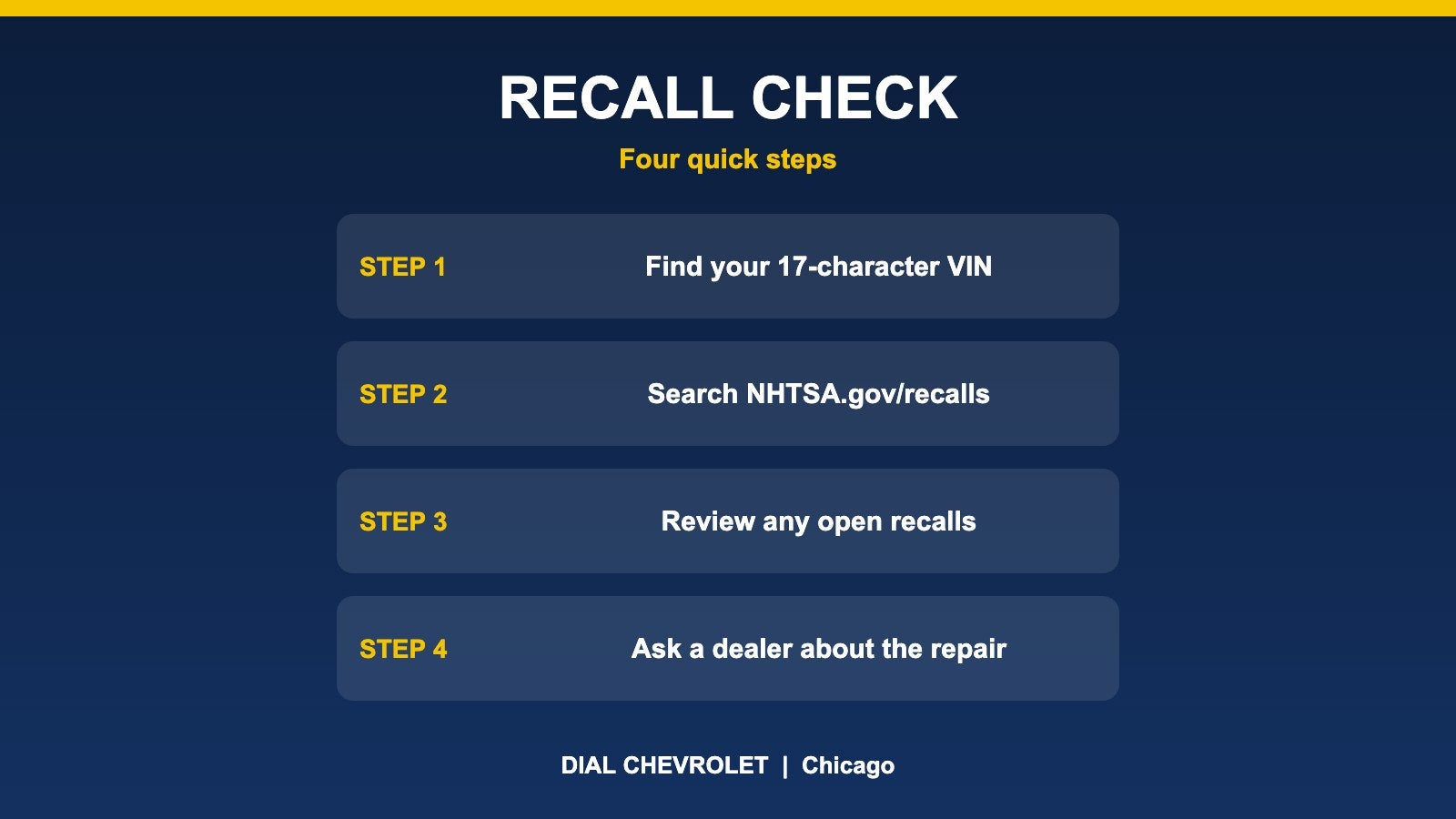
Recall check graphic: find your VIN, search NHTSA recalls, review open recalls, ask a dealer about the repair

Check Your Chevy for Recalls by VIN

Short answer: Enter your 17-character VIN at NHTSA.gov/recalls, or ask a Chevrolet dealer to look it up. If the search shows an open safety recall, NHTSA says to get the vehicle repaired for free at a local dealership. NHTSA also recommends checking for recalls at least twice a year. This guide is general information and lists no prices or offers. Step 1: Find your VIN NHTSA says the 17-character vehicle identification number (VIN) is on the lower left corner of the windshield, on the label inside the driver’s side door jamb, and on your registration or insurance documents. Step 2: Search for recalls Go to NHTSA.gov/recalls. Enter your VIN. NHTSA also lets you search by license plate. Read the result. If there are no unrepaired recalls, NHTSA’s search says so. If there is an open recall, it shows what the issue is and what steps to take. Kelley Blue Book notes that dealers also check for open recalls during routine maintenance such as oil changes, so it is worth asking at your next service visit. See our Chevrolet maintenance schedule guide for how routine visits fit together. What the VIN search does and does not show Shows: unrepaired safety recalls for your specific vehicle. Does not show: a safety recall that has already been repaired. New recalls: NHTSA notes that for some recently announced recalls, not every affected VIN has been identified yet, and VINs are added continuously, so check again later. Searching by year, make and model gives general results for recalls, investigations, complaints and manufacturer communications. Only the VIN or license plate search tells you about one specific vehicle. If your Chevrolet has an open recall Note the recall details shown in the search. Contact a Chevrolet dealer to schedule the repair. NHTSA says recall repairs are done for free. Follow any instructions in the recall notice about driving the vehicle until it is repaired. You can schedule service at Dial Chevrolet or contact us with your questions. Checking before you buy a used vehicle A recall check takes a minute and is easy to include when you compare vehicles. Recall status can change, so consider checking again close to the day you buy. Our used Silverado checklist and new vs used guide cover other points to review, and you can browse used inventory or new inventory when you are ready. Other ways to stay informed NHTSA’s SaferCar app can send an alert if a safety recall is issued for a vehicle, tire or car seat you add. NHTSA also lists recalls for car seats, tires and equipment, not only vehicles. If a warning light appears, our dashboard warning lights guide explains what the colors generally mean. A warning light is not the same thing as a recall, so use the VIN search for recall status. Schedule service at Dial Chevrolet Schedule service View service and parts specials Order parts Value your trade-in Contact Dial Chevrolet Sources NHTSA: recalls and VIN search NHTSA: check for recalls in two steps NHTSA: Vehicle Safety Recalls Week NHTSA: vehicle recalls handout Kelley Blue Book: everything you need to know about recalls Published by Dial Chevrolet, 6603 S Western Ave, Chicago, IL. General education only. NHTSA’s tools and wording can change; check NHTSA.gov/recalls for current information about your vehicle. This guide does not list prices or offers.

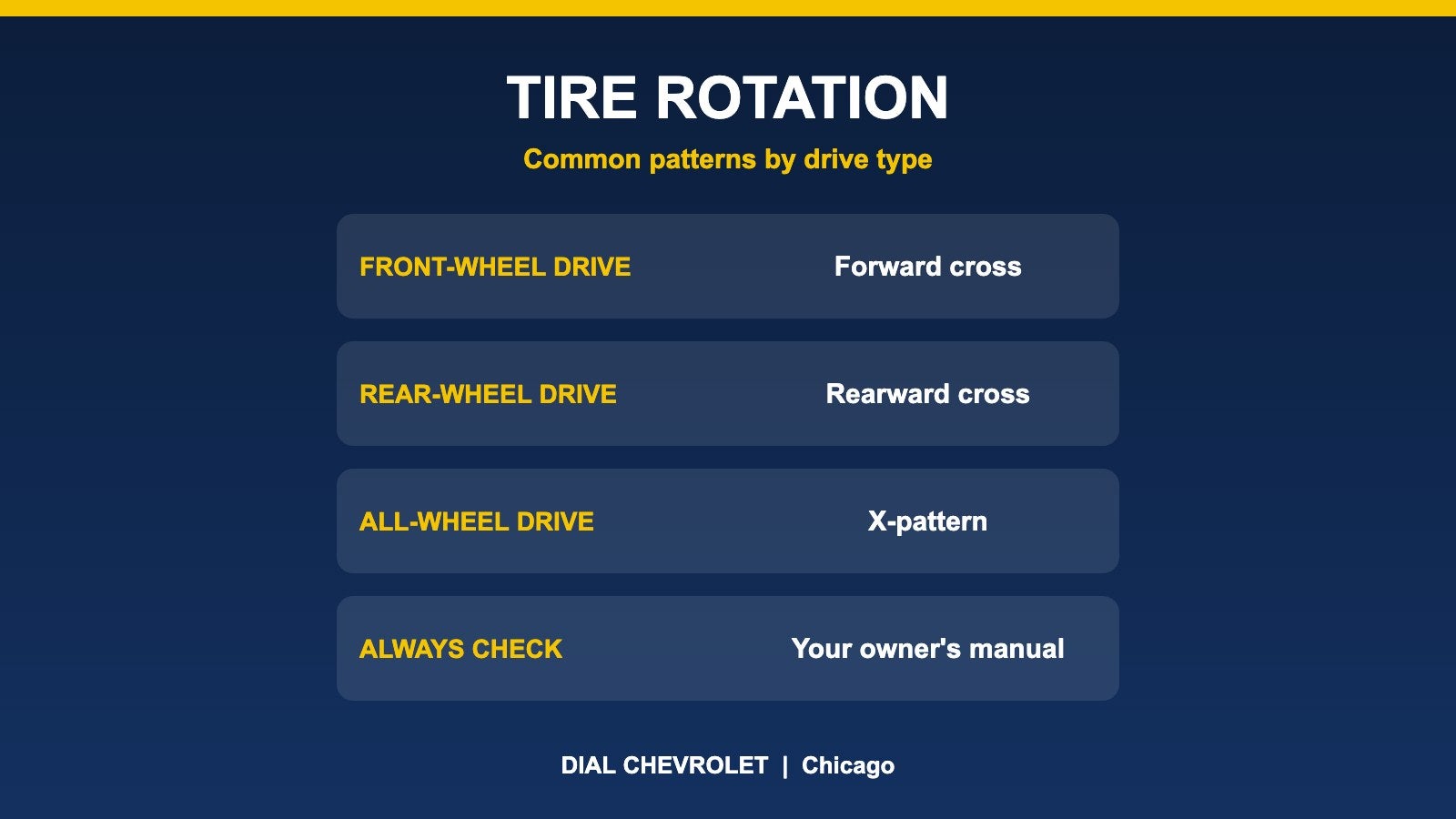
Tire rotation patterns graphic: forward cross, rearward cross and X-pattern by drive type

Chevy Tire Rotation: How Often and Which Pattern

Short answer: Chevrolet’s general maintenance guidance is to rotate tires every 7,500 miles, and NHTSA says that if your manufacturer recommends rotation, a range of 5,000 to 8,000 miles is typical, or sooner if uneven wear appears. The right pattern depends on whether your vehicle is front-wheel, rear-wheel, all-wheel or four-wheel drive, and your owner’s manual has the final word. This guide is general education and lists no prices or offers. Why tires get rotated Tires on different corners of a vehicle wear at different rates. Front tires handle most of the steering and braking, and on a front-wheel-drive vehicle they also deliver the power, while driven rear tires wear in their own way on rear-wheel-drive models. Rotating moves each tire to a new position so wear evens out over time. Chevrolet notes that regular rotation helps extend tire life, and AAA describes the same goal of even wear and steady performance. How often to rotate Chevrolet general guidance: every 7,500 miles. Its general maintenance page says the detailed schedule for your specific vehicle is in the owner’s manual. NHTSA: if recommended by the vehicle manufacturer, every 5,000 to 8,000 miles, or sooner if uneven wear appears. Easy habit: many drivers pair a rotation with an oil change visit. See our oil change guide and the Chevrolet maintenance schedule guide for how the services fit together. Common rotation patterns AAA describes these common patterns, which technicians choose based on drive type and tire type: Forward cross (front-wheel drive): the front tires move straight back on the same side, and the rear tires move forward and cross to opposite sides. Rearward cross (rear-wheel drive and four-wheel drive): the rear tires move straight forward on the same side, and the front tires move back and cross to opposite sides. X-pattern (all-wheel drive): every tire moves diagonally to the opposite axle and the opposite side. Sources describe these patterns a little differently, and some tires cannot be crossed side to side, so treat this list as a general guide and follow what your owner’s manual and technician recommend for your exact vehicle. When rotation may not be possible Different front and rear tire sizes: NHTSA’s tire guidance says some vehicles cannot be rotated front to rear if the tire sizes differ, so check the owner’s manual. Directional tires: these are built to turn one way and generally stay on the same side of the vehicle, which limits the pattern. Spare tire: a full-size matching spare may be included in some patterns. Your manual says whether yours is. Check these things at the same visit Tread depth: NHTSA describes the penny test. Place a penny upside down in the tread, and if you can see the top of Lincoln’s head, it is time to replace the tire. Uneven wear: NHTSA says irregular wear can point to a rotation need, an alignment issue or both, so mention it to your technician. Tire pressure: Chevrolet says the recommended pressure is listed in the owner’s manual and on the driver’s door frame. See our dashboard warning lights guide if your tire pressure light comes on. Brakes: wheels are already off during a rotation, which is a convenient time to ask for a look. Our brake warning signs guide explains what an inspection covers. Before winter in Chicago Cold weather and rough pavement are hard on tires. Our winter prep checklist covers tires and other items to review before the season. Schedule service at Dial Chevrolet Schedule service View service and parts specials Order parts Browse used inventory Contact Dial Chevrolet Sources Chevrolet: Certified Service maintenance Chevrolet Support: general maintenance schedule overview Chevrolet: tire maintenance NHTSA: tire safety AAA: tire rotation, why it is important and how to do it NHTSA (archived): tire maintenance Published by Dial Chevrolet, 6603 S Western Ave, Chicago, IL. General education only. Rotation intervals and patterns vary by vehicle and tire; follow your owner’s manual and a qualified technician’s advice. This guide does not list prices or offers.

Contact Us

Fill out this form below and we'll contact you shortly
*Required Fields